



 SAP Integration Insights● ISSUE 019JUNE 2026
Your ERP is live. Your ecosystem isn't.
With ECC mainstream support ending December 2027, thousands of businesses are going live on SAP S/4HANA Public Cloud, and discovering that migration was only half the battle.
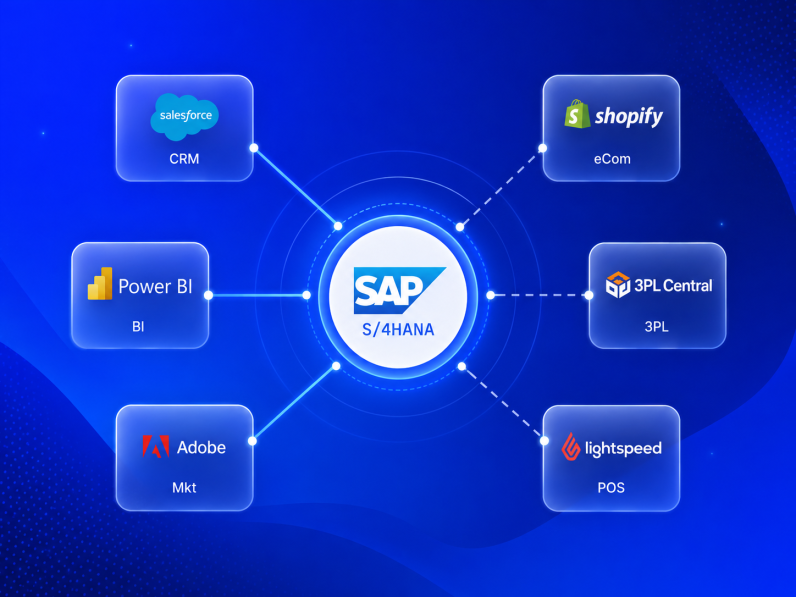
Going live is not the same as being connected.
The clock is no longer a metaphor. SAP has confirmed that mainstream maintenance for ECC 6.0 ends on December 31, 2027, and this time, there are no extensions.
Gartner estimates roughly 70% of Business Suite 7 / ECC customers have yet to complete their migration, meaning the next 18 months will see a wave of go-lives unlike anything the SAP ecosystem has experienced before. Many will choose SAP S/4HANA Public Cloud: the fastest, lowest-risk path to a modern ERP.
But here is what the migration playbook rarely prepares you for: going live on S/4HANA Public Cloud is not the same as being operationally connected.
70%
of ECC customers yet to migrate to S/4HANA
Gartner estimate
45%
of new SAP customers chose Public Cloud (GROW)
Gartner / Baer Group, 2025
46%
SAP Integration Suite adoption in 2025, up from 33% in 2024
SAPinsider Benchmark 2025
Nobody budgets for connectivity.
S/4HANA Public Cloud is a standardised, SAP-managed environment, its core strength and its constraint. You cannot customise the core. You integrate around it. An unconnected environment looks like this:
Orders placed on Shopify or Magento are manually keyed into SAP — a daily reconciliation task that breaks down the moment volume grows.
Master records in Salesforce drift from SAP — leading to pricing errors, invoice disputes, and service failures that surface in front of the customer.
3PL and warehouse partners operate on outdated inventory — resulting in fulfilment delays, oversells, and broken service-level agreements.
Close cycles drag because AR and AP entries require manual reconciliation across disconnected systems before the books can be trusted.
S/4HANA Public Cloud demands ERP-native thinking.
S/4HANA communicates through OData APIs and SAP Business Technology Platform, a fundamentally different connectivity model from ECC’s RFC/BAPI architecture. Reusing legacy middleware or generic connectors exposes the mismatch fast.
Generic iPaaS
Endpoint-to-endpoint
- Ignores ERP validation rules and document sequencing
- Fragile integrations that break during peak periods
- Manual fixes and delayed error recovery
- Rising long-term integration cost
ERP-native layer
Understands the data model
- Respects posting logic and finance constraints
- Honours OData model and document types
- Errors caught, logged, and retried — not dropped
- Stable under volume, predictable cost
"Generic iPaaS platforms focused purely on moving data between endpoints often result in fragile integrations that ignore ERP validation rules, document sequencing, and finance posting constraints."
— APPSeCONNECT Analysis, 2026
Built for ERP-centric integration landscapes.
Purpose-built for SAP-centric integration, with deep native support for S/4HANA Public Cloud. Every connector carries SAP’s business rules, document types, and posting logic, so integrations don’t just move data, they move it correctly.
FEATURE · 01
Pre-Built SAP S/4HANA Connectors
No custom development. Connectors respect SAP's OData API model, document sequencing, and posting rules out of the box.
FEATURE · 02
ProcessFlow Engine
Visually design, govern, and monitor multi-step workflows — order-to-cash, procure-to-pay, inventory sync — without middleware code.
FEATURE · 03
Intelligent Error Handling
Errors are caught, logged, and retried intelligently — not silently dropped. Full visibility across every integration touchpoint.
FEATURE · 04
Ready-to-Deploy Packages
Most customers go live in days, not months — without the cost and risk of a custom SI engagement. Starting at $99/month.
2026 is the last comfortable window.
S/4HANA migration programmes typically take 12–24 months from decision to go-live. Delay engaging your partner into late 2026 and you’ll meet premium consultant rates as supply tightens against a fixed deadline, the same applies to integration architecture.
2026 H1
Plan & architect
Map your integration architecture while consultant supply and timelines are still comfortable.
2026 H2
Build & test
Robust connections take time to build and validate — best done outside go-live pressure.
2027
Go live, connected
Enter your S/4HANA cutover with the ecosystem already wired in — not as an afterthought.
31 Dec 2027
ECC support ends
No extensions. Late starters face compressed timelines and a tightening consultant market.
TAKE THE NEXT STEP
Connect your SAP S/4HANA Public Cloud environment.
Talk to our SAP integration specialists. See exactly how APPSeCONNECT eliminates the connectivity gap, for your specific ecosystem.