




Microsoft Dynamics AX and Shopify Plus Integration & Automation
- Automate
- Align
- Accelerate
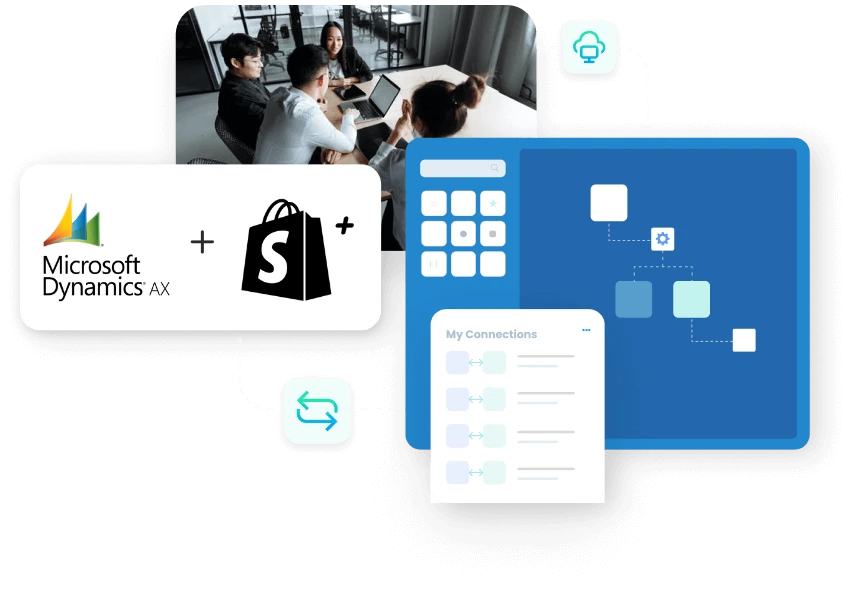
Microsoft Dynamics AX and Shopify Plus integration keeps store activity close to the ERP record. APPSeCONNECT connects the order flow between both systems, so teams are not stuck fixing the same order twice.
Dynamics AX handles the deeper business rules behind stock, pricing, finance, fulfillment, and customer accounts. Shopify Plus handles the storefront, checkout, and buyer updates. When both systems drift apart, teams run into overselling, pricing gaps, delayed fulfillment, and poor order visibility.
KEY BENEFITS
Why APPSeCONNECT Is the Gold Standard for Dynamics AX and Shopify Plus Integration
APPSeCONNECT gives Microsoft Dynamics AX and Shopify Plus a controlled integration layer between the ERP and storefront. It helps orders, customer records, product data, inventory updates, pricing rules, fulfillment details, returns, refunds, invoices, and account-based commerce records move through connected workflows instead of manual handoffs. Teams can keep Shopify Plus activity aligned with Dynamics AX without losing control of the ERP record.

Operational Scalability Is Blocked
As order volume grows, disconnected AX and Shopify Plus flows create more re-entry. The same pressure appears when SKUs increase, stores expand, warehouses grow, or buyer groups become more complex.

Revenue Leakage Is Invisible
Revenue can leak through overselling and missed orders. It can also leak through pricing gaps, delayed refunds, and failed fulfillment that never get traced back to the integration gap.

Operational Costs Keep Rising
Teams spend time recreating orders and checking stock. They also validate prices, chase shipment updates, and clean records that a connected integration flow can handle.

Customer Experience Becomes Harder to Control
Buyers may see stale stock or wrong prices. They may also receive late tracking updates when Shopify Plus and Dynamics AX fall out of sync.

Decision-Making Is Built on Lagging Data
Operations teams work with delayed order and inventory data. Finance and support teams often face the same problem when ERP-backed updates do not reach the storefront.

Business Agility Is Compromised
New stores and campaigns move slowly when every change needs manual coordination. Catalog updates, warehouse launches, pricing changes, and account workflows become harder to move quickly.
Standard Features Covered in Our Microsoft Dynamics AX and Shopify Plus Integration Template
APPSeCONNECT supports Microsoft Dynamics AX and Shopify Plus integration across B2C and B2B commerce flows. These features can be configured around your AX setup and Shopify Plus storefront. They can also follow your pricing rules, warehouse model, tax structure, and customer account logic.
- AX → Shopify Plus : Sync item master data from Dynamics AX to Shopify Plus. This covers title and description. It can also cover SKU, barcode, product status, category, collection, and variant data.
- AX → Shopify Plus: Sync on-hand stock by SKU. Map one or more AX warehouses to Shopify locations and refresh availability after goods receipt, sales activity, or manual stock correction.
- AX → Shopify Plus: Sync base prices from AX trade agreements. Add sale price, compare-at price, discount agreement, and currency-specific pricing where the storefront needs it.
- Shopify Plus → AX: Create AX sales orders from confirmed Shopify Plus orders. Line items move with delivery address, shipping method, payment mapping, and order status details.
- Shopify Plus → AX: Create or update AX customer records from first-order data. Billing address and shipping address move with contact details and customer group mapping.
- AX → Shopify Plus: Create Shopify Plus fulfillment updates from AX shipment posting. Carrier details, tracking number, shipment status, and partial fulfillment details can return to the store.
- Shopify Plus → AX: Create AX return orders from Shopify return requests. Refund posting, restocking logic, and inventory credit stay tied to the original sales order.
- AX → Shopify Plus B2B: Map AX customer accounts into Shopify Plus B2B company profiles. Contact persons, payment terms, and credit limits can stay connected to the account.
- AX → Shopify Plus B2B: Map AX customer price groups and trade agreements into Shopify Plus B2B catalogs. Tiered pricing and currency-specific price lists can follow the same account rules.
- AX → Shopify Plus: Control restricted product catalogs for B2B buyers. Product visibility can follow draft status, warehouse availability, and legal-entity-based access.
- Shopify Plus → AX: Map Shopify Plus draft orders into AX quotations or sales orders. PO numbers and approval triggers can move with the same sales workflow.
- AX → Shopify Plus B2B: Sync posted AX invoices back to the B2B buyer account. Due dates, payment terms, partial payments, and outstanding balances can stay visible.
- Shopify Plus ↔ AX: Map B2C tax lines to AX sales tax groups. B2B tax exemptions, VAT rules, GST treatment, and customer-specific tax logic can also stay connected.
Popular Microsoft Dynamics AX Integrations
Explore popular Microsoft Dynamics AX integrations across ERP and eCommerce apps. You can also connect POS, warehouse, fulfillment, finance, marketplace, and account-based commerce tools.



Looking for a Specific Integration?
Popular Shopify Plus Integrations
Explore popular Shopify Plus integrations across ERP and eCommerce apps. You can also connect POS, warehouse, fulfillment, finance, marketplace, and account-based commerce tools.


Looking for a Specific Integration?
INTEGRATION BROCHURE
Download the Dynamics AX and Shopify Plus Integration Brochure
Get the full brochure for planning a Microsoft Dynamics AX and Shopify Plus integration across storefront and ERP workflows. It also covers warehouse updates, pricing logic, fulfillment, returns, invoices, and account-based commerce flows.
Inside You’ll Find:
- Integration Architecture: See how Dynamics AX and Shopify Plus can exchange order data, customer records, product updates, stock changes, shipment details, returns, invoices, and account data.
- Flow Planning: Review the sync points needed for retail and wholesale teams. It also covers finance, multi-store operations, and multi-warehouse setups.
- Rollout Approach : Start with the core flows first. Then extend into returns, invoices, catalog rules, and account-level pricing
- Testing Checklist : Validate SKU mapping, tax rules, shipping logic, address mapping, payment data, warehouse mapping, and retry scenarios before go-live.
- Operational Readiness: Learn how teams can monitor runs and review failed records. They can also inspect snapshots and retry transactions after launch

Start Integration at just $99 per month with Shopify, Salesforce, HubSpot, Zoho, WooCommerce and more.
Enterprise-grade integration powered by hands-on support without enterprise pricing

INTEGRATION GUIDE
How Does the Workflow Run End-to-End
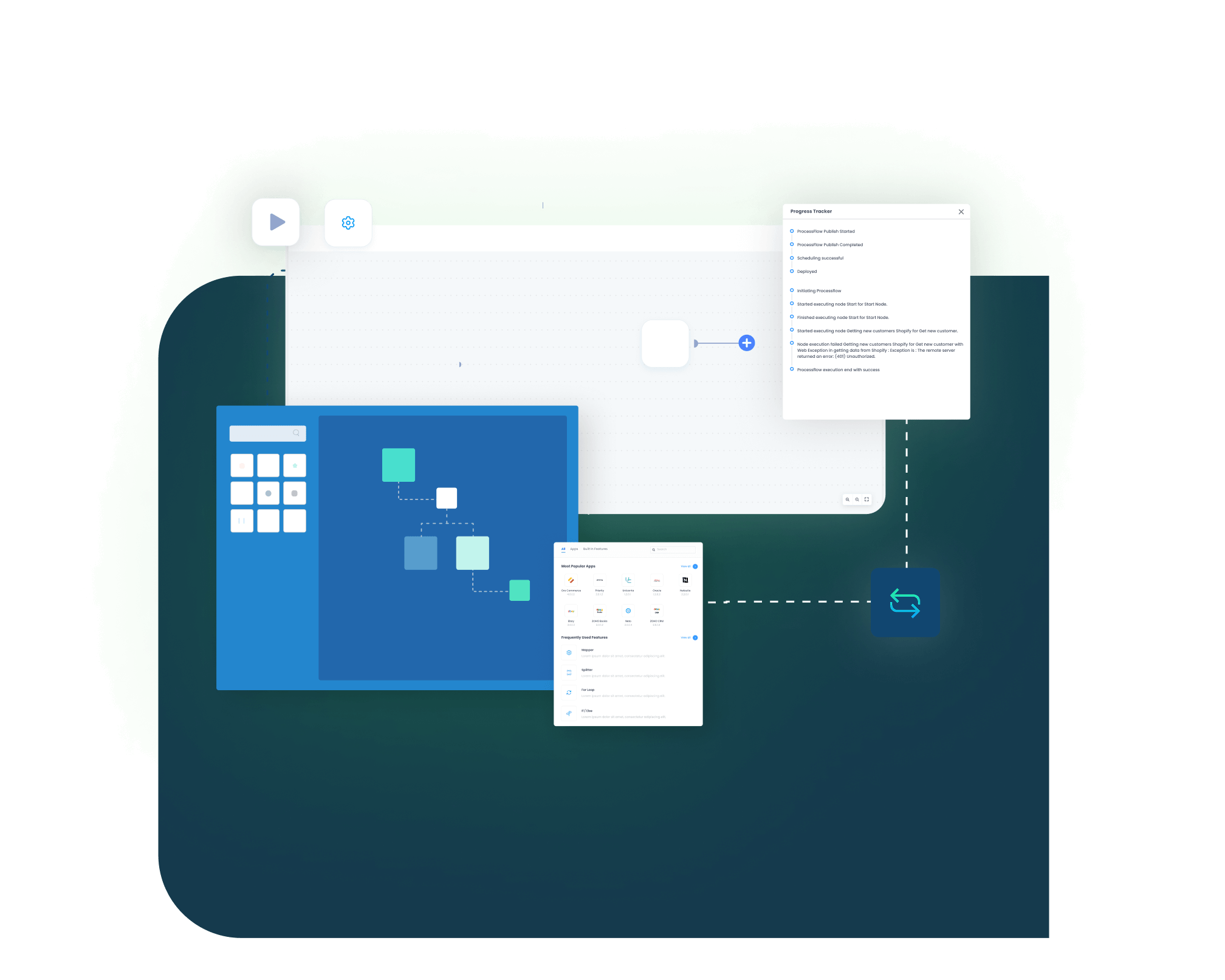
A Microsoft Dynamics AX and Shopify Plus integration runs through APPSeCONNECT ProcessFlows. Each ProcessFlow defines the source system and target system. It also defines the entity, connector action, schema, mapping logic, validation rules, run mode, retry settings, and monitoring path before data moves between AX and Shopify Plus.
Trigger & Source Connection
A webhook can start the ProcessFlow. A schedule, manual run, or configured sync can also open the source connection to Shopify Plus or Dynamics AX.
Data Extraction & Schema Reading
APPSeCONNECT reads the source entity and its schema. The entity can be an order, product, inventory record, customer, shipment, invoice, or account object.
Transformation & Field Mapping
Source fields are mapped into the target format. This can include SKU and item ID. It can also include price, tax, address, warehouse, carrier, payment, invoice, and account-level data.
Validation & Business Rule Execution
The flow checks the record before posting. It can review customer matching, SKU validity, stock rules, tax groups, pricing logic, payment terms, credit logic, warehouse mapping, and catalog access.
Target Push & Response Handling
The prepared record is written to the target system. APPSeCONNECT captures the API response, success state, sync result, and failure reason for each record.
Monitoring, Retry & Audit Logging
Logs and snapshots show how each run performed. Node status, transaction details, and retry controls help teams correct data issues and rerun unprocessed records.
Real-world use cases
Use Cases
APPSeCONNECT’s Microsoft Dynamics AX and Shopify Plus integration is built for businesses that need ERP and eCommerce operations to work as one connected system. It supports manufacturing and distribution teams. It also supports retail, wholesale, finance, multi-store, and multi-warehouse commerce models.
Manufacturing & Distribution — Dealer and distributor orders move into AX without manual rebuilds
A manufacturer or distributor using Shopify Plus needs orders, pricing, stock, and shipping status to follow AX rules. APPSeCONNECT keeps store demand closer to the ERP record, so warehouse and finance teams are not cleaning up after checkout.
- Shopify Plus orders can create AX sales orders with mapped customer, item, tax, and delivery data.
- AX inventory updates can keep warehouse availability closer to what buyers see online.
- Trade agreements and customer groups can stay tied to Dynamics AX. Account pricing can follow the same control.
- Shipment and tracking data can move back to the storefront. Return and refund data can follow the same order record.
What this integration handles
Live
Order-to-AX pipeline
Mapped
Trade agreements and account pricing
Auto
Inventory and catalog sync
Closed
Shipment and return loop
Supports manufacturers, distributors, dealer portals, and mixed B2B/B2C selling on one AX environment.
Multiple Shopify stores stay aligned with one Dynamics AX system
A retailer running multiple Shopify stores on one Dynamics AX instance needs clean order flow, shared inventory, and consistent pricing across every brand. APPSeCONNECT reduces the CSV work and re-entry that usually grows with each new store.
- Every confirmed Shopify Plus order can create an AX sales order with line-level detail.
- AX stock updates can sync back to mapped Shopify locations to reduce overselling.
- Product and variant changes can move from AX to the storefront. Price changes can move through the same flow.
- Fulfillment status can return after shipment. Carrier and tracking data can return with it.
What this integration handles
Live
Order sync
Auto
Product and price sync
Shared
Inventory across stores
Tracked
Fulfillment updates
Supports Shopify, Shopify Plus, Shopify POS, and multi-storefront setups connected to the same AX environment.
Account-based buying on Shopify Plus still follows AX rules
Wholesale teams need company accounts and customer-specific pricing that match the account structure inside Dynamics AX. Payment terms, PO numbers, invoices, tax rules, and catalog access also need to follow the ERP record.
- AX customer accounts and contacts can map to Shopify Plus company records.
- Trade agreements and price groups can drive customer-specific pricing. Catalog access can follow the same account rules.
- Draft orders and quotes can map into AX sales workflows. PO numbers can move with the order record.
- Invoices and due dates can stay tied to the ERP record. Tax rules can follow the same account structure.
What this integration handles
Synced
Company accounts and contacts
Custom
Pricing and catalogs
Mapped
PO numbers and quotes
Visible
Invoices and terms
Supports wholesalers, distributors, manufacturers, and Shopify Plus account-based storefronts.
Store transactions stay tied to the AX financial record
Finance teams need more than an order feed. They need tax lines and payment references to stay connected to the original sales order inside Dynamics AX. Refunds, invoices, and return activity need that same connection.
- Shopify payment and tax data can map into AX finance and reporting workflows.
- Refunds and returns can stay linked to the original order and customer record.
- AX invoices can sync back to account buyers where needed.
- Logs and snapshots support reconciliation. Transaction details can support audit work.
What this integration handles
Matched
Payment and order references
Posted
Invoice visibility
Traceable
Refunds and returns
Auditable
Logs and snapshots
Supports finance, accounting, tax, audit, and operations teams that need cleaner storefront-to-ERP traceability.
Meet appse ai
How appse ai Helps Streamline Microsoft Dynamics AX and Shopify Plus Integration
Once the core AX–Shopify Plus sync is live, the next problem is not basic connectivity. Teams still need to manage volume, failed records, repeated checks, and slow exception handling. appse ai adds AI-assisted workflow automation around ERP, CRM, and eCommerce processes, so teams can design flows faster, catch issues earlier, and review exceptions with more context.
- Workflow Design: Use no-code and AI-assisted tools to build or refine automation flows faster.
- Issue Detection: Spot failed records, broken runs, and repeated exception patterns earlier.
- Exception Review: See missing fields, mapping gaps, and validation errors with clearer context.
- Decision Support: Add routing and enrichment to workflow decisions. Validation and conditional logic can also support the flow where needed.
- Process Signals: Track bottlenecks and repeated failures. Teams can also see slow points across connected flows.
- API Orchestration: Extend automation across ERP and CRM systems. eCommerce apps and custom systems can also connect through the same layer.
- Workflow Optimization: Find where automation slows down, breaks often, or needs redesign.

Ready to Launch Your Microsoft Dynamics AX and Shopify Plus Integration Today?
Microsoft Dynamics AX and Shopify Plus should not operate as disconnected systems fighting over orders, pricing, stock, fulfillment, and finance data. APPSeCONNECT connects your ERP and storefront through structured integration flows, so you can scale commerce without scaling manual work.

Companies automating their business through APPSeCONNECT







Customer Success Stories

Witness how Saddleback enhanced their operational efficiency and productivity through seamless integration with APPSeCONNECT
Witness how Saddleback enhanced their operational efficiency and productivity through seamless integration with APPSeCONNECT, the company aimed to enhance operational efficiency and simplify business processes by implementing an automated application ecosystem. ---- SAP Business one, SAP B1, Shopify Plus
Read Case Study →
Established in 2005, Latitude 64 stands as a leading disc golf manufacturer based in Sweden
Established in 2005, Latitude 64 stands as a leading disc golf manufacturer based in Sweden, celebrated for its outstanding range of disc golf products characterized by superior quality. ---- SAP Business one, SAP B1, Shopify Plus
Read Case Study →
Nestle Nespresso Microsoft Dynamics AX Magento Integration Case Study
Nestle Nespresso is one of the largest and most recognized coffee and related products manufacturer with over 30 years of expertise in the industry. Microsoft Dynamics AX, Magento
Read Case Study →Related Resources
Articles and Guides to Help You With Your Integration and Automation Journey
Frequently Asked Questions
Microsoft Dynamics AX and Shopify Plus integration connects your ERP and storefront so business data can move between both systems. APPSeCONNECT can sync orders and customer records. Product updates, price changes, inventory updates, fulfillment data, returns, invoices, and account data can also stay connected.
Businesses use Microsoft Dynamics AX Shopify Plus integration to reduce manual order entry and stock mismatches. It also helps reduce pricing errors, delayed fulfillment, and disconnected customer records. APPSeCONNECT automates these ERP and eCommerce flows so teams work from cleaner data.
APPSeCONNECT connects Microsoft Dynamics AX with Shopify Plus through configured ProcessFlows. Each flow defines the source system and target system. It also defines the entity, mapping logic, validation rules, run mode, retry behavior, and monitoring path.
APPSeCONNECT can sync order data and customer records between Microsoft Dynamics AX and Shopify Plus. It can also sync product data, variant details, pricing, stock, shipment updates, tracking details, returns, refunds, invoices, and tax data. Account-based flows can include company records and payment terms.
Shopify Plus orders can sync to Microsoft Dynamics AX as sales orders through APPSeCONNECT. The order sync can include customer data and SKUs. It can also include quantities, prices, discounts, tax lines, shipping addresses, delivery methods, and payment references.
Microsoft Dynamics AX inventory can sync with Shopify Plus through APPSeCONNECT inventory flows. The sync can update SKU-level stock and on-hand quantity. It can also support warehouse availability, stock adjustments, and Shopify location mapping.
Yes. APPSeCONNECT can map Dynamics AX warehouses to Shopify Plus locations so stock availability follows the right warehouse or fulfillment model. This is useful for retailers, distributors, and multi-location operations.
Microsoft Dynamics AX price sync sends ERP-managed pricing into Shopify Plus through APPSeCONNECT. It can carry base prices and trade agreements. Sale pricing, discounts, compare-at pricing, customer groups, and multi-currency price lists can also be mapped.
Yes. APPSeCONNECT can connect Dynamics AX account records with account-based Shopify Plus workflows. It can support contacts and payment terms. Customer-specific pricing, catalogs, PO numbers, invoices, and tax logic can also stay tied to the ERP record.
After shipment processing in AX, APPSeCONNECT can send fulfillment status back to Shopify Plus. Carrier details and tracking numbers can move with the update. Partial shipment updates can also return to the storefront.
Yes. APPSeCONNECT can connect Shopify return requests with AX return orders. Refund references and restocking logic can stay tied to the original sales order. Inventory credits can also follow the same record.
Yes. APPSeCONNECT can map Shopify Plus tax lines to AX sales tax groups. It can also support VAT rules and GST treatment. B2B tax exemptions and customer-specific tax logic can stay connected.
Yes. APPSeCONNECT can connect Shopify Plus with on-premise Microsoft Dynamics AX environments. This helps businesses keep AX inside controlled infrastructure while using Shopify Plus as the cloud storefront.
If a sync fails, APPSeCONNECT provides logs and snapshots. Node status and transaction details help teams see where the issue happened. Retry options help teams rerun records after missing fields, mapping errors, API responses, credential issues, or system failures are reviewed.
appse ai adds AI-assisted workflow design on top of the integration flow. It can help with issue detection and exception context. Process signals and decision support help teams move from basic ERP and eCommerce sync toward smarter workflow automation.
Start by defining the flows you need first. Common starting points include order sync, inventory sync, product sync, price sync, customer sync, and fulfillment updates. APPSeCONNECT can then help map, configure, test, monitor, and scale the integration around your ERP and storefront setup.