





Australian mid-market businesses are entering 2026 with more pressure on both sides of the business. On one side, the Australian Taxation Office is pushing for cleaner digital records, more accurate GST reporting, tighter BAS preparation, and stronger payroll-linked compliance. On the other, these same businesses are trying to grow across states, manage more channels, handle seasonal demand, and serve customers without significantly increasing headcount.
For businesses using SAP Business One, Microsoft Dynamics 365, NetSuite, or Sage 300, this is no longer only a finance problem. It is an operations problem as well. If the ERP is not connected to eCommerce, payroll, payments, banking, supplier systems, and day-to-day workflows, the finance team ends up doing the same work again in spreadsheets. That slows down reporting, weakens accuracy, and makes every compliance period more stressful than it needs to be.
At APPSeCONNECT, we have seen this pattern across growing businesses for years. Our work has always been about helping businesses connect ERP with the systems around it, so data moves cleanly and teams stop working from partial records. appse ai is the AI capability layer of APPSeCONNECT. It adds AI-led validation, monitoring, exception handling, and guided automation on top of the integration base we already provide. In other words, APPSeCONNECT provides the integration foundation, and appse ai adds more intelligence, visibility, and control on top of it.
That matters in Australia now because compliance and growth are no longer separate projects. A business that wants cleaner BAS reporting, better GST handling, stronger payroll-to-ERP flow, and faster finance review needs the same thing it also needs for growth: a connected ERP that works across every channel and every team. The Australian businesses moving first on ERP automation are not only reducing compliance risk. They are building a stronger operating model while others are still trying to patch together manual work.
The ATO's Escalating Digital Requirements: Why Manual Reconciliation Is Now a Liability

The ATO’s direction is clear. Australian businesses are being pushed toward cleaner digital records, more accurate reporting, and less room for manual correction after the fact. This is not just about keeping better files. It is about running a business in a way where key tax and finance data stays accurate throughout the reporting period, not just at the end of it. This is especially visible in three areas.
- BAS accuracy enforcement: The first is BAS accuracy. BAS, or Business Activity Statement, depends on correct GST treatment, correct timing, and correct reporting across sales, expenses, and related finance records. When a business pulls numbers manually from ERP, eCommerce, payment platforms, and bank feeds, the risk of mismatches increases quickly. A wrong GST code in one sales channel or a delayed sync between systems can create a problem that finance only discovers much later.
- Monthly BAS reporting enforcement: The second is the move toward monthly BAS reporting for businesses with GST issues. Once a business is moved from quarterly to monthly reporting, the time available to clean up data becomes much smaller. That changes the whole rhythm of finance work. Teams can no longer rely on a long quarter-end correction cycle. They need numbers that stay accurate throughout the month.
- Payday Super from 1 July 2026: The third major change is Payday Super, which comes into effect on 1 July 2026. From that point, payroll data can no longer sit in one system while the ERP catches up later. The payroll-to-ERP flow has to be accurate, current, and steady. If wages, PAYG withholding, and super liabilities are still being handled through delayed or manual updates, the business is carrying a clear compliance risk.
The common thread across all three is simple. The ATO is moving away from a slower, periodic view of compliance and toward a model where digital accuracy matters all the time. That makes manual reconciliation a real liability. The answer is not to ask the finance team to work harder in spreadsheets. The answer is to connect systems properly and use automation to catch errors at the point where they begin.
At APPSeCONNECT, this is exactly how we frame the problem. Compliance is not something that starts when BAS is due. It starts when the first transaction enters the system. That is why APPSeCONNECT and appse ai focus on clean data movement, rule-based validation, and AI-supported error handling across the whole ERP environment.
Case Study: All Marine Spares
How a Marine Parts Distributor Improved Order Flow, Inventory Accuracy, and Shipping Efficiency
All Marine Spares is a good example of what this looks like in real life. The business operates in marine parts distribution, which means it deals with a large product range, heavy inventory movement, B2B customers, and a constant need for accuracy. In that kind of business, small errors do not stay small for long. A stock mismatch, order delay, or finance gap quickly affects customer service, supplier coordination, and internal operations.
Before automation, All Marine Spares was dealing with the same problem many Australian mid-market businesses face. Their ERP and operational systems were not working as one connected workflow. That left room for repeated manual work across order handling, stock checks, finance review, and general operational follow-up. The cost was not only time, but also the constant attention teams had to give to checking and correcting data. Teams were spending too much of their week fixing and checking data instead of using that time for higher-value work.
The specific outcome
After implementing APPSeCONNECT with appse ai capabilities, the difference was clear. Their ERP was connected more cleanly to sales and operations, and day-to-day work became much smoother. As Jason Mitchell, Managing Director of All Marine Spares, explained: APPSeCONNECT helped transform the company’s business processes by reducing manual work, smoothing day-to-day operations, and improving team productivity.
The result was a clear reduction in manual work across order handling, inventory updates, and shipping follow-up. For a lean mid-market team, that is a major shift. Those are not spare hours that were sitting idle. Those are hours that were previously being spent on repeated checks, manual movement of records, and fixing gaps between systems. When that burden is removed, the business gains time for customers, suppliers, planning, and growth.
From our point of view at APPSeCONNECT, this is where compliance and productivity meet. The same work that eats 10 to 20 hours a week is often the work that creates reporting risk. When ERP data has to be repaired by hand each week, BAS preparation becomes harder, payroll-linked finance work becomes slower, and finance leaders lose visibility. A business like All Marine Spares is not only becoming more efficient through ERP automation. It is also becoming less exposed to the kind of errors that stricter ATO oversight is more likely to detect.
The Australian Agribusiness Challenge: Seasonal Demand, Multi-State Operations, and Complex Supply Chains
Agribusiness shows why ERP automation matters so much in Australia. It is one of the clearest examples of a sector where operations change quickly, demand rises and falls with the season, suppliers are spread across locations, and stock movement has to be watched carefully. A business can go from a manageable pace to a peak period very quickly, and when that happens, disconnected systems become a serious weakness.
For agribusinesses operating across more than one state, the pressure is even higher. Orders may come from eCommerce, wholesale, or direct channel sales at the same time. Inventory has to stay accurate across all of them. Supplier invoices can arrive in high volumes during peak periods. Payroll, purchasing, stock movement, and sales all affect the ERP, and each one plays a part in finance accuracy and compliance readiness.
This is why APPSeCONNECT works well in this market. Our integration layer helps ERP stay connected to order channels, supplier processes, payroll, and finance systems, so teams are not waiting on manual updates. On top of that, appse ai adds an AI layer that can monitor data quality, flag mismatches, explain workflow decisions, and support teams during peak periods.
In practical terms, that means inventory can stay more current across sales channels, supplier invoices can be matched with less manual follow-up, payroll-linked finance entries can stay timely, and GST-critical data is less likely to fall out of step. appse ai supports this through its Operations and Inventory capability set, its Procure-to-Pay automation capability, and its Finance and AP/AR automation capability. We do not see these as separate tools. We see them as connected parts of one ERP-driven operating model.
For an Australian agribusiness, that changes more than efficiency. It changes resilience. The business can handle seasonal peaks without scaling headcount at the same pace. It can keep finance records more current and accurate. It can prepare BAS with less stress. Most importantly, it can keep operations moving without depending on end-of-period manual cleanup to make the numbers make sense.
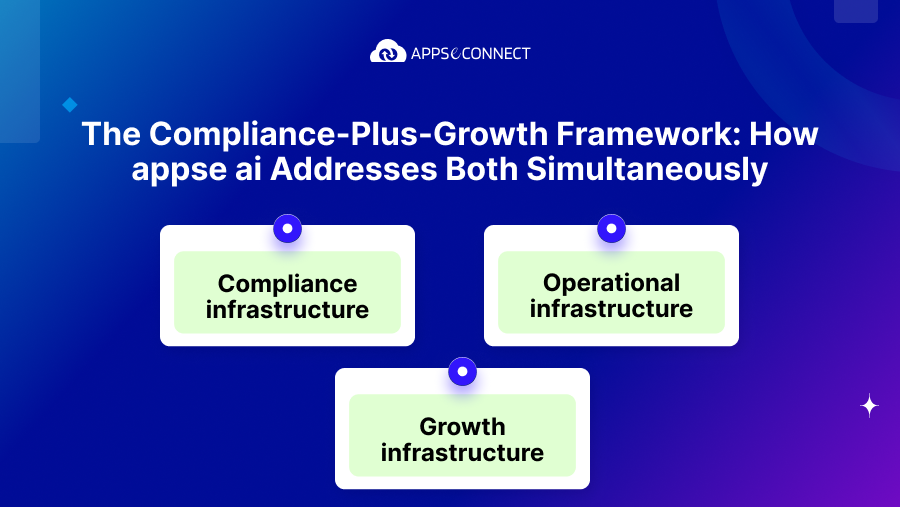
The Compliance-Plus-Growth Framework: How appse ai Addresses Both Simultaneously
At APPSeCONNECT, we do not treat compliance and growth as two different projects. For Australian mid-market businesses, they are usually solved by the same investment. Once ERP is connected to the systems around it, the business gets cleaner finance data, better operational flow, and more room to grow. appse ai then adds intelligence to that base, helping the business catch issues earlier and automate more of the work that slows teams down.
- Compliance infrastructure: A connected ERP acts as compliance infrastructure because it keeps tax, payroll, sales, and finance data aligned from the start. When GST treatment stays consistent across channels, BAS preparation stops becoming a late-stage repair job. When payroll flows cleanly into the ERP, super-related records are easier to manage in line with the new rules. When bank and payment records stay matched to ERP entries, finance gets a more accurate picture without rebuilding it by hand.
- Operational infrastructure: The same connected ERP also acts as operational infrastructure. Orders move faster, stock updates stay cleaner, supplier data reaches the right place sooner, and finance close work becomes easier to manage. Teams do not waste as much time checking which system has the right version of the truth. That makes day-to-day work calmer and more reliable.
- Growth infrastructure: Then there is the growth side. A business that can add new sales channels, manage more order volume, or expand into new markets without adding the same amount of back-office work has a real advantage. That is why we call this a compliance-plus-growth framework. The business is not only reducing ATO exposure. It is building a stronger base for the next stage of expansion.
This is the position APPSeCONNECT takes in Australia. appse ai is not just a surface-level layer of AI features. It is the AI capability layer of APPSeCONNECT, designed to strengthen the ERP integrations businesses already rely on. That is what makes the result practical. The automation is built into real ERP operations rather than sitting outside them.
Specific appse ai Capabilities for the Australian Market
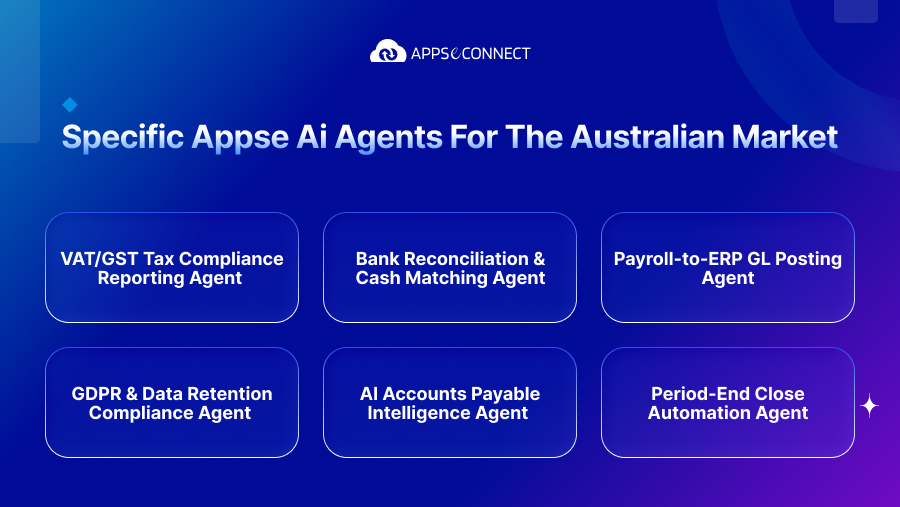
The Australian market has a few pressure points that come up again and again. GST handling, bank reconciliation, payroll-linked finance posting, supplier invoice overload, and period-end preparation all create strain when systems are disconnected. appse ai addresses these through focused AI capabilities built on top of APPSeCONNECT’s ERP integration base.
- VAT/GST Tax Compliance Reporting Agent: The GST Compliance Reporting Agent helps businesses keep GST treatment more consistent across connected channels and ERP records. In practice, it can spot differences in tax coding, transaction treatment, or reporting logic earlier, before those issues flow through to BAS preparation. For Australian businesses working across eCommerce, wholesale, and marketplace channels, that is a major gain because an error is easier to fix when it first appears than when finance is already under deadline pressure.
- Bank Reconciliation & Cash Matching Agent: The Bank Reconciliation & Cash Matching Agent helps match incoming payments to open ERP records more quickly and more consistently. It can identify mismatches, prepare summaries, and alert the right team when something does not line up. For businesses with several payment methods or heavy transaction volume, this removes a large amount of manual checking before BAS and close work.
- Payroll-to-ERP GL Posting Agent: The Payroll-to-ERP GL Posting Agent handles one of the most important compliance-related flows for 2026. GL refers to the general ledger, which is the core accounting record within the ERP. This agent helps move payroll data into that record in a more structured and timely way, including wage cost, PAYG withholding, and super-related amounts. With Payday Super coming into effect from 1 July 2026, this kind of automation becomes far more important because the business cannot afford a long lag between payroll activity and ERP visibility.
- GDPR & Data Retention Compliance Agent: The Data Retention and Privacy Governance Agent is relevant in a broader data-handling sense. Australian businesses still need clear controls around personal data, retention periods, and audit-ready records. This capability helps track data movement and supports better control across connected ERP, CRM, and eCommerce environments.
- AI Accounts Payable Intelligence Agent: The AI Accounts Payable Intelligence Agent supports three-way matching between purchase orders, goods received, and supplier invoices. This matters a great deal in Australian distribution and agribusiness settings, where invoice volume can spike during busy periods. When this work stays manual, finance teams often end up overloaded just when BAS and period-end pressure is highest.
- Period-End Close Automation Agent: The Period-End Close Automation Agent streamlines period-end finance preparation by pulling data from connected systems, reconciling it against ERP records, and preparing the numbers in a more structured way. For businesses that have already been moved to monthly BAS reporting, this is not just a nice time-saver. It becomes part of how the finance team keeps up.
Australian-Specific Deployment Considerations

Australian businesses often have practical deployment needs that global software vendors do not always treat seriously enough. Data location, infrastructure mix, audit expectations, and operating hours can all affect what kind of ERP automation is workable in the real world. At APPSeCONNECT, we see these as operational design decisions, not edge cases.
- Data sovereignty: The first is data sovereignty. Some businesses, especially those working in regulated sectors or sensitive supply chains, need tighter control over where their data is processed and stored. APPSeCONNECT supports cloud, on-premises, and hybrid deployment models, and appse ai works within that wider platform approach. That means businesses do not have to choose between automation and control. They can build a setup that fits their own requirements.
- APRA compliance context: The second is governance and audit visibility. For Australian businesses in sectors with stricter oversight, automated work cannot be a black box. This is where FlowInsight, part of the APPSeCONNECT and appse ai approach, becomes useful. It explains automated actions in plain language and helps teams understand what happened, why it happened, and how the workflow made its decision. That is important for internal confidence, finance review, and wider audit preparation.
- Hybrid deployment: The third is hybrid infrastructure. Many mid-market businesses in Australia still operate with a mix of local systems and cloud tools. Some have ERP elements on-premises, while sales, payroll, or support tools sit in the cloud. APPSeCONNECT is designed for that reality. Businesses do not have to replace their infrastructure just to automate it. We connect what they already run and make it work more cleanly.
- Time zone management: The fourth is time zone and operating-hour coverage. Australian businesses often work across states, supplier time zones, or broader APAC operating windows. appse ai helps here because automated checks, validations, and workflows can continue running even when the finance team is offline. That keeps data moving and reduces the backlog staff face the next morning.
How appse ai Compares to the Australian iPaaS Alternatives
Australian mid-market businesses usually look at three broad categories when they explore automation. The first is simple SaaS automation tools. The second is large enterprise integration platforms. The third is a more ERP-led approach like APPSeCONNECT with appse ai. In our view, the difference comes down to fit.
- Generic SaaS automation tools (Zapier, Make.com): Simple SaaS automation tools can be useful for light tasks. They can connect cloud apps and move small pieces of data from one place to another. But they are not built around ERP-first operations. They do not understand SAP Business One, Sage 300, Microsoft Dynamics 365, or NetSuite in the way a finance-driven business needs. They may be fine for basic alerts or small marketing tasks, but they are not the right answer for BAS-ready finance operations or payroll-linked ERP flows.
- Enterprise iPaaS platforms (Workato, Celigo, MuleSoft): Large enterprise iPaaS platforms are powerful, but they are often built for businesses with dedicated integration teams, bigger budgets, and longer implementation cycles. For a mid-market Australian distributor, manufacturer, or agribusiness, that can create a mismatch. The platform may be strong, but the time, cost, and effort required to get value from it can be too high.
- appse ai: APPSeCONNECT takes a different position. We are ERP-first in the way we build and the way we deliver. appse ai is our AI capability layer on top of that integration base. It brings AI-led monitoring, workflow intelligence, guided automation, and exception handling into an ERP-driven operating model. The result is a platform that is easier for mid-market businesses to adopt because it is shaped around the systems they already use and the operating pressure they already feel.
That is also why our pricing starts from a point that smaller growth-focused businesses can actually work with. We are not asking Australian mid-market teams to buy an enterprise IT programme just to get clean ERP automation. We are giving them a way to make ERP, compliance, and growth work together on terms that fit their stage.
Implementation and Pricing: Transparent, No Hidden Costs

Pricing matters because mid-market businesses need to know what they are committing to before they begin. At APPSeCONNECT, we keep the pricing model clear because the goal is to help businesses start and scale without confusion. appse ai follows that same approach because it is part of the wider APPSeCONNECT platform, not a separate add-on introduced later.
- Starter (Free): The Starter level gives businesses a way to explore the platform with core connectivity and basic access. It is useful for understanding the platform and seeing how connected ERP automation could work in their environment.
- Growth (from $99/month): The Growth plan is often where Australian mid-market businesses begin using APPSeCONNECT more seriously, depending on their integration scope, workflow needs, and deployment model. This level includes workflow automation, app connectivity, and access to the AI-led capabilities that make appse ai useful in daily operations. For a business trying to improve finance flow, GST handling, payroll-to-ERP data flow, and operational control, this level makes ERP automation far more accessible than traditional enterprise tools.
- Enterprise (Custom): The Enterprise level is designed for businesses with more complex infrastructure, stronger data location needs, or broader governance requirements. This is where on-premises deployment, advanced AI automation, higher support expectations, and more tailored setup options come in.
What matters just as much as the plan names is what businesses do not get. They do not get a pricing structure that feels unclear, unpredictable, or difficult to evaluate upfront. We know that Australian businesses dealing with 2026 compliance pressure need predictability. They need to know what the platform is for, what it includes, and what it will cost to run. That is how APPSeCONNECT approaches the market, and appse ai stays inside that same model.
The Cost of Waiting in 2026

For Australian mid-market businesses, the cost of waiting is not theoretical. It shows up in compliance risk, in finance team strain, and in slower growth. When systems stay disconnected, the business is forced to keep repairing its own operations by hand. That creates a steady drag on both accuracy and capacity.
- ATO compliance risk: The first cost is compliance exposure. Manual reconciliation between ERP, eCommerce, payroll, banking, and finance tools creates the kind of gaps the ATO is now better positioned to detect. A wrong GST treatment, a delayed payroll-linked entry, or an incomplete finance trail can become more than a small mistake. It can become the start of a compliance issue that takes time and money to resolve.
- Payday Super exposure: The second cost is Payday Super exposure. Once super has to be handled much closer to payday under the new rules, businesses with weak payroll-to-ERP flow are left exposed. A manual or delayed process may have been tolerated under an older quarterly rhythm, but it becomes much harder to defend under the new requirement.
- Operational capacity cost: The third cost is lost operating capacity. The All Marine Spares case shows how much operational drag disconnected systems can create. Manual fixes, repeated checks, and broken process flow quietly consume time that lean teams could otherwise use for customers, planning, and growth. For a lean mid-market business, that can consume a meaningful share of the team’s real working capacity.
- Competitive disadvantage: The fourth cost is competitive disadvantage. Businesses that connect ERP, automate finance and operations, and build cleaner processes now will be able to grow without adding the same amount of manual overhead. They will launch new channels faster, handle seasonal spikes better, and keep finance operations more current and accurate. Businesses that wait will still be spending time fixing the basics while competitors move ahead.
Ready to Make Your Australian Business ATO-Ready and Operationally Excellent?
At APPSeCONNECT, we help Australian businesses connect SAP Business One, Microsoft Dynamics 365, Sage 300, and NetSuite with the systems they depend on every day. appse ai adds the AI capability layer that helps monitor those flows, catch issues earlier, explain workflow decisions, and support finance and operations with less manual work.
If your business is preparing for higher BAS accuracy expectations, stronger digital record-keeping, and Payday Super from 1 July 2026, this is the right time to review whether your ERP setup is actually ready. The question is no longer whether automation will help. The question is whether your current process flow is already costing you time, accuracy, and control.
Book an ERP integration consultation for your Australian business with APPSeCONNECT and see how appse ai works inside a connected ERP environment built for compliance and growth. We can show you how the platform fits your ERP, your channels, your finance flow, and the way your business actually runs.
Frequently Asked Questions
appse ai helps by improving the quality and timing of the data that flows into ERP and finance processes. On top of APPSeCONNECT’s integration base, it adds AI-led validation, reconciliation support, and workflow intelligence that helps businesses keep GST-related and BAS-related data more accurate throughout the period.
appse ai supports the payroll-to-ERP flow by helping move payroll results, wage costs, PAYG withholding, and super-related records into the ERP in a more timely and structured way. That makes it easier for businesses to keep finance records more current and accurate as Payday Super changes take effect.
APPSeCONNECT supports SAP Business One as one of the core ERP environments in its integration ecosystem, and appse ai builds on that ERP integration base with AI-led monitoring, validation, automation, and exception handling.
Through APPSeCONNECT, appse ai supports integration with major eCommerce platforms such as Shopify, WooCommerce, Adobe Commerce, BigCommerce, and Amazon. The goal is to keep ERP, order, inventory, payment, and finance records more closely aligned across channels.
APPSeCONNECT supports cloud, on-premises, and hybrid deployment models, and appse ai works within that same approach. This gives businesses more flexibility when they need stronger control over where data is processed and stored.
Many businesses using APPSeCONNECT’s pre-built connectors can begin quickly, with simpler setups going live faster than traditional custom projects and broader multi-system setups taking longer based on scope. The exact timing depends on the ERP, the connected systems, and the amount of workflow logic involved.