






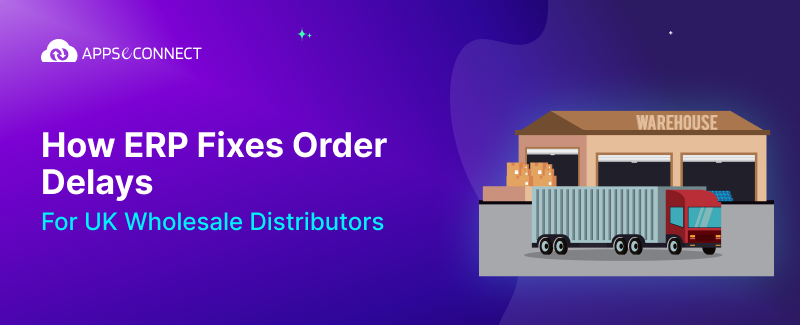
UK wholesale distributors are stuck in the middle of a demanding supply chain. Orders come in fast; by phone, email, online stores, and marketplaces, while suppliers move at their own pace with their own limits. In many businesses, each part of this chain runs on a different system and those systems do not speak to each other quickly enough. The result is familiar: orders are delayed, promised dates slip, and stockouts appear even when the warehouse is full of other items nobody ordered.
A modern ERP for wholesale distribution UK companies gives everyone one place to work from. Orders, inventory, purchasing, and finance share the same view of what is really happening. That single view is what reduces delays, prevents many stockouts, and gives teams the confidence to promise realistic delivery dates. The rest of this article explains why delays happen, what they cost, why older tools do not cope, and how modern ERP and the right integration layer change the experience for UK distributors.
The Real Reason UK Distributors Face Delays & Stockouts
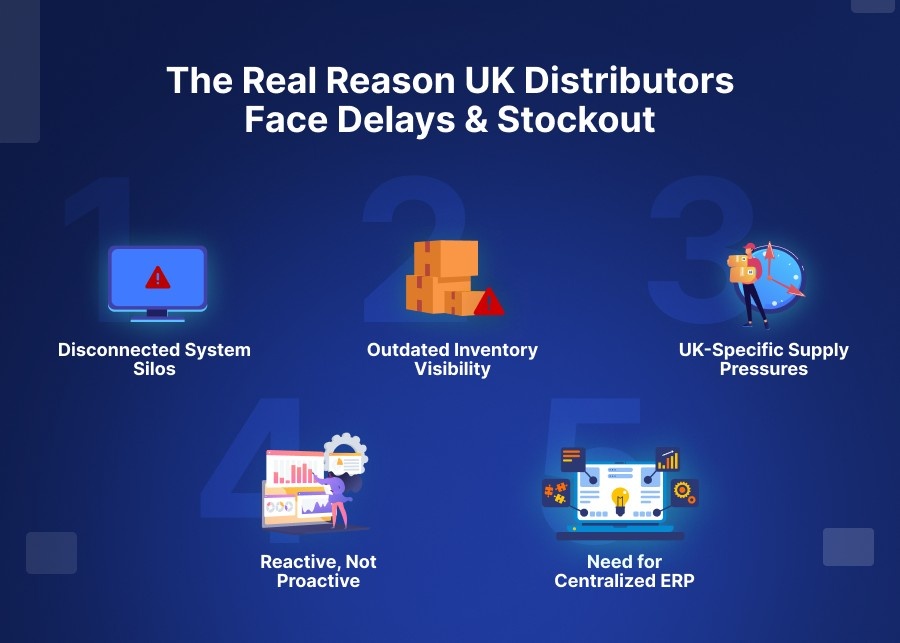
Order delays and stockouts are often blamed on busy teams or unreliable suppliers, yet the deeper cause lies in how information moves. Many UK distributors still run separate systems for accounting, order capture, warehouse activity, and ecommerce. Each system may work reasonably well on its own, but because they do not share data in real time, every department sees a different picture of reality.
A sales rep takes a big order and promises next-day delivery based on a report printed that morning. Meanwhile, the warehouse already pulled stock for earlier orders but hasn’t updated the numbers yet. Purchasing was counting on a pallet from a European supplier that’s now delayed by a week. None of this is unusual on its own. The problem is that no single system brings them together quickly enough for people to react before a promise is made.
The UK context adds extra pressure. Distributors often serve customers across multiple regions with different delivery expectations, and they may operate several depots with overlapping ranges. Imports can be affected by customs checks, strikes, or weather, and those disruptions ripple into promised dates. When information about all of this lives in disconnected tools, planners spend more time trying to understand what has happened than working out what to do next.
This is why many businesses that face repeated delays start to look at wholesale distribution ERP software UK options. They realise that without a central system to gather orders, stock, and supplier information in one place, every decision will include more guessing than they can comfortably accept.
The Hidden Costs of Order Delays & Stockouts for UK Wholesale Distributors
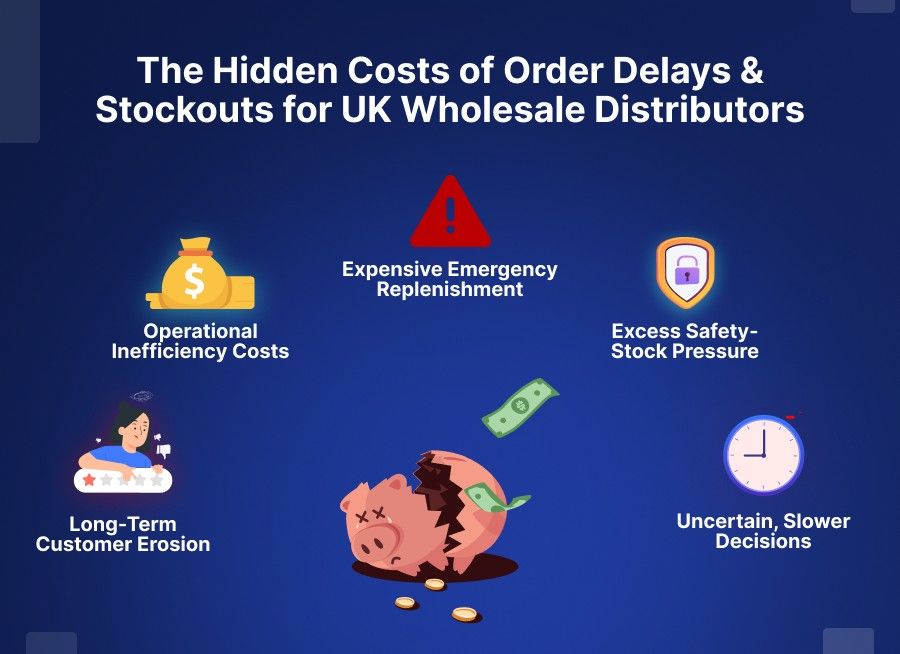
The most visible cost of a delay or stockout is the immediate impact on a single order, yet the hidden costs spread widely across the organisation. When a regular customer cannot receive the full quantity they requested, they may quietly reduce their next order or test a competitor. Over months, a distributor can lose a large part of a customer’s spend without ever seeing a single loud complaint.
Inside the business, delays lead directly to wasted effort. Warehouse teams may pack and unpack the same pallets several times as priorities change. Vehicles run less efficient routes because deliveries are split and re-scheduled at short notice. Staff in customer service spend valuable time explaining missed dates and arranging partial shipments instead of building stronger relationships or finding new opportunities. None of these activities generate new revenue, yet th-ey consume many hours.
Financial costs appear in less obvious places. When stock runs out unexpectedly, distributors often pay for emergency replenishment, sometimes from more expensive suppliers or with higher freight charges attached. These urgent purchases may save individual orders, but they erode margin across the year. At the same time, nervous planners may react by increasing safety stock for certain lines, which ties up working capital in inventory that sits on shelves for too long.
There is also a cost to decision making when data is unreliable or late. When directors and managers can’t trust the numbers in front of them, they hold back. Investment decisions get delayed or made on incomplete information. Opening a new depot gets pushed. A big promotion stays on the shelf. Better supplier terms don’t get negotiated because no one can see demand clearly. Every delay and stockout doesn’t just frustrate a customer; it also blurs the picture of what’s coming next.
Modern ERP to reduce stockouts UK wide pays for itself not only by improving service on individual orders, but by reducing these hidden drains on margin, time, and confidence.
Why Traditional Tools Fail in Distribution
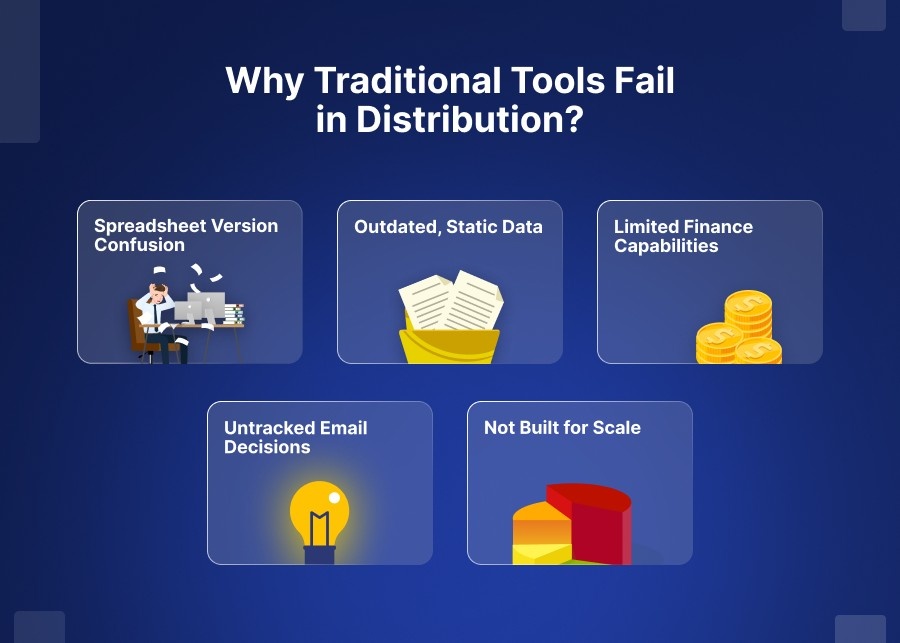
Traditional tools such as spreadsheets, simple finance systems, and email based workflows are attractive because they are cheap and familiar. For a small operation with limited product range and a few regular customers, they may even work for a while. However, once order volumes grow and product ranges expand, those same tools become a barrier to effective distribution.
Spreadsheets are a common example. A planner might build an impressive workbook that tracks stock, forecasts demand, and suggests purchase quantities. While that planner is available and careful, the tool can be helpful. The moment two or three versions circulate, nobody is sure which is correct. Because spreadsheets do not update when an order is raised or a shipment is received, they are always slightly behind events. Decisions made from them are therefore always based on yesterday’s view.
Basic finance systems have a similar limitation. They can record stock in and stock out, but they rarely understand the full flow of distribution. They might not handle multiple warehouses well, they may ignore back orders, and they often lack strong tools for allocating stock fairly when demand exceeds supply. They also struggle with complex price structures where discounts vary by customer group, contract, or region.
Email fills the gaps between these tools. Sales staff send informal messages asking whether they can promise certain quantities by certain dates. Warehouse managers reply with rough estimates based on their own observations. Purchasers send updates about late deliveries. None of this dialogue is captured centrally in a way that can guide future decisions.
As a result, these traditional tools fail not because they are bad at what they do, but because they were never designed to run a modern distribution operation. Companies that want to move beyond this juggling act eventually begin comparing distribution management software UK choices and looking specifically at ERP platforms that treat orders, stock, and purchasing as parts of one process instead of separate systems.
How a Modern ERP Solves These Distribution Challenges
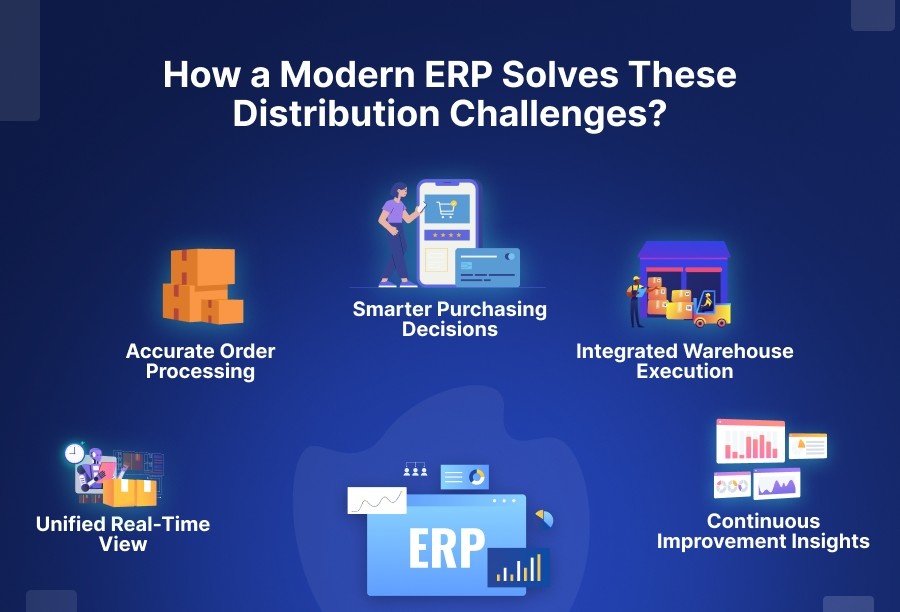
A modern ERP specifically configured for distribution breaks the pattern of guessing and reacting by giving everyone a single, real time view of the business. Instead of separate pockets of information controlled by individual departments, orders, stock, suppliers, and finances share one database and one set of rules.
When an order comes in online or through a sales rep, it goes straight into the ERP. The system checks stock in all locations, applies the right price for that customer, and marks items that need back ordering. Then sales, warehouse, and purchasing all see the same information. No extra spreadsheets or long email chains.
Purchasing gets the same real-time view. Instead of building plans from exported files and old averages, they see open orders, current stock, and incoming deliveries in one place. Many cloud ERP systems built for UK wholesale distributors include tools that recommend purchase orders based on minimum stock rules, supplier lead times, and seasonal patterns. Planners still make the call, but they’re working with a much clearer picture of the trade-offs.
The warehouse also gains from this integrated approach. Pick lists are generated directly from ERP, so they always reflect the latest decisions. As picks, shipments, and returns are processed, the system updates stock instantly. That updated stock figure then powers everything from ecommerce availability displays to sales promises made by account managers. Each action feeds the same central record instead of being lost in a local spreadsheet or note.
Over time, the ERP also builds a history of how and where problems arise. Reports can show whether delays cluster around certain products, suppliers, or customers. That information helps distributors correct root causes rather than treating every delay as a one-off event. For many organisations, this is where the real value of ERP for wholesale distribution UK operations emerges, because it supports not just daily execution but continuous improvement.
Why UK Distributors Prefer Microsoft Dynamics 365 ERP
Among the available ERP platforms, Microsoft Dynamics 365 often appears as a strong candidate for UK distributors because it combines robust core functionality with linkage to tools staff already know. Many employees already work comfortably in Outlook and Excel, and Dynamics extends that environment with structured processes for distribution. This familiarity reduces resistance to change and shortens the learning curve.
Dynamics 365 supports the features that wholesale businesses rely on, such as multiple warehouse management, flexible pricing, discount schemes, and controlled back order handling. It can be run as cloud ERP for wholesale distributors UK companies, which allows businesses to avoid large upfront investments in servers and to scale capacity more easily as volumes grow. Cloud deployment also makes it straightforward to connect branch locations, field sales teams, and remote workers.
Another reason UK distributors lean towards Dynamics is its place in the wider Microsoft ecosystem. Reporting through Power BI, identity management through Azure Active Directory, and collaboration through Teams all tie neatly into the ERP. When leadership looks for the best ERP for wholesale business UK wide, they often value the ability to build dashboards, self service reports, and automated alerts on top of the data without complex custom development.
However, choosing Dynamics is only part of the story. For it to deliver its full value, distributors must connect it to other systems that already support their business. This is where Microsoft Dynamics 365 integration UK work becomes essential. Whether the company uses WooCommerce, marketplace accounts, courier platforms, or specialist industry applications, those systems need controlled data exchange with ERP. With the right integration approach, Dynamics becomes the reliable centre of the application landscape rather than just another separate tool.
How ERP Fixed Order Delays & Stockouts
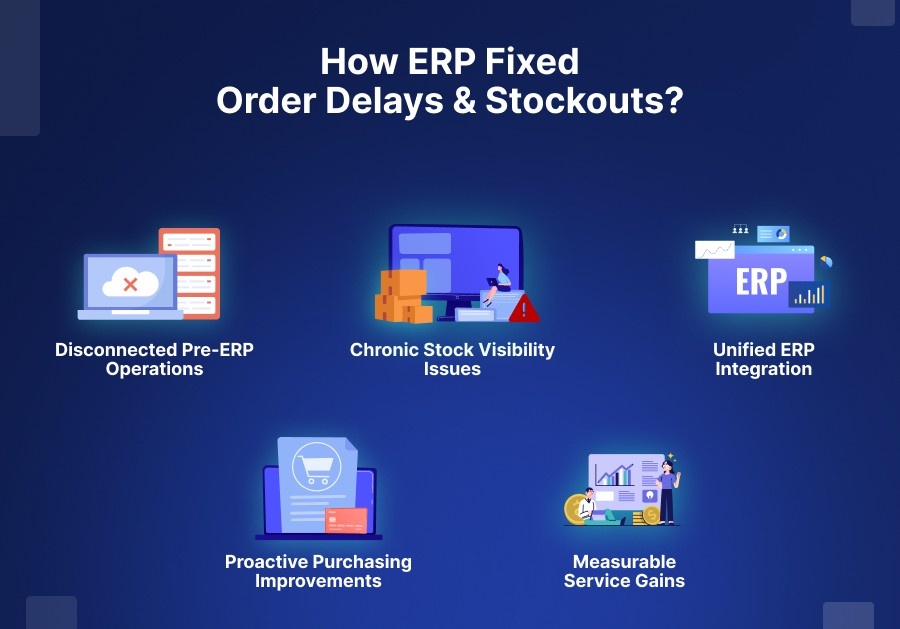
Consider, for example, a UK distributor selling health and personal care products to independent pharmacies, online retailers, and small supermarkets. Before switching to ERP, they ran on a basic finance system, kept separate stock spreadsheets for each warehouse, and had a simple web store that wasn’t connected to actual inventory. When flu season hit or a big promo launched, orders spiked; and the cracks showed up fast.
Sales staff often promised next day delivery on items that appeared available in old reports, only to discover that the last pallets had been committed to other customers. The web store continued to accept orders for out of stock items because nobody had time to update quantities manually every hour. Warehouse teams spent evenings sorting out which orders would ship complete and which would go out partially, while customer service teams prepared apology messages.
After moving to a modern ERP and cleaning up product and customer data, the distributor integrated its web store and order entry processes directly with the new system. Orders from all channels landed in the same order module. Stock levels updated as soon as goods were picked, received, or adjusted. Purchasing staff used ERP suggestions, tuned with their own experience, to place orders earlier for items with predictable seasonal spikes.
The impact did not appear overnight, yet over a few months the pattern changed. Customers still occasionally received revised delivery dates, but these revisions were given early instead of at the last moment. The number of complete orders shipped on the first attempt increased. Emergency orders placed with suppliers declined because planners could see problems forming days in advance rather than hours.
This example mirrors what many businesses report when they implement ERP to reduce stockouts UK operations. The technology did not remove every challenge, but it allowed the company to see and act much earlier, which is often the difference between a controlled adjustment and a crisis.
Solve ERP Integration Challenges in the UK with APPSeCONNECT
Even with the right ERP in place, UK distributors still need to tackle the question of integration. Most organisations use several important systems alongside ERP, such as ecommerce platforms, transport and route planning tools, and possibly separate customer relationship management software. If each of these systems relies on manual updates to stay in line with ERP, the benefits of centralisation quickly erode.
APPSeCONNECT helps distributors sidestep this mess. Instead of stitching together custom scripts for every connection, teams use the platform to define how data moves, which fields line up, and what happens when something breaks. It’s structured and manageable. For example, an order placed on a web store can automatically become a sales order in Microsoft Dynamics 365. Stock levels and prices flow back to the store on their own.
This approach brings two important advantages. First, it reduces the amount of manual entry and checking that staff must perform. Once flows are configured and tested, they repeat the same behaviour consistently, freeing teams to concentrate on exceptions or higher value activities. Second, it offers clear visibility into what is happening. APPSeCONNECT includes monitoring tools that show which messages succeeded, where any problems occurred, and what needs attention. That visibility is crucial for businesses that want to claim they are running the best ERP integration in UK distribution, because it turns integration from a fragile collection of scripts into a service that can be managed.
For UK distributors who already see the value of cloud ERP for wholesale distributors UK regions, APPSeCONNECT becomes the natural partner, ensuring that ERP is fully connected to the channels and tools that generate and fulfil orders. The platform does not replace ERP; it extends its reach so that information flows smoothly across the organisation instead of getting stuck at system boundaries.
Book a Live Demo to See How APPSeCONNECT Fixes Your Distribution Challenges
Reading about integration is helpful, but most distributors decide only after they have seen a solution handle scenarios that resemble their own business. A live APPSeCONNECT demonstration offers that view. During a session, consultants can simulate real journeys, starting from a test order placed on an ecommerce site, following it into ERP, and then watching stock and shipment information flow back to the customer channel.
Teams can also bring their own questions to the session. They might want to understand how the platform handles partial shipments, how credit rules interact with web orders, or how returns are reflected in both ERP and ecommerce records. Because APPSeCONNECT works with visual workflows and configurable mappings, these examples can be shown and adjusted in real time rather than simply described in theory.
For many UK wholesale distributors, this kind of demo does more than showcase software. It prompts internal discussion about how processes should work in the future. People see what could be automated, what should remain under manual control, and where existing habits are no longer helping. From there, they can decide whether APPSeCONNECT offers a practical path from their current mix of systems to something more integrated and resilient.
Conclusion
A modern ERP for wholesale distribution UK companies, especially platforms such as Microsoft Dynamics 365 used as cloud ERP for wholesale distributors UK wide, gives teams a single, real time view of orders, stock, and purchasing. When that ERP is connected to ecommerce, transport, and other systems through an integration platform like APPSeCONNECT, which many see as one of the best ERP integration in UK distribution environments, data stops getting lost between systems and starts flowing as one continuous process, so delays reduce, stockouts become less frequent, and distributors can focus more of their energy on serving customers and growing the business instead of constantly repairing broken processes.
Frequently Asked Questions
It covers orders, stock, purchasing, and finance in one shared system, so every team works from current, consistent information.
It gives real time visibility of demand, stock, and inbound deliveries, allowing planners to react early instead of after failures.
It combines strong distribution features with familiar Microsoft tools, cloud deployment options, and flexible integration across ecommerce and logistics.
Data becomes fragmented and outdated, staff repeat manual checks, and critical decisions depend on guesses rather than a reliable system.
It reduces hardware dependence, supports remote access for branches and teams, and scales capacity more easily as order volumes change.
Without integration, ecommerce, transport, and other systems still require manual updates, which reintroduces delays, errors, and duplicate work.
It connects ERP with ecommerce and other applications using managed workflows, reducing manual entry and improving visibility into data flows.
It provides configurable connectors and monitoring, so Dynamics connects reliably to online stores, marketplaces, and other systems without constant custom coding.
Document current manual steps, identify recurring problems, and then request an APPSeCONNECT demo tailored to your order and stock scenarios.
No, smaller distributors also benefit by starting with key flows, then expanding automation as volumes, channels, and product ranges grow.