






Saudi Arabia’s manufacturing sector is at a pivotal moment. Under Vision 2030’s National Industrial Strategy, the Kingdom is rapidly expanding its industrial base across plastics, metals, FMCG, pharmaceuticals, and petrochemicals. New factories are opening in industrial cities like Jubail, Yanbu, and Riyadh, while existing plants are modernizing to meet global export standards. Yet this growth brings a critical challenge: most Saudi manufacturers still operate on fragmented systems that cannot keep pace with multi-plant coordination, import-dependent supply chains, and strict regulatory compliance requirements.
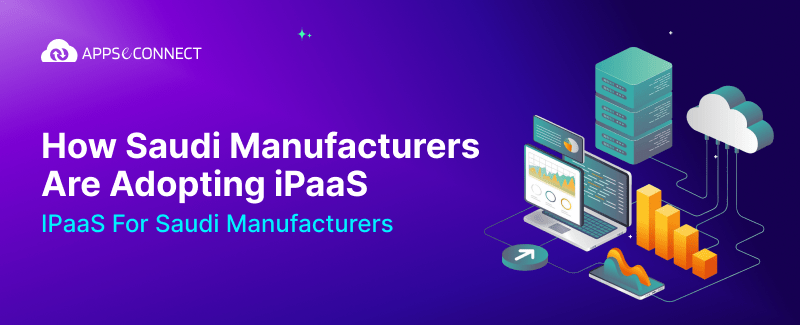
Integration Platform as a Service (iPaaS) offers a solution built for this complexity. It connects SAP, Oracle, IFS, and Focus ERP systems with MES, WMS, ZATCA e-invoicing portals, customs clearance platforms, and supplier networks – all without heavy custom coding. For Saudi manufacturers managing import-heavy supply chains, multi-warehouse operations, and Saudization compliance tracking, iPaaS transforms scattered data flows into unified, automated workflows.
For Saudi manufacturers, this approach fits Vision 2030. It supports smarter factories and a stronger industrial base by making systems work together every day.
Integration Challenges in Saudi Manufacturing
Saudi factories operating in industrial cities face distinct integration challenges. Plants must coordinate across multiple locations – often with different ERP versions – while managing ZATCA e-invoicing compliance, Saudization workforce reporting, and customs documentation for imported raw materials. The result is fragmented visibility, delayed decision-making, and operational inefficiencies that directly impact margins and competitiveness.
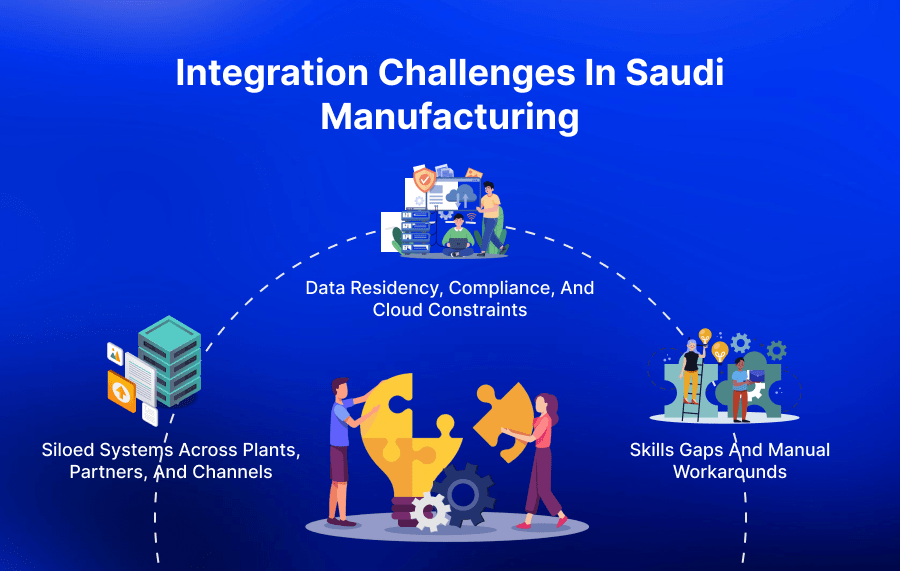
Siloed Systems Across Plants, Partners, And Channels
A typical Saudi manufacturer operates SAP, Oracle, IFS, or Focus ERP at headquarters, local MES and WMS inside plants across Jubail, Yanbu, or Dammam, and separate systems for maintenance, quality, and logistics. Many also manage relationships with international suppliers, regional distributors, and e-commerce portals like Noon and Amazon.sa.
Each system holds part of the truth. Orders move through email, spreadsheets, and CSV uploads. Plant teams work from one schedule, sales from another, and finance from end-of-week exports. When demand spikes, planners spend more time reconciling numbers than adjusting capacity.
Without a shared integration layer, each new channel or partner becomes a fresh point-to-point project. Over time, that web of scripts and manual steps becomes fragile and expensive to maintain.
Data Residency, Compliance, And Cloud Constraints
Saudi Arabia has strengthened digital government, cloud, and data sovereignty rules. Agencies such as the Digital Government Authority, the cloud regulatory framework, and data protection laws expect clear control over how and where information is stored.
Manufacturers also need to comply with ZATCA’s e-invoicing (FATOORAH) mandate, which requires structured electronic invoices and near real-time reporting through approved solutions.
Many plants still prefer on-premise ERP and shop-floor applications, while group functions adopt SaaS systems. Integrating across these boundaries, while respecting data residency and security classifications, is difficult when every connection is custom-built.
Skills Gaps And Manual Workarounds
Saudi manufacturers invest heavily in ERP, MES, and industrial automation, but integration talent is limited. Teams rely on a small group of developers or external partners to maintain critical interfaces.
When those resources are busy, departments fall back to spreadsheets, USB transfers, and email approvals. Quality engineers track defects in separate tools. Maintenance teams log shutdowns in standalone systems. Finance rekeys invoice data to match ZATCA submissions and customer portals.
These workarounds keep production running, but they increase error rates and make audits painful. Integration becomes a constraint instead of an enabler.
Why iPaaS Adoption Is Rising in Saudi Arabia
Saudi manufacturers are not adopting iPaaS as a passing trend – they are adopting it because it directly supports Vision 2030’s digital transformation mandates. The National Industrial Strategy calls for smart factories, automated supply chains, and real-time data flows. Government initiatives like the Digital Government Authority’s cloud-first policies and ZATCA’s e-invoicing requirements create both pressure and incentive for manufacturers to modernize their integration infrastructure.
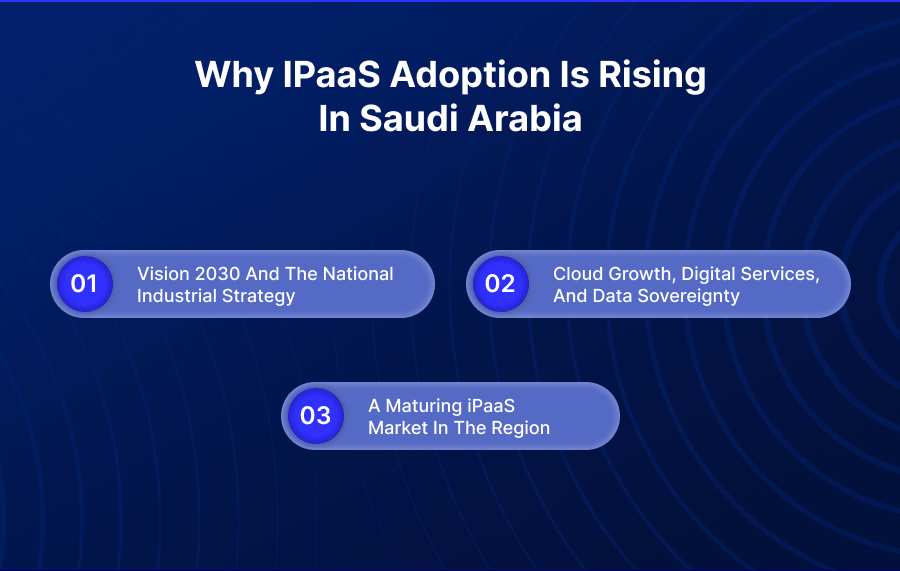
Vision 2030 And The National Industrial Strategy
Vision 2030 wants manufacturing to be more diverse and tech-driven. Policies now support smart factories, automation, and data-led decisions with connected machines and integrated supply chains.
All this needs reliable data movement. iPaaS helps teams plug in new tools quickly without rewriting the ERP, so plants stay connected as they grow.
Cloud Growth, Digital Services, And Data Sovereignty
Saudi cloud adoption is accelerating. Analysts estimate the local cloud computing market around USD 10.5 billion in 2024, with growth rates above 30% through the next decade.
At the same time, over 97% of government services have been digitized, and demand is rising for “sovereign” cloud setups that honor strict data residency and cybersecurity expectations.
Manufacturers now run a mix of on-premise ERP, regional data centers, and public cloud SaaS. iPaaS helps them connect across those environments while keeping sensitive data in approved locations.
A Maturing iPaaS Market In The Region
Worldwide iPaaS spending is growing fast, with multiple research firms projecting compound growth above 25–30% for the rest of the decade.
In the Middle East and Africa, iPaaS revenues are expected to more than double between 2021 and 2028, reflecting demand for integrated services across sectors such as energy, transport, and manufacturing.
Saudi manufacturers benefit from this momentum. Vendors now offer more connectors, more regional experience, and better alignment with local compliance. That makes iPaaS a concrete option for plants and headquarters, not just for central IT.
How iPaaS Simplifies Manufacturing Operations
iPaaS turns integration from a set of brittle scripts into a managed service. Instead of building each connection in isolation, teams design repeatable flows that connect applications by domain.
Unifying Core Manufacturing And Business Systems
Manufacturers can use iPaaS to connect ERP, MES, WMS, maintenance systems, quality tools, logistics platforms, and sales channels. New apps plug into a shared integration layer instead of directly into each other.
A production order in ERP can trigger updates in MES, reserve materials in WMS, and inform planning tools without duplicate configuration. When a sales order arrives through a B2B portal or marketplace, it flows into ERP and plant systems with a consistent identifier and structure.
This approach supports multi-plant setups where each site uses different local tools. The iPaaS layer handles translation and routing so headquarters can still see one coherent picture.
iPaaS also strengthens traceability and returns management. For batch and lot traceability, production events tagged with batch identifiers flow from MES into ERP and quality systems, enabling full visibility from raw material receipt to finished goods dispatch. When a quality issue surfaces, teams can trace affected batches across plants and customer shipments within minutes. For raw material RMAs, iPaaS automates the return authorization workflow: when incoming inspection rejects a supplier shipment, the platform triggers RMA creation in ERP, updates inventory holds in WMS, notifies procurement for replacement orders, and logs the event in supplier quality records, all without manual handoffs between departments.
Standardized Data Flows And Governance
With iPaaS, teams define standard “contracts” for data domains: orders, inventory, production events, quality alerts, or maintenance requests. Each contract includes required fields, optional fields, and validation rules.
When a new system joins, its fields are mapped into those contracts instead of inventing a new integration pattern. That reduces ambiguity when something fails. Teams know which system owns each attribute and which direction corrections should flow.
A small governance group can review and approve changes to these contracts. Over time, this builds a library of reusable flows that industrial projects can adopt instead of starting from zero.
Here is a compact view of common domains:
| Domain | Typical Source | Key Targets |
|---|---|---|
| Sales Orders | B2B portal, marketplace | ERP, WMS, production planning |
| Production Data | MES, machine interfaces | ERP, quality, maintenance |
| Inventory | WMS, ERP | Commerce, planning, finance |
| Quality Events | QMS, lab systems | ERP, supplier management |
| Invoices | ERP, billing tools | Banks, e-invoicing solution |
Monitoring, Exceptions, And Controlled Recovery
iPaaS platforms provide monitoring dashboards that show message volumes, failure rates, and backlog size by domain. Operators can see which flows are healthy and which need attention.
When an exception occurs, the platform presents the record that failed, the rule that objected, and options to fix or replay. Teams no longer search through scripts and log files inside each application.
Safe reprocessing with idempotency lets plants retry integration steps without creating duplicate records. That capability is critical for high-volume environments where delays or duplicates translate directly into cost.
Benefits for Saudi Manufacturers
For Saudi manufacturers, iPaaS delivers distinct advantages: real-time visibility across multi-plant clusters in industrial cities, automated import/export document coordination with customs and logistics partners, and streamlined ZATCA compliance for e-invoicing. Over time, these capabilities translate into measurable improvements: 40–70% reduction in manual reconciliation work, 20–50% improvement in order fulfillment accuracy, and 30–60% fewer data discrepancies across systems
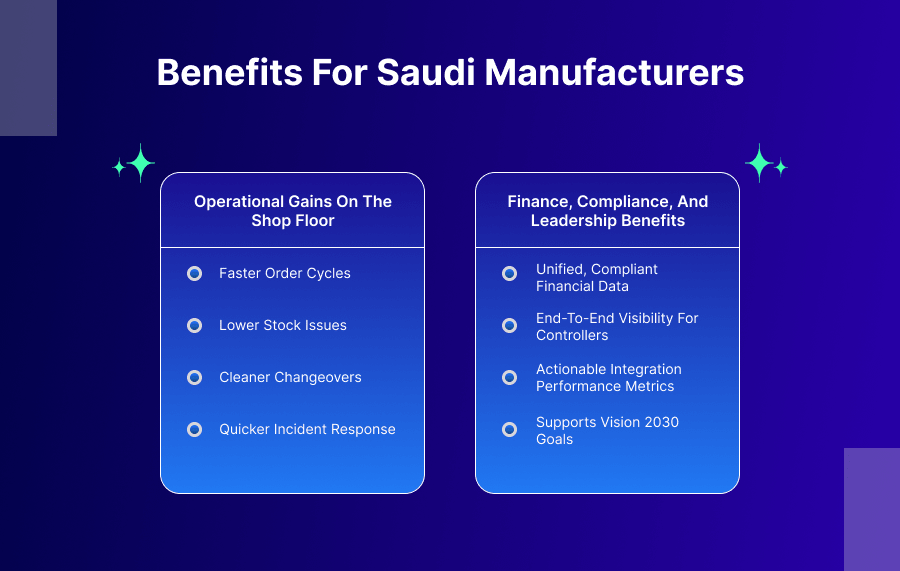
Operational Gains On The Shop Floor
Connected systems reduce manual retyping and copy-paste work between production, inventory, and planning. Operators receive production orders that already match stock levels and customer priorities.
Quality holds and machine downtime events can trigger automatic updates to available-to-promise views and delivery estimates. Supervisors gain near real-time visibility of order status without waiting for end-of-shift reports.
Key outcomes include:
- Faster Order Cycles: Orders move from quote to production and dispatch without repeated data entry.
- Lower Stock Issues: Inventory levels reflect receipts, issues, and adjustments quickly enough to avoid surprises.
- Cleaner Changeovers: Schedules update across plants and warehouses when customers change quantities or dates.
- Quicker Incident Response: Exceptions surface with context, so teams resolve issues in minutes instead of days.
Finance, Compliance, And Leadership Benefits
Finance teams work from data that reconciles across ERP, bank interfaces, and e-invoicing tools. iPaaS can feed structured information into ZATCA-compliant solutions, helping businesses respect FATOORAH rules while keeping invoicing logic in one place.
Controllers see order-to-cash, procure-to-pay, and inventory positions in one view. That makes cash planning more accurate, even when plants and channels use different applications.
Leaders gain a small set of integration metrics: freshness in minutes, exception rates, and time to recover after incidents. Those metrics show whether the integration program is improving, and whether it supports the company’s Vision 2030 commitments.
Example Use Case
Consider a mid-sized Saudi plastics packaging manufacturer with plants in multiple industrial cities. The company produces food-grade containers for the FMCG sector, runs ERP at headquarters, operates separate WMS systems in each plant, maintains a B2B portal for industrial buyers, and lists products on regional marketplaces.
Before iPaaS: Fragmented Orders And Delayed Reporting
Sales teams capture orders through the portal and marketplaces. Staff download those orders in CSV format and import them into ERP. From there, planners manually create production orders and email spreadsheets to plant managers.
Inventory in the WMS systems updates separately. Marketplace quantities change only when staff remember to push new files. When demand spikes, sales oversell popular items or commit dates that plants cannot meet.
Finance exports weekly data from ERP to reconcile with bank statements and e-invoicing tools. ZATCA-aligned invoices are generated through a separate system, and mismatches require manual investigation.
Designing The iPaaS Blueprint
The company adopts an iPaaS platform and designs flows by domain rather than by system pair. Orders from the B2B portal and marketplaces flow into iPaaS first, where they are validated, enriched, and then posted into ERP with a unified identifier.
When ERP confirms a sales order, iPaaS sends structured tasks to each plant’s WMS and, where needed, to MES. Inventory changes return through the same layer and update online channels.
The platform also prepares invoice data from ERP in the correct format for the chosen ZATCA-compliant solution. Tax identifiers, line references, and totals remain consistent across the systems that present the invoice.
After iPaaS: Measurable Outcomes
After iPaaS deployment, the manufacturer achieved measurable results. Order-to-production time dropped by 55%, from over four hours of manual processing to under two hours of automated flow. Online inventory availability now tracks actual stock within 15 minutes of production events, reducing stock-related order cancellations by 40%. Manual reconciliation work decreased by 65%, freeing finance staff for higher-value analysis. ZATCA invoice rejections fell to near zero as structured data eliminated formatting mismatches.
Finance closes periods with fewer adjustments because ERP, bank feeds, and e-invoicing data match at the document level. When exceptions occur, teams use the iPaaS console to inspect and replay records instead of hunting through emails.
Leadership now sees one integrated dashboard of orders, shipments, and cash effects. That clarity supports better decisions on capacity, pricing, and new channels.
Why APPSeCONNECT Fits Saudi Manufacturing Needs
APPSeCONNECT is a comprehensive iPaaS platform with 100+ pre-built integrations, strong ERP support specifically tailored for the Middle East region, and prebuilt manufacturing workflows that enable real-time synchronization and automation. Unlike generic integration tools, it connects SAP, Oracle, Microsoft Dynamics, and regional ERP systems with MES, WMS, eCommerce platforms, and compliance portals using visual process designers and low-code configuration.
For Saudi manufacturers, it offers a practical way to modernize integration without losing control of on-premise assets.
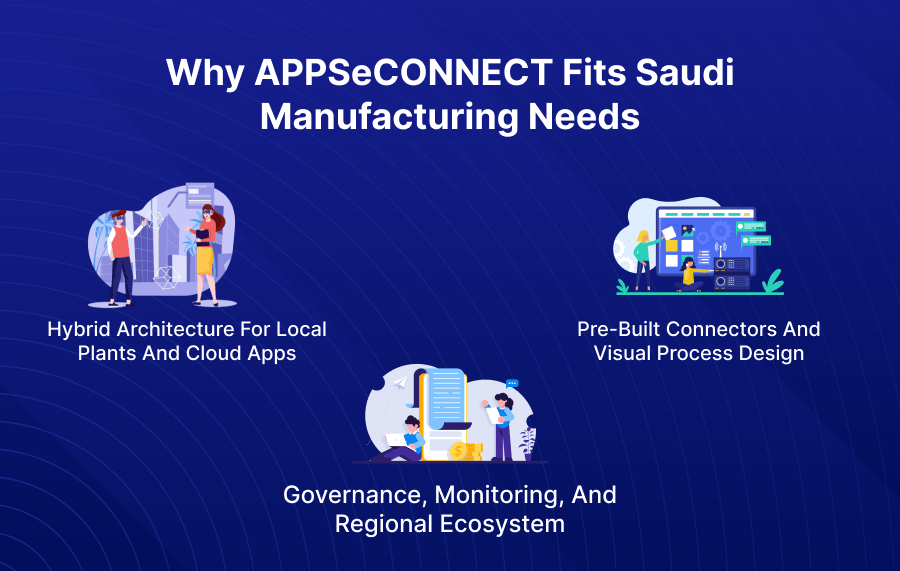
Hybrid Architecture For Local Plants And Cloud Apps
Many Saudi manufacturers keep ERP and plant systems inside local data centers while adopting cloud applications for CRM, procurement, or analytics. APPSeCONNECT supports this pattern through a hybrid architecture: a local agent connects to internal systems while orchestration and monitoring run in the cloud.
This setup helps align with local data sovereignty expectations because sensitive systems remain on the customer network. Only the data required for each flow is transmitted, and customers control which objects and fields participate in each integration.
That model suits manufacturers who need to honor internal security classifications while still connecting to external partners and platforms.
Pre-Built Connectors And Visual Process Design
APPSeCONNECT provides ready connectors for widely used ERPs, eCommerce platforms, and CRM systems, along with templates for common business flows.
Manufacturing teams can adopt these templates for order sync, inventory updates, customer synchronization, and invoicing, then adjust mappings in a visual designer instead of writing large amounts of code. The ProcessFlow designer presents each step as a node, which makes reviews with operations and finance much easier.
Over time, integration teams can build their own templates for plant-specific domains such as production events, quality holds, or maintenance triggers. Those templates can be reused for new plants or partner integrations.
Governance, Monitoring, And Regional Ecosystem
APPSeCONNECT includes monitoring, logging, and controlled replay features, so integration teams see which flows are healthy and where exceptions concentrate. Role-based access control means people have different permissions. Developers build, operators run, and auditors check. This keeps work clear and reduces mistakes.
APPSeCONNECT works with partner companies across the Middle East and North Africa. Saudi manufacturers can pick local experts who know the platform and local business rules. This makes setup faster and more reliable.
Connected governance, clear monitoring, and regional expertise together make APPSeCONNECT a strong fit for manufacturers building long-term integration programs.
Final Thoughts
Vision 2030 has set ambitious targets for Saudi Arabia’s industrial transformation: smarter factories, diversified manufacturing, and globally competitive supply chains. For manufacturers navigating this transition, iPaaS has evolved from an experimental technology to a strategic enabler. It bridges the gap between legacy on-premise systems and cloud-based innovation, ensuring compliance with ZATCA e-invoicing while enabling real-time coordination across plants and partners.
By adopting an integration platform such as APPSeCONNECT, manufacturers can turn fragmented connections into governed flows that support plants, partners, and finance together. The result is shorter cycles, fewer errors, and reporting that leaders trust when they plan the next stage of growth.
Frequently Asked Questions
It is a cloud-based integration platform that connects ERP, plant systems, partners, and channels using governed, reusable workflows instead of fragile scripts.
It replaces spreadsheets and repeated data entry with automated order, inventory, and production updates that move between systems in near real time.
Yes, a hybrid iPaaS setup connects on-premise ERP and plant systems to cloud tools while keeping sensitive applications inside controlled networks.
No, mid-sized manufacturers can start with a few key flows, then expand integration coverage as volumes, plants, and channels grow.
It standardizes identifiers, reduces mismatches, and feeds clean data into reporting tools, giving leaders reliable views of orders, inventory, and cash.
It connects ERP, CRM, eCommerce, WMS, and other business systems, then supports plant-specific flows using configurable, low-code ProcessFlows.
Timelines vary, but many manufacturers can design, build, test, and launch an initial domain-focused flow within a few focused weeks.
It records integration events, keeps clear logs, and maintains consistent references, which simplifies audits, reconciliations, and compliance evidence for critical processes.
Yes, low-code designers let teams adjust mappings and steps visually, while more complex logic can still be added by technical specialists.
Choose one high-impact domain, map current manual handoffs, and design a focused integration flow that proves value quickly and clearly.