






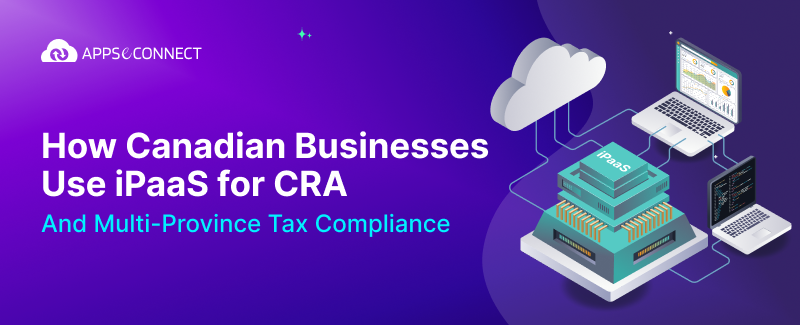
As Canadian businesses expand across provinces, managing tax compliance with the Canada Revenue Agency (CRA) becomes increasingly complex.
Different provinces apply varying GST, HST, PST, and QST rules, making accurate tax calculation, reporting, and reconciliation a constant challenge. Manual processes and disconnected systems often lead to data inconsistencies, delayed filings, and higher compliance risk.
With increased digitization and data-driven audits, the CRA now expects businesses to maintain consistent, traceable tax data across all systems. Even minor mismatches between ERP, accounting, and sales platforms can result in reassessments, penalties, or audit scrutiny, especially for businesses operating across multiple provinces.
This is where iPaaS solutions like APPSeCONNECT play a critical role. By seamlessly integrating ERP, accounting, eCommerce, and payroll systems, APPSeCONNECT ensures tax-relevant data flows accurately across platforms.
It helps businesses maintain real-time visibility, automate tax workflows, and stay compliant with CRA requirements and multi-province tax regulations, without adding operational complexity.
What is iPaaS and How It Supports Canadian Tax Compliance
iPaaS (Integration Platform as a Service) is a cloud-based integration solution that connects core business systems, such as accounting software, ERP, CRM, eCommerce platforms, and payment gateways, into a unified, synchronized environment.
Instead of relying on spreadsheets, manual uploads, or disconnected tools, iPaaS enables seamless and automated data flow across applications. This ensures that financial and tax-related data remains consistent, accurate, and up to date across the organisation.
In the context of CRA and provincial tax compliance, iPaaS acts as the connective layer that ensures tax-relevant data, such as taxable sales, refunds, payroll entries, and adjustments, flows accurately from source systems into accounting and reporting platforms used for CRA filings.
Why iPaaS Matters for Canadian Tax Compliance
As businesses grow across provinces, managing CRA requirements and multi-tax structures becomes increasingly complex. Here’s how an iPaaS solution like APPSeCONNECT helps Canadian businesses stay compliant:
Accurate GST/HST, PST & QST Calculations
iPaaS ensures tax calculations are applied consistently across sales channels, invoices, and accounting systems. By synchronising tax rules and transaction data in real time, businesses reduce discrepancies between collected, recorded, and reported taxes, one of the most common causes of CRA reporting errors.
Single Source of Truth Across Systems
With iPaaS, all connected platforms rely on a shared, synchronised dataset. This eliminates mismatched numbers between ERP, accounting, and payment systems, ensuring CRA filings reflect complete, aligned, and trustworthy data across federal and provincial tax obligations.
Reduced Manual Errors
Manual data handling often leads to duplication, missed entries, or formatting issues. iPaaS automates data movement between systems, significantly reducing human intervention and lowering the risk of errors that could trigger reassessments or penalties.
Timely Tax Filing and Remittance
Real-time data synchronisation reduces the need for last-minute reconciliations at reporting deadlines. Finance teams can prepare GST/HST returns faster, meet CRA remittance timelines, and avoid late filing penalties or interest charges.
Improved Audit and Review Readiness
CRA audits often require businesses to trace transactions across multiple platforms. iPaaS maintains consistent records and detailed data flows, making it easier to present transaction histories, supporting documents, and audit trails when requested.
Real-Time Compliance Visibility
Instead of discovering issues at month-end or quarter-end, iPaaS provides ongoing visibility into tax-relevant data. This allows businesses to identify inconsistencies, missing information, or anomalies early, before they impact CRA reporting or compliance outcomes.
Key Pain Points for Canadian Businesses
For Canadian businesses operating across provinces, tax compliance is one of the most complex and high-risk areas of regulatory management. Errors in GST/HST, PST, and QST reporting directly impact CRA filings, audit exposure, penalties, and cash flow, making tax-centric integration challenges far more critical than general compliance concerns.
Tax-Specific Compliance Challenges for Multi-Province Canadian Businesses
For organizations operating across multiple provinces, tax compliance challenges are amplified by fragmented systems, province-specific tax rules, and increasing CRA scrutiny. The most common tax-related pain points include:
Inconsistent tax data across systems – Sales platforms, ERPs, and accounting tools often record tax data differently, leading to reconciliation issues during CRA filings.
Complex GST/HST, PST, and QST treatment – Province-specific tax rules based on customer location, product type, and nexus requirements increase the risk of miscalculation.
Limited audit readiness and traceability – Manual reconciliation makes it difficult to trace transactions end-to-end during CRA audits or reviews.
As regulations continue to evolve alongside digital transformation, sustainability expectations, and changing work models, compliance is no longer a one-time task, it is an ongoing, organization-wide responsibility.
The following key pain points highlight where Canadian businesses most often struggle and why a more connected, proactive approach to compliance management has become essential:
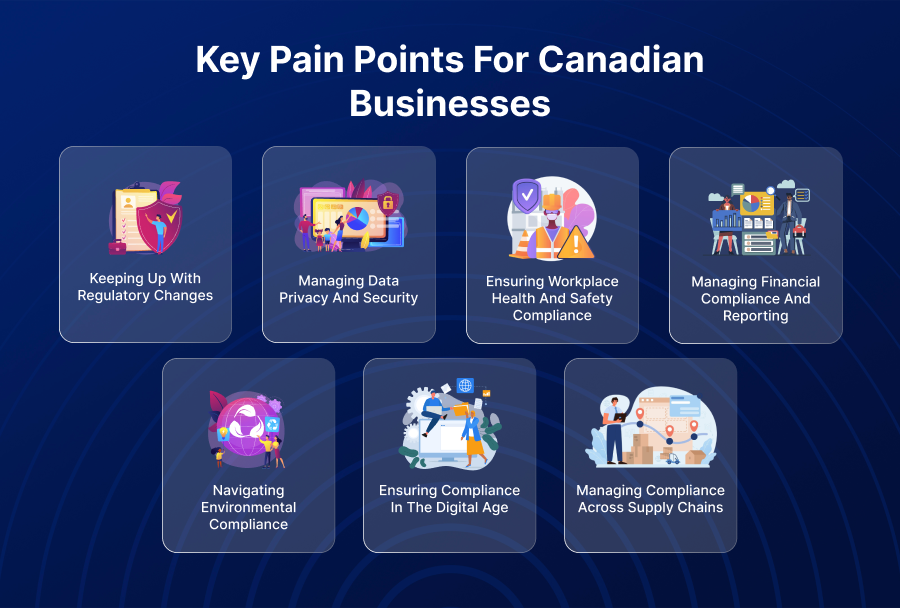
Keeping Up with Regulatory Changes
Canadian regulations evolve frequently across taxation, employment, data protection, and industry-specific compliance. The challenge for businesses isn’t just staying informed, it’s translating regulatory updates into actionable changes across systems, processes, and reporting structures.
Key challenges include:
- Monitoring updates from multiple authorities such as the CRA, provincial tax agencies, Employment and Social Development Canada (ESDC), and provincial labour boards
- Interpreting federal vs. provincial regulatory differences and overlap
- Updating internal policies, workflows, and reporting systems in line with new rules
- Coordinating compliance changes across finance, HR, legal, and IT teams
Managing Data Privacy and Security
Data privacy is a growing compliance risk in Canada, especially with stricter enforcement under federal and provincial privacy laws. Businesses must safeguard sensitive customer and employee data while managing rising cyber threats.
While data privacy is a broad compliance area, failures in securing financial and transactional data directly impact the integrity of tax records used for CRA filings and audits.
Key challenges include:
- Complying with PIPEDA, provincial privacy laws (e.g., Quebec’s Law 25), and breach notification requirements
- Preventing cyber threats such as ransomware, phishing, and unauthorized access
- Ensuring secure data storage, encryption, and role-based access controls
- Training employees to follow data-handling and cybersecurity best practices
Ensuring Workplace Health and Safety Compliance
Workplace health and safety obligations in Canada extend beyond physical hazards to include mental health, ergonomics, and remote work environments. Managing consistent compliance across provinces adds further complexity.
Workplace compliance systems often feed payroll and benefits data into accounting platforms, making inaccuracies a downstream risk for payroll tax reporting and CRA remittances.
Key challenges include:
- Meeting provincial OH&S requirements across multiple locations
- Addressing mental health, stress, and psychosocial workplace risks
- Updating safety policies as work models and technologies evolve
- Conducting regular safety training, incident reporting, and compliance audits
Managing Financial Compliance and Reporting
Financial compliance in Canada is highly regulated, with strict accuracy and reporting requirements. Errors in tax filings or payroll can result in audits, penalties, and reputational damage.
Key challenges include:
- Maintaining accurate GST/HST, PST, payroll, and corporate tax filings
- Managing compliance across federal and provincial tax jurisdictions
- Maintaining audit trails, internal controls, and financial transparency
- Integrating financial data from multiple systems for accurate reporting
Navigating Environmental Compliance
Environmental regulations in Canada are becoming stricter as sustainability expectations increase. Businesses must track environmental impact while complying with both federal and provincial requirements.
Environmental compliance data increasingly feeds into financial reporting, grants, credits, and tax adjustments, creating indirect but material impacts on corporate tax reporting.
Key challenges include:
- Complying with emissions, waste management, and resource usage regulations
- Collecting accurate environmental data across operations and facilities
- Managing compliance in energy, manufacturing, and resource-intensive industries
- Demonstrating sustainability efforts to regulators, investors, and customers
Ensuring Compliance in the Digital Age
As Canadian businesses adopt cloud platforms, automation, and AI-driven tools, compliance requirements become more fragmented and harder to manage.
Key challenges include:
- Securing data across cloud, SaaS, and integrated business platforms
- Managing compliance implications of AI, automation, and digital workflows
- Aligning digital marketing and customer data practices with privacy laws
- Keeping compliance frameworks updated as technologies and regulations evolve
Managing Compliance Across Supply Chains
Canadian businesses are increasingly held accountable for the compliance practices of their suppliers and partners. Limited visibility into supply chains can create both regulatory and reputational risk.
Key challenges include:
- Conducting supplier due diligence and ongoing compliance monitoring
- Managing cross-border and multi-province regulatory requirements
- Ensuring ethical labour, environmental, and sourcing practices
- Tracking supplier certifications, audits, and compliance documentation
These tax-centric challenges are rarely caused by policy gaps alone. In most cases, they stem from fragmented systems, disconnected data flows, and manual reconciliation between platforms. Without an integrated foundation, even well-intentioned compliance efforts break down at scale, especially for businesses managing CRA obligations across multiple provinces.
How iPaaS Like APPSeCONNECT Streamlines CRA and Multi-Province Tax Compliance
For Canadian businesses, CRA and multi-province tax compliance goes far beyond filing returns on time. It requires maintaining accurate, consistent, and audit-ready data across GST/HST, PST, and QST obligations, often across multiple jurisdictions.
Sales platforms, ERPs, accounting systems, payroll tools, and payment gateways all generate tax-relevant data that must ultimately align with CRA and provincial reporting requirements.
When these systems operate in silos, compliance becomes complex, time-consuming, and highly error-prone.
From a compliance standpoint, iPaaS works by capturing tax-relevant transactions at the source, validating them against predefined rules, and synchronizing them with accounting and ERP systems used for CRA and provincial filings. This ensures that every taxable event is recorded consistently from origin to reporting.
This is where an iPaaS solution like APPSeCONNECT plays a critical role. And, this is how it helps:
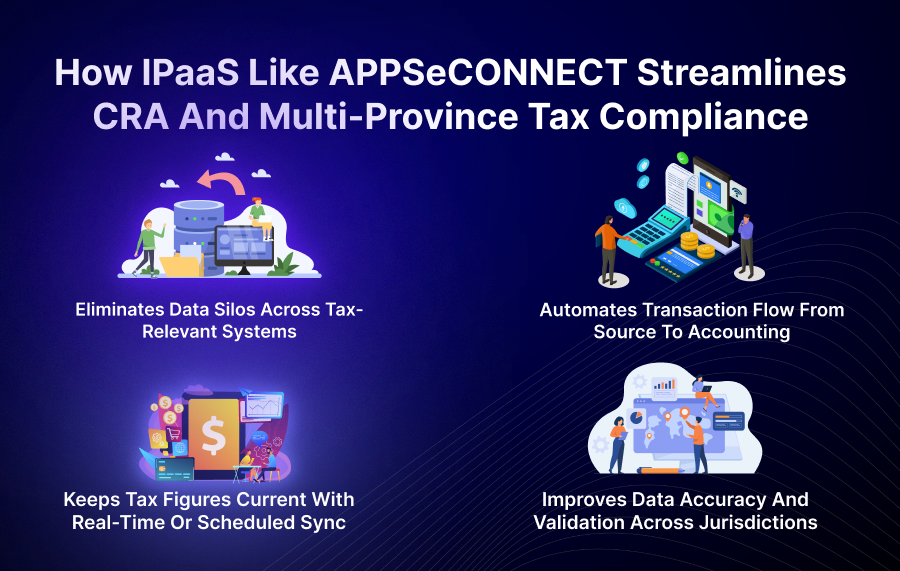
1. Eliminates Data Silos Across Tax-Relevant Systems
One of the biggest challenges in CRA and provincial tax compliance is fragmented financial data spread across multiple business applications. Different departments often rely on different systems, making it difficult to consolidate tax-critical information accurately.
Typically:
- Sales data is captured in eCommerce platforms, POS systems, or subscription billing tools
- Purchase, inventory, and supplier data resides in ERP or procurement systems
- Payroll, reimbursements, and employee benefits are managed through separate HR and finance platforms
When these systems don’t communicate with each other, finance teams are forced to manually extract, reconcile, and combine data, often using spreadsheets and manual checks.
APPSeCONNECT removes these silos by integrating all tax-relevant systems into a unified data pipeline. Transactions flow automatically from source systems into the accounting or ERP platform used for CRA and provincial tax reporting.
This ensures that every taxable event, sales, purchases, payroll entries, adjustments, and refunds, is captured consistently, regardless of where it originates.
2. Automates Transaction Flow from Source to Accounting
Manual handling of financial transactions is one of the most common causes of errors in CRA and provincial tax reporting. Re-entering invoices, bills, credits, and payments across systems often leads to mismatched amounts, incorrect tax codes, or timing differences, especially when dealing with multiple tax jurisdictions.
APPSeCONNECT automates the end-to-end flow of transactions from source systems such as eCommerce platforms, POS, procurement tools, and payroll software directly into the accounting or ERP system. Each transaction is mapped, validated, and posted with the correct tax treatment based on predefined integration rules.
As a result, taxable transactions are recorded accurately and consistently across systems. Automation significantly reduces manual intervention, minimises data entry errors, and ensures that GST/HST, PST, and QST figures are always derived from system-driven records rather than human-dependent processes.
3. Keeps Tax Figures Current with Real-Time or Scheduled Sync
Preparing CRA filings and provincial returns becomes especially challenging when financial data is outdated or incomplete near reporting deadlines. Delayed updates between systems often result in last-minute reconciliations, missing transactions, or incorrect tax totals, putting compliance and accuracy at risk.
APPSeCONNECT addresses this by enabling real-time or scheduled synchronization of tax-relevant data across connected systems. Sales, purchases, payroll entries, adjustments, and refunds are automatically updated in the accounting or ERP platform either as they occur or at predefined intervals aligned with reporting cycles.
This continuous data flow ensures finance teams always have access to the most current tax figures. With up-to-date GST/HST and provincial tax totals available throughout the reporting period, businesses gain better visibility into tax liabilities, reduce period-end pressure, and improve accuracy and timeliness in CRA submissions.
4. Improves Data Accuracy and Validation Across Jurisdictions
Accurate data is the foundation of CRA and multi-province compliance, but discrepancies can easily arise when multiple systems apply different tax rules or data structures. Even small errors can lead to misreported taxes, reassessments, or penalties.
Common issues include:
- Tax codes not aligning across sales, accounting, and payroll systems
- Incorrect application of provincial tax rules based on customer or ship-to location
- Missing mandatory fields such as invoice numbers, supplier details, or tax registration IDs
- Duplicate or mismatched entries caused by manual re-entry or reconciliation
APPSeCONNECT improves accuracy by validating and standardising data as it flows between systems. Integration rules ensure correct tax mapping, mandatory fields are populated, and duplicates are prevented before transactions reach the accounting layer.
This results in consistent, audit-ready tax data across all jurisdictions, giving finance teams greater confidence that CRA and provincial filings are accurate, complete, and compliant.
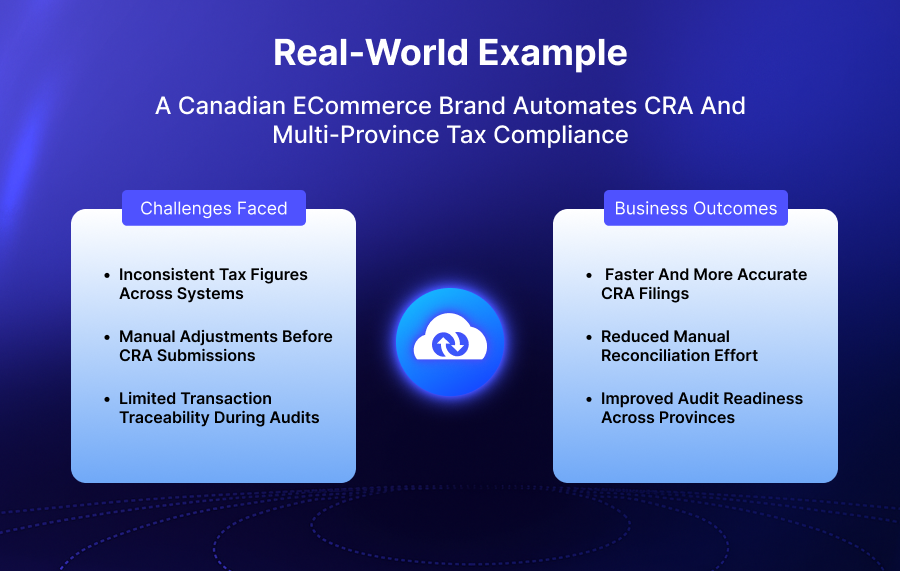
Real-World Example: A Canadian eCommerce Brand Automates CRA and Multi-Province Tax Compliance
Business Benefits Beyond Tax Compliance
While tax compliance is often the primary driver for integration initiatives, the impact of iPaaS extends far beyond meeting CRA requirements.
Modern businesses operate across multiple systems, teams, and channels, and without seamless connectivity, inefficiencies quickly multiply. APPSeCONNECT helps organizations move beyond compliance and build a more agile, efficient, and future-ready enterprise.
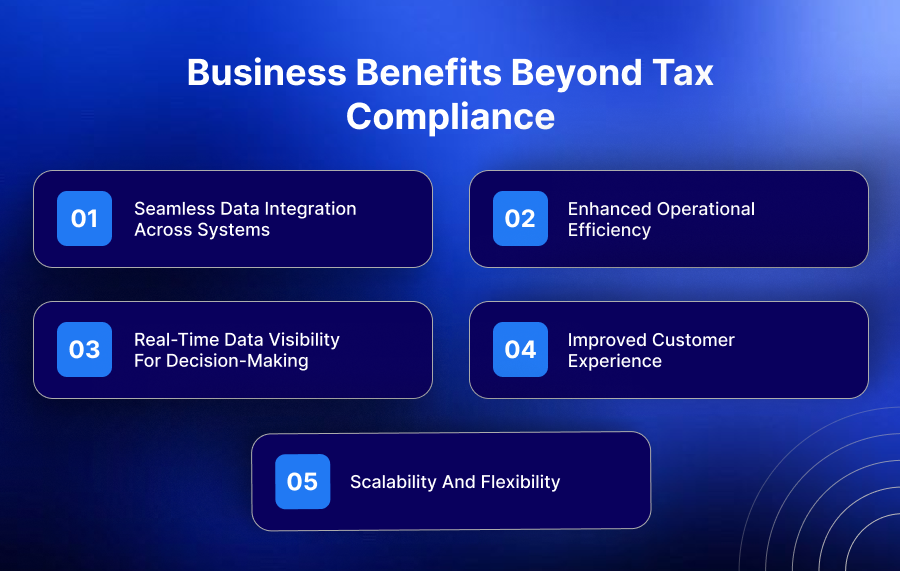
1. Seamless Data Integration Across Systems
APPSeCONNECT enables seamless integration between core business systems such as ERP, CRM, eCommerce platforms, POS, and accounting software, without heavy custom development.
Instead of operating in disconnected silos, data flows automatically and consistently across applications in real time. This eliminates duplicate data entry, reduces reconciliation errors, and ensures information accuracy across departments.
With a unified data ecosystem, businesses gain a single source of truth for operations, finances, inventory, and customer data. The result is improved collaboration, better visibility across functions, and a connected digital infrastructure that supports smarter decision-making and long-term operational efficiency.
2. Enhanced Operational Efficiency
By automating data exchange and business workflows, APPSeCONNECT significantly reduces manual, repetitive tasks that slow down teams. Order processing, invoicing, inventory updates, and reporting are synchronized automatically, removing delays and human dependencies.
This automation minimizes bottlenecks, shortens process cycles, and improves overall throughput. Employees can redirect their time toward strategic initiatives rather than administrative work, while managers gain confidence that processes are running accurately in the background.
The outcome is a leaner, more productive organization that operates faster, scales more easily, and adapts quickly to changing business demands.
3. Real-Time Data Visibility for Decision-Making
APPSeCONNECT ensures that business data is continuously synchronized across systems, providing real-time visibility into critical performance metrics.
Leaders no longer need to rely on delayed reports or manually consolidated spreadsheets. Sales trends, inventory levels, financial data, and customer interactions are always current and accessible. This enables proactive decision-making, whether adjusting pricing strategies, optimizing inventory, or responding to demand fluctuations.
Real-time insights help businesses reduce risks, improve forecasting accuracy, and make timely, data-driven decisions that enhance competitiveness in fast-moving markets.
4. Improved Customer Experience
A connected systems landscape directly translates into better customer experiences. APPSeCONNECT centralizes customer data across sales, support, and fulfillment platforms, ensuring that every interaction is informed and consistent.
Teams have instant access to complete customer histories, order statuses, and service records, enabling faster response times and more personalized engagement. Accurate, real-time data reduces order errors, improves delivery transparency, and strengthens customer trust.
By delivering smoother experiences across touchpoints, businesses can increase customer satisfaction, drive repeat purchases, and build long-term brand loyalty.
5. Scalability and Flexibility
APPSeCONNECT is designed to grow with your business. As organizations expand into new markets, adopt additional applications, or modify workflows, integrations can be scaled or adjusted without reengineering the entire IT ecosystem.
The platform’s flexible architecture supports evolving business models while maintaining system stability and performance. This scalability ensures that operational efficiency is preserved even during periods of rapid growth or transformation.
With predictable integration costs and minimal disruption, businesses gain the agility needed to innovate, adapt, and remain competitive in an ever-changing digital landscape.
The Future of Tax Automation in Canada
Canada’s tax landscape is undergoing a significant transformation as automation, advanced analytics, and system integration reshape how businesses manage compliance and interact with the Canada Revenue Agency (CRA).
As regulatory complexity grows across federal and provincial jurisdictions, automation is becoming essential for accuracy, efficiency, and scalability. Below are the key trends shaping the future of tax automation in Canada.
As the CRA continues to modernize its digital infrastructure and expand its use of analytics, businesses will be expected to maintain higher standards of data accuracy, transparency, and real-time reporting across systems.
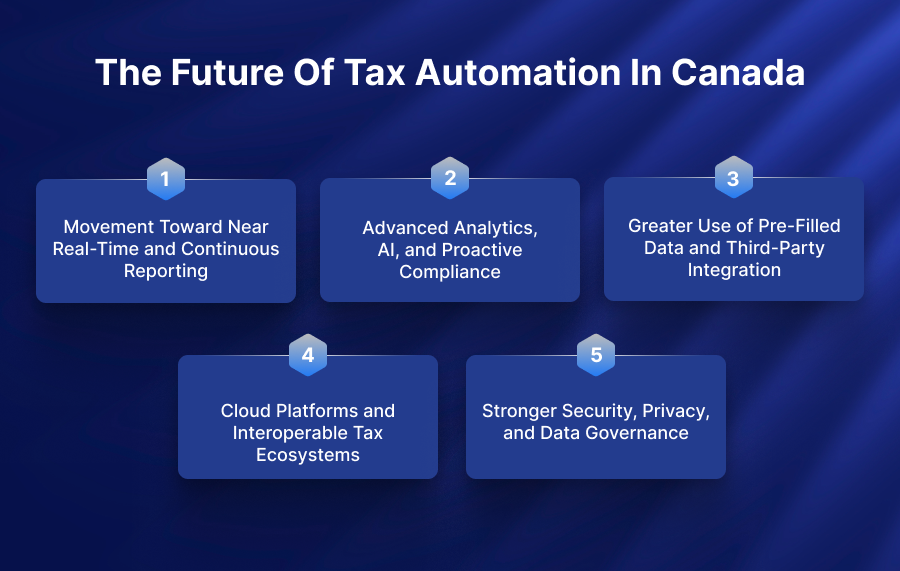
1. Movement Toward Near Real-Time and Continuous Reporting
Canada is gradually moving away from purely periodic tax filings toward more continuous and near real-time data validation.
While GST/HST and payroll remittances are still reported periodically, the CRA increasingly relies on transaction-level data captured closer to the source. Automated integrations between accounting systems, payroll platforms, and tax engines allow businesses to validate tax data throughout the reporting cycle rather than only at filing time.
This shift reduces end-of-period reconciliation pressure, minimizes errors caused by delayed adjustments, and enables businesses to maintain an always-ready compliance posture, especially important for organizations operating across multiple provinces with varying tax rules.
2. Advanced Analytics, AI, and Proactive Compliance
The CRA is expanding its use of data analytics and artificial intelligence to improve compliance outcomes. Automated risk assessment models analyse large volumes of taxpayer data to identify anomalies, inconsistencies, and potential non-compliance earlier in the process.
For businesses, this signals a move toward proactive compliance, where issues can be identified and corrected before audits or reassessments occur. AI-driven insights also help segment taxpayers by risk profiles, enabling more targeted reviews rather than broad, reactive enforcement.
As these capabilities mature, businesses will need automated, accurate data flows to ensure their filings align with CRA expectations.
3. Greater Use of Pre-Filled Data and Third-Party Integration
Pre-filled tax data is becoming a cornerstone of Canada’s automated tax future. The CRA already leverages information from employers, financial institutions, and government bodies to pre-populate individual and business tax returns.
As automation expands, businesses can expect deeper integration of third-party data directly into corporate tax calculations, payroll filings, and indirect tax reporting. This reduces manual data entry, improves accuracy, and shortens preparation cycles.
Over time, pre-fill capabilities will evolve from basic population of fields to intelligent validation, where discrepancies between internal systems and CRA data are flagged automatically.
4. Cloud Platforms and Interoperable Tax Ecosystems
Cloud adoption is accelerating across Canadian finance and tax functions, enabling seamless integration between ERPs, accounting software, payroll systems, and tax compliance tools.
Cloud-based platforms support automated data synchronization and provide real-time visibility into tax positions across entities and provinces. Standardized APIs and data formats are improving interoperability, allowing tax automation solutions to scale as businesses grow or regulations change.
This interconnected ecosystem reduces reliance on spreadsheets and manual uploads, replacing them with automated workflows that are faster, more resilient, and easier to audit.
5. Stronger Security, Privacy, and Data Governance
As tax automation increases data volume and connectivity, security and privacy remain top priorities in Canada’s regulatory environment.
The CRA operates within strict data protection frameworks, and businesses are expected to maintain strong controls over taxpayer and financial information. Automated tax systems are increasingly built with encrypted data transfers, role-based access, audit trails, and continuous monitoring to mitigate cyber risks.
Enhanced data governance not only protects sensitive information but also supports transparency and traceability, critical factors as automated reporting becomes more prevalent and regulatory scrutiny intensifies.
Building a Future-Ready Tax Compliance Framework with APPSeCONNECT
As Canadian tax regulations continue to evolve across federal and provincial jurisdictions, businesses can no longer rely on manual processes or disconnected systems to stay compliant.
This is where iPaaS solutions like APPSeCONNECT become a strategic enabler rather than just a technical tool.
By integrating ERPs, accounting platforms, eCommerce systems, payroll applications, and payment gateways into a single, synchronized ecosystem, APPSeCONNECT ensures tax-relevant data flows accurately, consistently, and securely across the organization.
For Canadian businesses operating across provinces, tax compliance is no longer just a finance responsibility, it’s a systems challenge. With iPaaS solutions like APPSeCONNECT, organizations can move from reactive compliance to a proactive, audit-ready posture. Book a free integration consultation to assess your current tax data flow and identify gaps before they become compliance risks.
Frequently Asked Questions
iPaaS (Integration Platform as a Service) for CRA and multi-province tax compliance in Canada connects ERP, accounting, eCommerce, payroll, and payment systems to ensure tax-relevant data flows accurately and consistently for GST, HST, PST, and QST reporting. It helps businesses reduce errors, automate reconciliation, and remain audit-ready across provinces. This makes iPaaS for CRA and multi-province tax compliance in Canada a critical foundation for accurate, audit-ready reporting.
Canadian businesses use iPaaS to automatically synchronize taxable transactions from source systems into accounting and ERP platforms used for CRA filings. By automating data flow and validation, iPaaS reduces manual reconciliation and ensures accurate multi-province tax reporting.
An iPaaS solution like APPSeCONNECT helps manage GST, HST, PST, QST, and payroll-related tax data by ensuring consistent data integration across systems. While it does not calculate taxes itself, it ensures the accuracy of tax data used by accounting and tax engines.
No. APPSeCONNECT does not replace accounting platforms, ERP systems, or tax calculation tools. Instead, it acts as a secure integration layer that ensures accurate, consistent, and complete tax-relevant data flows between these systems for CRA and provincial compliance.
iPaaS reduces CRA audit risk for Canadian businesses by maintaining transaction-level data consistency, preserving audit trails, and eliminating manual data handling. APPSeCONNECT ensures that tax data can be traced from source systems to CRA reporting, enabling faster and more confident audit responses.
iPaaS is essential for multi-province tax compliance in Canada because businesses must apply different GST, HST, PST, and QST rules consistently across systems based on location and transaction type. iPaaS ensures these rules are applied consistently across systems, reducing discrepancies and compliance risk.
iPaaS supports Canadian eCommerce businesses selling across provinces by automating the flow of sales, refunds, and tax data into ERP and accounting systems used for CRA reporting. This ensures accurate province-wise tax reporting, faster CRA filings, and better scalability as online sales grow.
Accounting and tax compliance tools calculate and report taxes, but they rely on accurate data inputs. iPaaS solutions like APPSeCONNECT do not calculate taxes; instead, they ensure that tax-relevant data flows accurately and consistently between eCommerce platforms, ERPs, payroll systems, and accounting software. This integration layer eliminates reconciliation gaps and ensures CRA filings are based on reliable, system-synced data.
Evaluating iPaaS for CRA and multi-province tax compliance typically involves finance leaders, IT teams, and operations stakeholders. CFOs focus on audit readiness and accuracy, while IT teams assess system integration, data flow, and scalability. APPSeCONNECT supports both perspectives by aligning financial compliance needs with technical integration requirements.
Yes. iPaaS is future-ready for upcoming CRA tax automation requirements as Canada moves toward increased automation, analytics, and near real-time reporting.