





Modern businesses face a critical decision when building their integration architecture.
With 95% of organizations reporting integration challenges and companies managing an average of 897 applications, choosing between Integration Platform as a Service (iPaaS) and serverless integration can make or break your digital transformation strategy.
Both approaches promise seamless connectivity, but they serve different needs, technical capabilities, and business goals.
The iPaaS market is exploding at 24.2% annual growth, while serverless computing reshapes how developers build scalable solutions.
This guide cuts through the complexity to help you make an informed decision that aligns with your organization’s unique requirements and future ambitions.
- iPaaS offers visual, no-code integration with pre-built connectors. It is ideal for quick deployment and standard business app connections without developer resources.
- Serverless integration provides complete customization through code-based functions that scale automatically. It is perfect for complex logic but requires programming expertise.
- iPaaS vendors handle updates, patches, and API changes while serverless requires your team to own and maintain all integration code.
- Deploy iPaaS for standard integrations and serverless for custom processing, combining speed with flexibility as your needs evolve.
- This iPaaS vs serverless integration comparison shows why enterprises prefer iPaaS for ERP stability, predictable iPaaS integration pricing, and faster evaluation through an iPaaS integration demo.
What is iPaaS?
Integration Platform as a Service (iPaaS) is a cloud-based integration solution that connects applications, data sources, and systems across your entire IT ecosystem. Think of it as a central hub where all your business applications communicate seamlessly, without requiring extensive custom coding or infrastructure management.
iPaaS platforms provide a visual, often drag-and-drop interface that lets both technical and non-technical users create integrations.
Instead of writing thousands of lines of code to connect your CRM to your ERP system, you select pre-built connectors, map the data fields, and let the platform handle the heavy lifting.
Integration Platform as a Service (iPaaS) is a cloud-based integration solution that enables organizations to connect ERP, CRM, eCommerce, and SaaS applications using pre-built connectors, low-code workflows, and centralized monitoring, without custom integration development.
Core Features of iPaaS Platforms:
- Pre-built connectors for popular applications like Salesforce, SAP, Shopify, and hundreds more
- Visual workflow designers that eliminate the need for complex coding
- Data transformation tools that automatically map fields between different systems
- Real-time monitoring dashboards showing integration performance and errors
- Built-in security and compliance features including encryption and audit trails
Leading iPaaS platforms like APPSeCONNECT offer over 700 ready-to-deploy connectors and support both cloud and on-premises deployments. This flexibility makes iPaaS particularly attractive for businesses with hybrid IT environments where some systems live in the cloud while others remain on-premises.
The value proposition is simple: faster time to market, lower development costs, and reduced maintenance burden. Companies report achieving ROI up to 10.3 times when combining AI initiatives with robust integration platforms, while developer productivity increases by 35-45%.
What is Serverless Integration?
Serverless integration takes a fundamentally different approach. Rather than using a platform with pre-built connectors, you write custom code (functions) that execute in response to specific events or triggers. The cloud provider manages all the infrastructure, automatically scaling your functions from zero to thousands of instances based on demand.
Despite the name, serverless does not mean there are no servers. It means you do not manage them. Your integration logic runs on cloud infrastructure (like AWS Lambda, Azure Functions, or Google Cloud Functions) that scales automatically and charges you only for actual execution time, down to the millisecond.
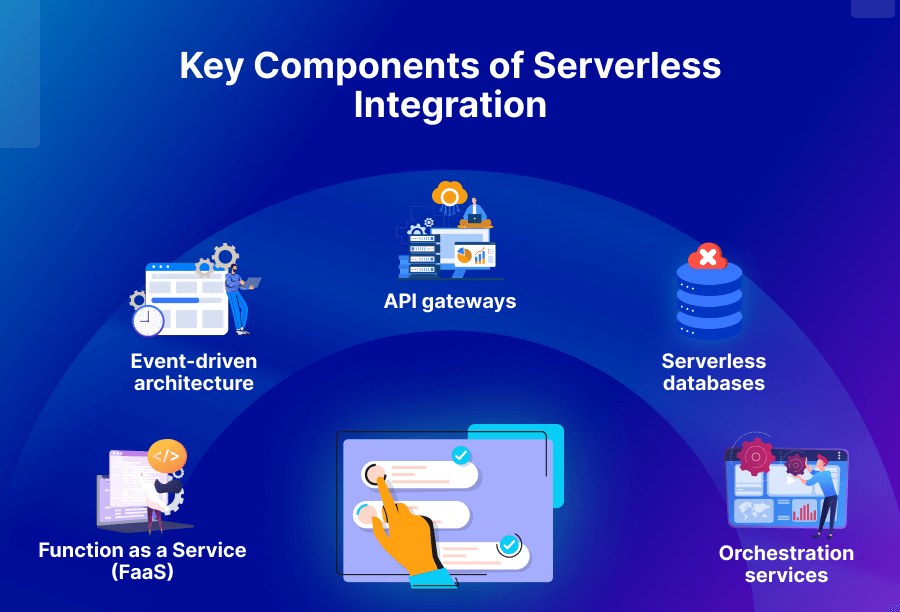
Key Components of Serverless Integration:
- Function as a Service (FaaS): Short-lived code functions triggered by events like HTTP requests or file uploads
- Event-driven architecture: Functions respond to real-time events from databases, message queues, or API calls
- API gateways: Route HTTP requests to appropriate serverless functions
- Serverless databases: Auto-scaling data stores that charge based on actual usage
- Orchestration services: Coordinate multi-step workflows across multiple functions
Serverless integration shines in scenarios requiring extreme scalability or highly customized logic. A file upload can trigger a function that processes the data, transforms it, and loads it into multiple systems. You only pay when the function executes, making it incredibly cost-effective for sporadic or unpredictable workloads.
However, this approach requires development expertise. You need skilled engineers who understand cloud-native architectures, event-driven design patterns, and the specific services offered by your cloud provider. The flexibility comes with responsibility for writing, testing, and maintaining your integration code.
When Serverless Integration Is Not Ideal:
Serverless integration is not recommended for core ERP workflows such as order synchronization, inventory updates, or financial postings where predictable execution, auditability, and guaranteed uptime are critical. Cold starts, retry storms, and code-level ownership introduce operational risk during peak transaction periods.
Comparing iPaaS and Serverless Integration
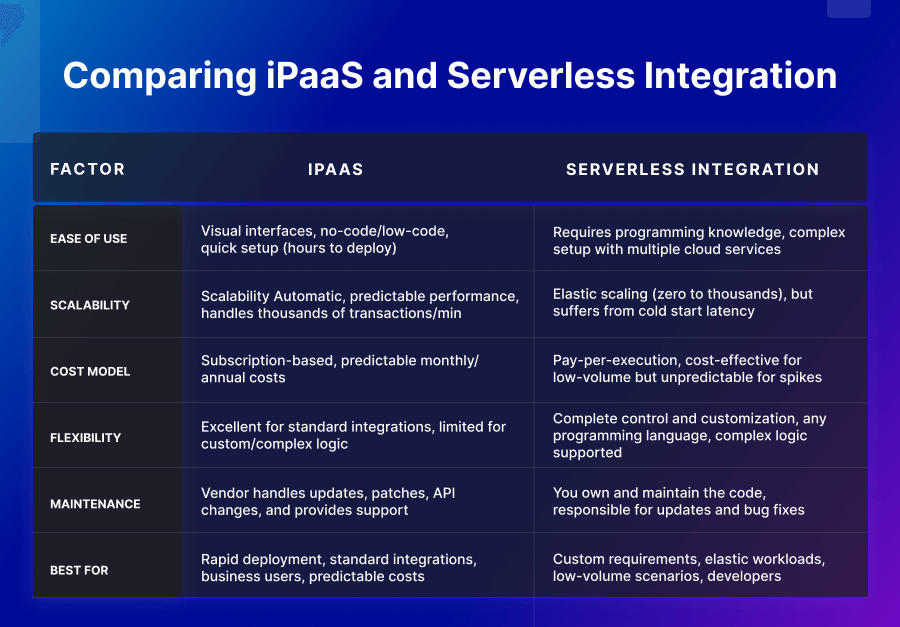
Both integration approaches solve the same fundamental problem (connecting systems), but they do it in dramatically different ways. This iPaaS vs serverless integration comparison helps enterprise teams evaluate not just technical differences, but also ownership models, risk exposure, and long-term operational impact across ERP, SAP, and eCommerce environments. Understanding these differences helps you choose the right tool for your specific situation.
Here’s a high-level overview before we go into the depth:
Executive Decision Rule:
If integration stability, audit readiness, and ERP uptime are business-critical, iPaaS is the safer architectural choice.
If integration logic is experimental, event-driven, or product-facing, serverless offers greater flexibility.
Now, let’s get into each point:
Quick decision lens for enterprise teams: If your priority is business continuity, auditability, and predictable operations, iPaaS aligns better with enterprise governance. If your priority is engineering velocity, custom workflows, and event-driven scale, serverless fits modern product teams. For SAP program owners and operations leaders, the difference is less about technology and more about ownership. iPaaS shifts integration risk to the platform vendor. Serverless shifts integration responsibility to your internal engineering team. This distinction becomes critical during ERP upgrades, API deprecations, audit cycles, and peak transaction periods. |
Ease of Use and Setup
iPaaS platforms win hands-down in accessibility.
- Their visual interfaces let business analysts and citizen developers create integrations without writing code.
- You can connect Shopify to QuickBooks in hours rather than weeks.
- The learning curve is gentle, with most platforms offering extensive documentation, video tutorials, and ready-to-use templates.
Serverless integration requires programming knowledge and familiarity with cloud services.
- You need to understand concepts like event-driven architecture, asynchronous processing, and cloud provider-specific tools.
- Setup involves configuring multiple services: API gateways, function triggers, message queues, and monitoring tools.
- The initial investment is substantial.
Winner for rapid deployment: iPaaS
Scalability and Performance
Both approaches scale automatically, but in different ways. iPaaS platforms handle scaling behind the scenes. As your integration volume grows, the platform allocates more resources. You do not configure anything; it just works. Most platforms can handle thousands of transactions per minute without breaking a sweat.
Serverless functions scale from zero to thousands of concurrent executions within seconds. This elasticity is nearly perfect, but comes with a trade-off called cold starts.
| Cold Start refers to the latency experienced when a serverless function executes for the first time or after being idle. The cloud provider must initialize the execution environment before running your code. |
When a function has not run recently, the first invocation takes longer (sometimes several seconds) while the cloud provider initializes the execution environment. For real-time, latency-sensitive applications, this can be problematic.
In operational terms, cold starts can delay inventory updates, order acknowledgements, or customer notifications.
For eCommerce or ERP-triggered workflows, even seconds of delay can cause overselling or SLA breaches.
Enterprise Impact Example:
In high-volume ERP and eCommerce environments, even a 2-3 second integration delay can lead to overselling, duplicate order creation, or missed SLA commitments, directly impacting revenue, customer trust, and compliance reporting.
Winner for predictable performance: iPaaS | Winner for elastic scalability: Serverless
Cost and Pricing Models
iPaaS platforms typically use subscription-based pricing. You pay monthly or annually based on factors like number of connections, data volume, or number of transactions. This creates predictable costs that finance teams love.
Some platforms charge per connector, while others offer unlimited integrations within a tier.
Serverless integration follows a pay-per-execution model. You pay only for actual compute time, measured in milliseconds.
For workloads that run sporadically, this can be remarkably cost-effective. A function that runs 100 times per day for 500 milliseconds might cost just a few dollars per month.
However, serverless costs can be unpredictable.
From a finance perspective, iPaaS aligns better with annual budgeting and cost forecasting. Serverless requires continuous cost monitoring and governance controls to avoid surprise overruns. This difference becomes visible during flash sales, seasonal peaks, or API retry storms.
From a commercial standpoint, iPaaS integration pricing is typically structured around predictable subscription tiers based on connections, workflows, or transaction volume. This allows enterprises to forecast costs accurately, avoid surprise bills, and align integration spend with annual IT and digital transformation budgets.
A sudden spike in events can trigger thousands of function executions, potentially leading to unexpected bills. You need proper monitoring and cost alerts to avoid surprises.
Pricing Reality Check:
iPaaS pricing models typically follow subscription-based tiers aligned to connections, workflows, or data volume, making annual cost forecasting straightforward. Serverless pricing, while low at small scale, becomes unpredictable during retries, API failures, and seasonal traffic spikes, especially in SAP-driven environments.
Flexibility and Customization
iPaaS platforms excel at standard integrations. Connecting common applications is streamlined and efficient.
However, when you need highly specialized logic or unusual data transformations, you might hit platform limitations. Most platforms offer custom scripting capabilities, but you are still working within the platform’s framework.
Serverless integration gives you complete control. You write the exact code you need, using any programming language supported by your cloud provider.
- Need to implement a complex business rule? No problem.
- Want to integrate with a proprietary system using a custom protocol? Write the code.
This flexibility is a strength and a responsibility.
Maintenance and Support
iPaaS platforms handle most maintenance tasks. When Salesforce updates their API, the platform vendor updates the connector. You don’t patch servers, update libraries, or worry about security vulnerabilities in the integration infrastructure. The platform provider handles all this, plus offers technical support when things go wrong.
With serverless integration, you own the code. You are responsible for updating it when APIs change, fixing bugs, and ensuring compatibility with new versions of cloud services.
While the cloud provider maintains the underlying infrastructure, your integration logic requires ongoing care and feeding from your development team.
This also introduces key-person risk. When integration logic lives in custom code, knowledge often sits with a small set of engineers. iPaaS centralizes this knowledge in documented workflows and platform support models.
Use Cases for iPaaS and Serverless Integration
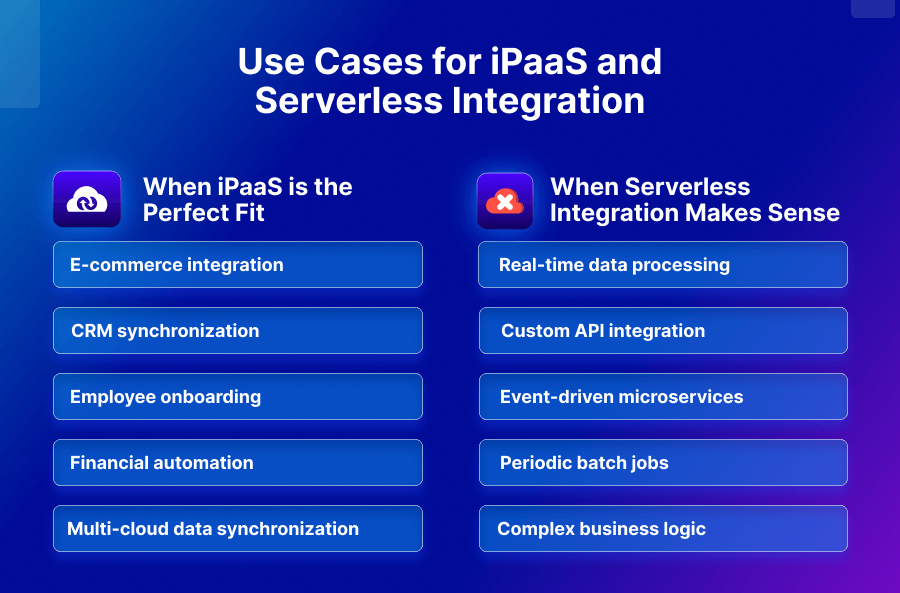
Choosing between these approaches becomes clearer when you examine real-world scenarios where each excels.
When iPaaS is the Perfect Fit:
- E-commerce integration: Connect your Shopify store to ERP systems, payment gateways, and shipping providers
- CRM synchronization: Keep customer data consistent across Salesforce, marketing automation tools, and support platforms
- Employee onboarding: Automate workflows across HR systems, IT provisioning, and training platforms
- Financial automation: Integrate accounting software with banking systems and payment processors
- Multi-cloud data synchronization: Keep data consistent across AWS, Azure, and on-premises systems
Business outcome: Faster go-live, fewer integration errors, lower reliance on IT teams.
Typical KPIs: Sync latency reduction, error rate reduction, deployment time.
When Serverless Integration Makes Sense:
- Real-time data processing: Process streaming data from IoT devices or user events with variable volume
- Custom API integration: Build bespoke integration logic for proprietary systems
- Event-driven microservices: Connect loosely coupled services in cloud-native applications
- Periodic batch jobs: Run nightly ETL processes without maintaining 24/7 infrastructure
- Complex business logic: Implement sophisticated algorithms that go beyond standard integration patterns
Business outcome: Fine-grained control, cost efficiency at scale, architectural flexibility.
Typical KPIs: Event throughput, execution cost per workflow, system response time.
A retail company might use iPaaS to connect their e-commerce platform with inventory management, while simultaneously employing serverless functions to process customer clickstream data for real-time personalization. The approaches complement each other beautifully.
Architecture Patterns that Make The Choice Obvious
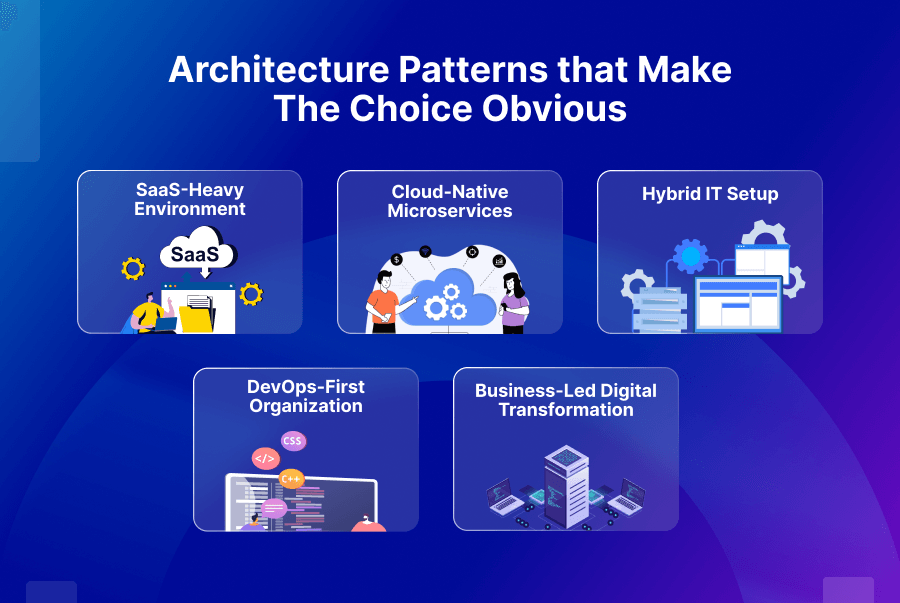
Your existing architecture often dictates which integration approach fits best. Let’s examine patterns that make the decision straightforward.
Each pattern below acts as a shortcut decision signal. If your current architecture strongly resembles one of these, the integration choice becomes less subjective.
Pattern 1: SaaS-Heavy Environment
If your organization runs primarily on SaaS applications (Salesforce, Microsoft 365, Workday, ServiceNow), iPaaS is your natural choice.
These platforms already have pre-built connectors for virtually every major SaaS application. Why reinvent the wheel when someone has already built and tested the integration?
Pattern 2: Cloud-Native Microservices
Organizations building modern applications with microservices architecture typically lean toward serverless integration.
Your development team already understands event-driven patterns, API gateways, and cloud-native design. Serverless functions slot naturally into this architecture, enabling loose coupling and independent service scaling.
Pattern 3: Hybrid IT Setup
Companies with both cloud and on-premises systems benefit enormously from iPaaS platforms that support hybrid deployments.
| Hybrid Integration connects both cloud-based and on-premises systems, allowing organizations to maintain legacy applications while adopting modern cloud services, typically using secure agents or gateways to bridge the environments. |
APPSeCONNECT, for example, offers cloud configuration with on-premises sync agents, bridging the gap between legacy systems and modern cloud applications without exposing internal systems directly to the internet.
Pattern 4: DevOps-First Organization
If your organization embraces DevOps culture with infrastructure-as-code, CI/CD pipelines, and strong engineering practices, serverless integration might feel more natural.
Your team can version control integration logic, run automated tests, and deploy changes through established pipelines. The tooling and mindset already exist.
Pattern 5: Business-Led Digital Transformation
When business units drive integration requirements and IT resources are limited, iPaaS democratizes integration development.
- Marketing can connect their automation platform to the CRM.
- Finance can integrate expense systems with accounting software.
Business moves faster without waiting for developer capacity.
Architecture Summary:
- SaaS-heavy and hybrid ERP environments favor iPaaS for reliability and governance.
- Cloud-native, product-led architectures favor serverless for flexibility.
- Enterprises running SAP alongside digital channels benefit most from a hybrid approach.
Architecture Anti-Patterns to Avoid
Some integration choices look attractive early but create operational debt later. These anti-patterns signal a mismatch between architecture and integration strategy.
Anti-Pattern 1: Serverless for Core ERP Sync
Using serverless functions for SAP order, inventory, or invoice sync introduces operational risk. Cold starts, retries, and code ownership increase failure probability during peak loads.
Anti-Pattern 2: iPaaS for Product-Level Custom Logic
For recommendation engines, real-time pricing, or AI-driven workflows, iPaaS scripting layers become brittle. Serverless handles this complexity better.
Anti-Pattern 3: No Governance Layer
Mixing tools without centralized monitoring creates blind spots. This leads to delayed failure detection and audit risk.
Quick architecture decision checklist:
|
Hybrid Approach: Getting The Best of Both Worlds
Here’s a secret that successful organizations understand: you do not have to choose just one approach. Many companies run iPaaS and serverless integration side by side, using each for what it does best.
A hybrid integration strategy might look like this:
- Use iPaaS for standard business application integrations where pre-built connectors exist and business users need self-service capabilities
- Deploy serverless functions for specialized processing, custom algorithms, or integration with proprietary systems
- Leverage iPaaS monitoring and governance capabilities across both integration types for centralized visibility
- Allow iPaaS to trigger serverless functions when complex custom logic is needed mid-workflow
Some modern iPaaS platforms actually run on serverless infrastructure underneath, giving you the benefits of both approaches. Azure Logic Apps and Google Application Integration are built on serverless foundations, providing elastic scaling and pay-per-execution pricing while maintaining visual workflow designers and pre-built connectors.
Example: Hybrid integration in a growing retail enterprise
A mid-sized retail brand running SAP ERP and Shopify used iPaaS to handle order sync, inventory updates, and invoice creation. This reduced manual reconciliation errors and stabilized daily operations.
As the business scaled, they introduced serverless functions to process real-time customer behavior events and promotional pricing logic. These functions triggered only during traffic spikes, keeping compute costs low while maintaining performance.
Result:
- iPaaS ensured operational reliability.
- Serverless delivered flexibility where standard connectors fell short.
- The hybrid model supported growth without rewriting existing integrations.
Conclusion
You don’t have to find a universal winner in the iPaaS versus serverless integration debate. It’s important that you match the right tool to your specific situation.
- iPaaS platforms deliver rapid deployment, accessibility for non-developers, and lower maintenance overhead, making them ideal for standard business integrations.
- Serverless approaches provide maximum flexibility, cost efficiency for variable workloads, and complete customization control, perfect for specialized technical requirements.
Most successful organizations adopt a pragmatic hybrid strategy, leveraging iPaaS for rapid connectivity between business applications while using serverless functions for custom processing logic.
The most effective integration strategies start with clarity, not tooling.
- If your organization needs rapid SAP, eCommerce, or ERP integrations with minimal risk, iPaaS is the fastest path.
- If your workflows demand deep customization, serverless fills the gaps.
For most enterprises, the winning approach blends both.
Platforms like APPSeCONNECT are purpose-built for enterprise integration, combining iPaaS reliability with modern automation, governance, and hybrid connectivity, especially for SAP, ERP, and eCommerce-driven organizations.
For organizations evaluating platforms, requesting an iPaaS integration demo is the fastest way to understand how real-time ERP, SAP, and eCommerce workflows can be automated without custom code or operational risk.
Frequently Asked Questions
iPaaS is a low-code integration platform with pre-built connectors, while serverless integration relies on custom code executed on-demand. iPaaS prioritizes speed, governance, and stability; serverless prioritizes flexibility and developer control.
For enterprise systems like SAP and ERP, iPaaS is generally better due to predictable performance, built-in governance, and lower operational risk. Serverless suits custom, product-facing, or experimental workflows.
Yes, iPaaS is specifically designed for SAP and ERP integrations, offering pre-built connectors, real-time sync, audit logs, and upgrade-safe workflows that reduce dependency on custom code and ABAP development.
Serverless integration is best when workflows require highly custom logic, event-driven processing, or integration with proprietary systems where pre-built connectors do not exist.
iPaaS uses subscription-based pricing with predictable costs, while serverless follows pay-per-execution pricing that can fluctuate during traffic spikes, retries, or high-volume ERP workloads.
Yes, cold starts can delay execution in serverless integrations, potentially impacting SAP order processing, inventory updates, and real-time eCommerce workflows during peak transaction periods.
Yes, many enterprises adopt a hybrid approach, using iPaaS for core ERP and business integrations while leveraging serverless functions for specialized processing or real-time analytics.
iPaaS is easier to maintain because the platform vendor manages API updates, patches, monitoring, and support, whereas serverless requires ongoing developer ownership and code maintenance.
Yes, enterprise-grade iPaaS platforms provide encryption, role-based access, audit trails, and compliance certifications, often improving security by eliminating manual data transfers and scripts.
Organizations should choose iPaaS for stability, governance, and ERP reliability, serverless for customization and agility, or a hybrid approach when both operational reliability and flexibility are required.