






Enterprises of today run an average of 897 applications, yet only 28% of them are connected so that the data and process can be shared seamlessly across on-prem and cloud systems. The result? Process fragmentation and data silos across business units. This lack of streamlined business processes may lead to a lack of business scalability and versatility. It may also limit the ability of the business to extract value from its data assets.
According to Gartner, by 2026, more than 75% of large enterprises will rely on iPaaS as a core integration strategy to support digital business initiatives. Yet many organizations still struggle with integration sprawl, rising operational risk, and mounting pressure on already stretched IT teams.
For CIOs and enterprise IT leaders, the challenge is no longer whether systems can be integrated, but how quickly integrations can scale as applications, users, and data volumes multiply without increasing technical debt or dependency on scarce engineering resources.
The problem of business fragmentation is compounded by traditional integration approaches that contribute to growing technical debts. In fact, companies spend an additional 10 to 20% of their project budget simply addressing the debts. This is the reason why companies are gradually shifting to iPaaS. An iPaaS integration for enterprises offers a versatile and scalable way to connect the various applications in your business environment.
Unlike traditional approaches, an iPaaS platform’s structured implementation emphasizes systematic planning, modern architectural patterns, and rigorous governance and framework. iPaaS platforms also help address ongoing integration challenges like scalability, versatility and the need for continuous management. This has increased the urgency among organizations to shift to iPaaS from traditional integration approaches to streamline their operations.
So, here in our blog, we are going to take a look at how an enterprise iPaaS integration platform can be used to deliver versatility and user scalability at an enterprise level. We will also tell you how APPSeCONNECT exemplifies iPaaS for all your diverse enterprise needs.
The Real Challenge: Growing Integration Demand, Limited IT Bandwidth
These days, companies are steeply expanding the number of systems and applications that they use on a daily basis, both on-prem and in the cloud. As per research, 70% of enterprises have already created cloud solutions. This has increased the demand for seamless connectivity between the systems.
Because of a lack of connectivity between the applications, many IT departments are overburdened. They are also dealing with disparate systems, resulting in fragmented data, disrupted business processes, and a lack of productivity.
This has given the need for companies to opt for one such solution that will bring together all their business units: sales, finance, marketing, and operations. However, most companies do not have deep technical expertise to make this happen. This is creating a wide gap between the team’s delivery capacity and business needs. The result?
- Bottlenecks in business processes
- Increased errors and inefficient process
- Delays in achieving strategic goals like digital transformation
For enterprise IT leaders, this imbalance creates real business risk. Integration backlogs delay new digital initiatives, manual workarounds introduce data inconsistencies, and governance gaps increase compliance exposure across regulated industries such as manufacturing, finance, and healthcare.
Without an integration platform designed to scale users and workflows independently of core IT teams, organizations risk slowing innovation while operational complexity continues to grow.
iPaaS integration for enterprises can be used to bring together the different systems in your business environment. It can further streamline your operations and allow you to achieve your various organizational goals.
What “Versatility” Means in an Integration Platform?
In the context of enterprise integration, versatility refers to an integration platform’s ability to adapt to changing business models, application ecosystems, and operating environments, without requiring redesign or redevelopment of existing integrations.
A versatile iPaaS enables enterprises to integrate new SaaS applications, legacy systems, marketplaces, and data sources quickly while maintaining consistent governance, security, and performance across regions and business units.
In an enterprise iPaaS integration platform, versatility mainly refers to the ability to connect and manage various application systems and data sources efficiently. This includes:
Flexibility:
Your integration platform should connect cloud-based, on-prem, and hybrid systems. This allows for smooth integration across the various systems in your environment.
Data management:
iPaaS integration comes with centralized data management capability. This ensures that there is a bidirectional flow between the various systems across different departments.
Automation:
Versatile iPaaS integration platform for growing businesses comes with the capability to automate various routine tasks like data synchronization and notification. This further reduces manual effort and streamlines operations.
API integration:
The iPaaS integration platform also makes use of API in order to exchange data securely and efficiently between the platforms. This helps support the operations for both small-scale and large-scale enterprises.
In this way, by opting for iPaaS, you can enjoy enhanced business versatility and smooth operations.
Why User Scalability Matters More Than Ever?
Ensuring user scalability has become more important than ever. It allows your business to grow along with your business. Effective integration connects the various resources seamlessly. It allows you to include new systems and applications without breaking the existing workflow. It is also capable of handling growing data demands.
While traditional integration discussions focus on system scalability, modern enterprises must also address user scalability, the ability for multiple teams, roles, and business units to design, manage, and monitor integrations without overloading central IT teams.
As organizations decentralize operations across regions, departments, and partner ecosystems, integration platforms must support secure, role-based access for hundreds or thousands of users operating simultaneously.
Scaling with an increase in the number of users:
User scalability involves having multiple roles with different levels of access within an IT enterprise. A scalable iPaaS for enterprise application integration platform lets you onboard thousands of users with different role-based access without compromising your business scalability.
Scaling with growth in data and transactions:
Enterprises often work with high volumes of data. This is especially true for sectors like financial, logistics, and healthcare. So, the platform should be able to handle peak load, especially without degrading the performance.
Scaling with organizational growth:
As companies expand, the integration layer should also grow without disrupting the existing workflows in your business environment. iPaaS is a cloud-native solution that can accommodate capacity growth without requiring major architectural changes or expenditures.
Where Traditional Integration Approaches Fall Short?
Before iPaaS integration, companies would bring together various systems in the environment using various custom integration approaches. These approaches have multiple limitations. These limitations resulted in siloed data, operational inefficiency, and a lack of business productivity.
Here are some of the traditional integration approaches:
- Custom-coded point-to-point APIs
- Enterprise Service Bus (ESB) solutions
- Manual ETL jobs
- Home-grown middleware
These approaches suffer from:
| Traditional Approach | Limitation |
|---|---|
| Point-to-point coding | High maintenance, brittle, slow deployment |
| ESBs | Complexity, often on-premise only, lacking hybrid/cloud support |
| Manual ETL | Batch only, not real-time, error prone |
| Legacy middleware | Expensive licenses, steep learning curves |
Unlike traditional approaches, modern iPaaS platforms abstract integration complexity through centralized orchestration, reusable components, and governed automation. This eliminates brittle dependencies between systems while reducing long-term maintenance costs and technical debt accumulation.
As enterprises scale, point-to-point and ESB-based architectures often collapse under their own complexity, making iPaaS a strategic necessity rather than an architectural preference.
So, if you are willing to avoid these shortcomings, then it is high time that you opt for iPaaS integration for enterprises.
How iPaaS Delivers Both Versatility and User Scalability?
Modern iPaaS platforms are architected to decouple integration logic from underlying systems, allowing enterprises to scale users, workflows, and transaction volumes independently. This architectural flexibility enables faster onboarding of applications and teams without redesigning integration foundations.
iPaaS solutions come with multiple extraordinary features that makes it ideal for addressing the versatility and user scalability requirements of your organization.
Cloud-native architecture:
iPaaS for enterprise application integration platforms are built on cloud-native architecture. The companies have the flexibility to scale their resources automatically in response to increased transactions and workload. This eliminates the need for complex capacity planning and costly system updates.
Prebuilt templates and connectors:
iPaaS comes with numerous prebuilt connectors and templates. This can help speed the intergalactic process as you can create workflows using the existing code. This can drastically increase the integration speed. It also cuts down on development time.
Low-code/no-code interface:
iPaaS platforms come with a low-code/no-code interface that can be used to drag and drop items as per requirement. This can further help improve workflows. It also allows the development works to be carried out easily.
Hybrid integration support:
Most modern iPaaS integration solutions offer hybrid integration support. This means that you are able to integrate both on-prem and cloud applications without having to face any kind of challenges.
Real-time data synchronization and automation:
iPaaS for enterprise application integration allows for real-time data synchronization. This ensures that all the teams have access to similar data. You can also automate the workflows and reduce manual tasks by making use of an iPaaS solution.
Along with the ones mentioned above, there are a lot of other advanced iPaaS features as well that can be used to reap excellent business benefits.
Business Outcomes Teams See with iPaaS:
A 2024 Forrester study found that companies achieved a 30% increase in developer efficiency and 345% return on investment (ROI) over three years after adopting an integration suite.
These outcomes are particularly impactful across industries such as manufacturing, retail, logistics, and healthcare, where real-time data exchange, process automation, and system resilience directly influence revenue performance and customer experience.
Operational efficiency:
An integration platform for growing businesses allows companies to build and manage their integrations across on-prem, multi-cloud, and hybrid environments. It can also transform data formats so that the services can communicate easily with each other. Teams can also use automation to eliminate manual workflows.
Improved accessibility:
Modern iPaaS integration platforms are known for their ease of use. Because of the prebuilt connectors and intuitive interface, companies can easily start creating new automation and workflows. The no-code interface also allows you to create custom integrations without requiring any kind of advanced technical knowledge.
Improved security:
The integration services offered by iPaaS for enterprise application integration are highly secure. They protect the data using role-based access control, audit logging, alerting, etc. iPaaS platforms also comply with various advanced compliance standards like GDPR, CCPA, etc.
Increased agility:
With iPaaS integration, the IT teams can easily add services and instances as needed. They can also incorporate new technologies with no-code/ low- code connectors. The iPaaS platforms also come with support for real-time data exchange.
Reduced time to market:
With iPaaS real-time integration, the teams are able to create integration workflows in days instead of weeks or months. This allows the product delivery process to become faster. It also helps the teams save up a significant amount of time.
Operational cost savings:
By saving IT bandwidth, reducing manual work, and eliminating the need for rework, an integration platform for growing businesses can easily reduce operational costs while still ensuring process efficiency. The iPaaS integration pricing is also subscription-based. So, you pay only for what you use.
Improved customer experience:
Real-time workflows allow faster responses to orders, customer service updates, inventory changes, etc. It also paves the way for personalized engagement. This further helps improve the experience for the customers.
So, as you can see, by making maximum use of iPaaS platforms, you can ensure that all your business operations are carried out in a streamlined way.
How APPSeCONNECT Delivers iPaaS Integration for Versatility and User Scalability?
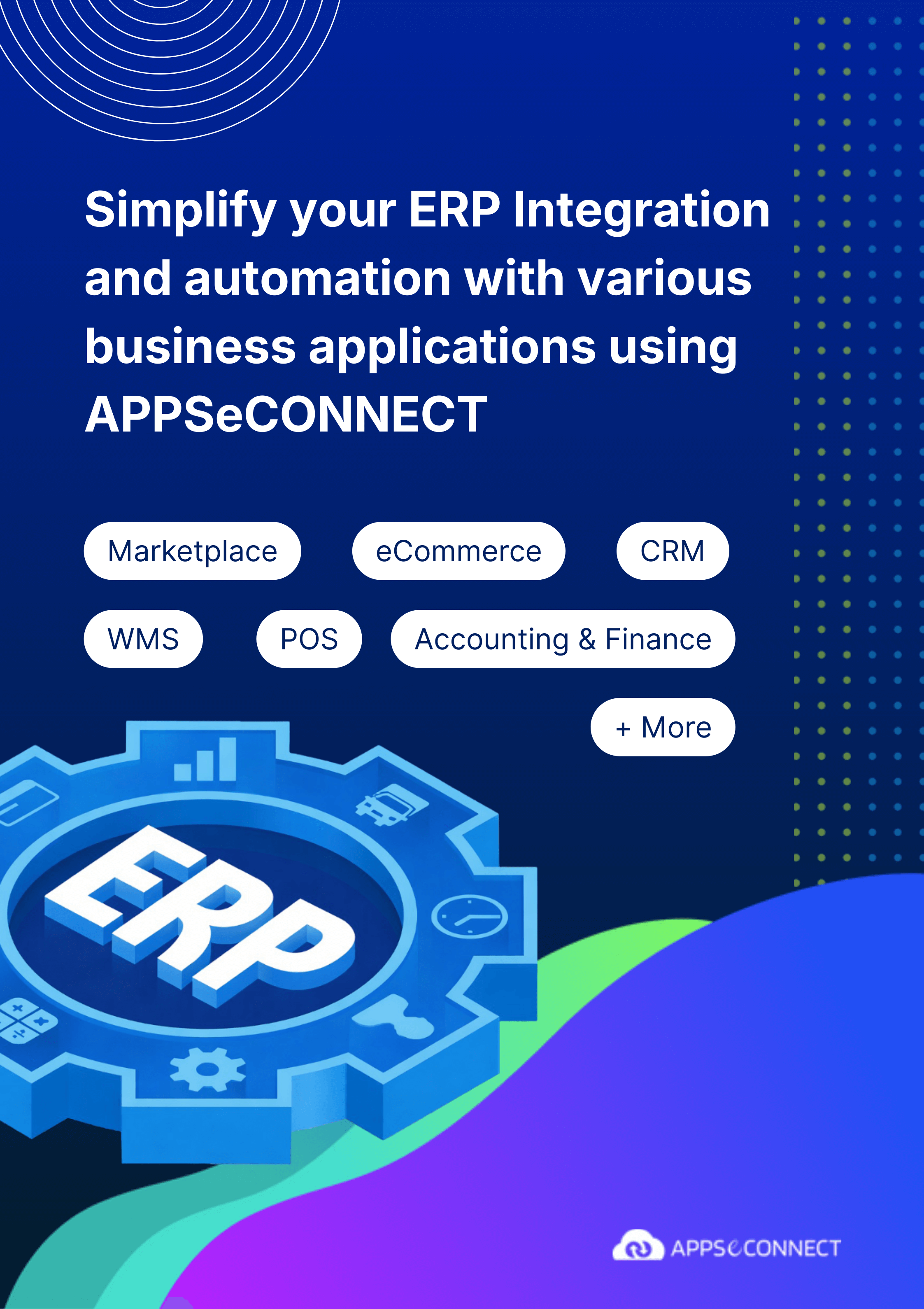
APPSeCONNECT’s modern iPaaS integration solution has been particularly designed to meet all your diverse enterprise demands. With APPSeCONNECT’s enhanced set of features and functionalities, you will be able to ensure that all your business processes are streamlined. You can enjoy seamless data exchange between the systems. You can also check the iPaaS integration demo to learn more about APPSeCONNECT’s services.
Unlike generic iPaaS tools focused primarily on SaaS-to-SaaS connectivity, APPSeCONNECT is purpose-built for ERP-centric enterprise integrations, supporting complex business processes across SAP, Microsoft Dynamics, eCommerce platforms, CRMs, and marketplaces.
APPSeCONNECT enables enterprises to balance centralized governance with decentralized execution, allowing IT teams to maintain control while empowering business users to scale integrations confidently.
Unlike general-purpose iPaaS platforms such as Celigo, Boomi, or Workato that focus primarily on SaaS-to-SaaS workflows, APPSeCONNECT is engineered for ERP-centric, transaction-heavy enterprise integrations.
APPSeCONNECT’s versatility features:
- Prebuilt connectors and protocol support: APPSeCONNECT comes with multiple connectors and templates using which you can virtually connect any application. It also provides protocol support for REST, SOAP, FTP, SMTP, etc.
- Data transformation: APPSeCONNECT has enhanced data transformation techniques. This allows for seamless data translation.
- Hybrid deployment: APPSeCONNECT offers support for on-prem, cloud, and hybrid installations. This further adds versatility to the environment.
APPSeCONNECT’s user scalability features:
- Low-code visual designer: The integration specialists can use APPSeCONNECT’s services to design workflows without extensive coding.
- Role-based access: The users are able to get the required permission based on their roles. This allows for enhancing security and governance.
- Scalable architecture: APPSeCONNECT’s microservices-oriented design builds the path for both horizontal as well as vertical scaling.
Why Our iPaaS Is Built For Both Cloud & On-premise System?
Use Case & Case Examples:
Apparel Retail Automation – Companies using APPSeCONNECT automated ERP and eCommerce integration, providing real-time inventory visibility and multi-channel order processing. As a result, enterprise retail teams achieved near real-time inventory accuracy across channels, reduced order fulfillment delays, and eliminated manual reconciliation between ERP and eCommerce systems, allowing operations to scale during peak demand without increasing IT workload.
Logistics Coordination – A logistics provider integrated shipping, GPS tracking, and warehouse systems for real-time tracking and alerts. This enabled centralized visibility across logistics operations, faster exception handling through automated alerts, and improved delivery reliability, while significantly reducing manual coordination effort between operations and IT teams.
Manufacturing Efficiency – A manufacturer bridged legacy ERP with modern systems, automating supply chain workflows and reducing downtime. By automating critical supply chain integrations, the organization improved production planning accuracy, minimized operational downtime, and enabled IT teams to support future system expansions without redesigning existing integrations.
The following enterprise use cases demonstrate how iPaaS-driven integration delivers measurable operational impact while supporting scalability across industries.
Parting Thoughts:
These days, iPaaS integration is no longer a luxury. It is a necessity for digital-first enterprises. The traditional approach for integration cannot keep up with the demand for versatility and scalability which is why companies are mostly switching to iPaaS to support their diverse needs. With proven benefits, iPaaS has become a crucial tool for modern enterprises. iPaaS platforms like APPSeCONNECT combine robustness with scalability and versatility, thereby allowing companies to accelerate their digital transformation journey.
For enterprises navigating rapid application growth, increasing data volumes, and expanding user bases, choosing the right iPaaS platform is a strategic decision that directly impacts agility, cost efficiency, and long-term scalability.
Frequently Asked Questions
Integration Platform as a Service (iPaaS) is a cloud-based integration platform that enables enterprises to connect ERP systems, cloud applications, databases, and marketplaces through centralized, governed automation. For enterprises managing hundreds of applications and users, iPaaS is critical for reducing integration complexity, maintaining data consistency, and supporting scalable digital transformation initiatives.
iPaaS improves enterprise integration versatility by supporting cloud, on-premise, and hybrid environments while enabling reusable workflows, API-driven integrations, and real-time data exchange. This allows enterprises to integrate new applications and business processes quickly without redesigning existing integration architectures.
User scalability in an enterprise iPaaS platform ensures that multiple teams, IT, operations, finance, and business users, can securely build, manage, and monitor integrations simultaneously. As enterprises grow across regions and departments, scalable role-based access prevents IT bottlenecks while maintaining governance and security.
iPaaS reduces IT workload by providing low-code or no-code integration tools, prebuilt connectors, automated error handling, and centralized monitoring. This allows business teams to manage integrations independently while IT focuses on governance, security, and strategic initiatives instead of manual integration maintenance.
Yes, enterprise-grade iPaaS platforms offer robust security features such as role-based access control, audit logging, encryption, and compliance with standards like GDPR, SOC 2, and ISO frameworks. These capabilities make iPaaS suitable for enterprises operating in regulated industries such as manufacturing, finance, and healthcare.
Unlike ESBs or point-to-point integrations, iPaaS offers cloud-native scalability, reusable integration components, and centralized governance. Traditional approaches often lead to technical debt and limited scalability, while iPaaS enables enterprises to adapt integrations quickly as applications, users, and data volumes grow.
Enterprises using iPaaS typically achieve faster time-to-market, improved operational efficiency, reduced integration costs, and better data visibility across systems. By automating workflows and enabling real-time data synchronization, iPaaS directly supports scalability, agility, and improved customer experience.
APPSeCONNECT is purpose-built for ERP-centric enterprise integrations, offering deep support for SAP, Microsoft Dynamics, eCommerce platforms, CRMs, and hybrid environments. It combines centralized governance with scalable, role-based access, enabling enterprises to manage complex integrations while empowering teams to scale automation confidently.