






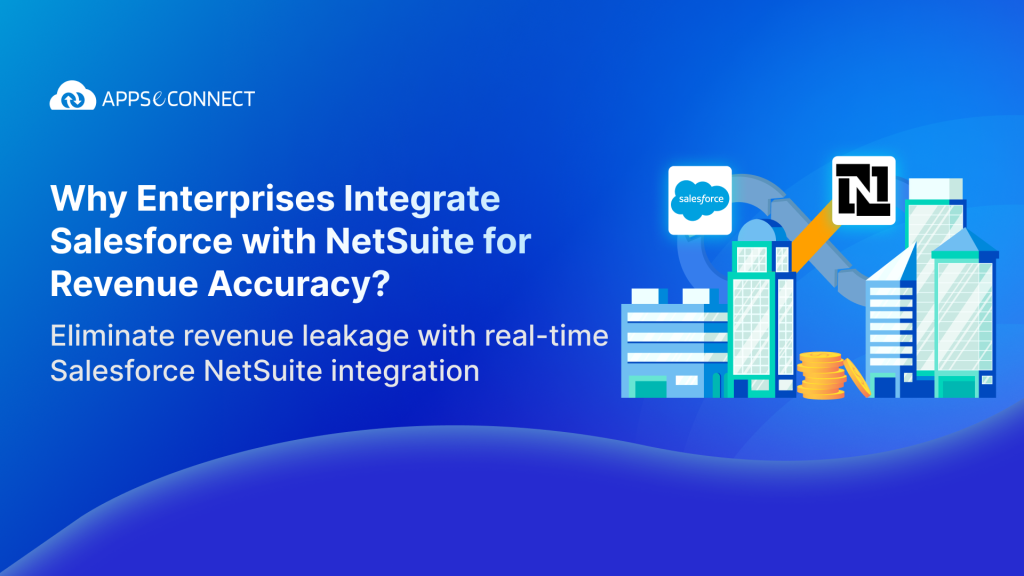
If your ERP (NetSuite) and CRM (Salesforce) platforms deal in silos, then you can easily expect slip-ups, mismatches, messy workflows, and loss of revenue. Closing a deal in Salesforce will only lead to billing or inventory fallout due to sync issues. This can become a daily headache for your business. NetSuite Salesforce integration can easily solve these problems for you. The integration can make the systems talk to each other, share data, and give the teams a single source of truth.
For enterprise CFOs, RevOps leaders, and IT heads, revenue accuracy is not just about closing deals , it is about ensuring that what is sold, billed, recognized, and reported remains consistent across systems. When Salesforce and NetSuite operate independently, enterprises lose visibility across the full revenue lifecycle, leading to forecast inaccuracies, delayed billing, compliance risks, and revenue leakage.
Revenue accuracy refers to the ability of an enterprise to ensure that sales pipeline data (CRM), billing and revenue recognition data (ERP), and financial reporting remain synchronized in real time , without manual reconciliation or data loss.
So, here we are going to take a look at how Salesforce integration with NetSuite can lead to revenue accuracy. We will also tell you how APPSeCONNECT’s enterprise integration services can further streamline the integration process.
The Revenue Accuracy Problem in Enterprise Systems:
Statistics show that 41% of inaccurate data stems from human error, especially due to manual processes and duplicate entry.
Companies deal with multiple systems, each of which has a vital role to play in the revenue lifecycle. For instance:
- Salesforce tracks the promise of revenue: opportunities, leads, and quotes.
- NetSuite manages the recognition of revenue: invoices, orders, finances, revenues, reporting cycle.
When these two systems operate in complete silos, you may have to deal with a lot of problems:
- Salesforce’s sales data will not be aligned with NetSuite’s accounting data.
- Manual data transfer may lead to increased errors.
- Data silos may cause financial problems.
- Financial reporting may be incorrect, causing a lack of business visibility.
In enterprise environments, revenue accuracy breaks most often at the handoff points , when opportunities turn into orders, orders into invoices, and invoices into recognized revenue. Without system-level synchronization, enterprises rely on spreadsheets, manual uploads, and delayed reconciliations, increasing the risk of revenue leakage at every stage.
According to enterprise finance benchmarks, even a 1-2% revenue mismatch across CRM and ERP systems can translate into millions of dollars in reporting inaccuracies, delayed cash flow, and audit exposure for large organizations.
In this way, operating NetSuite and Salesforce systems in silos can lead to severe revenue accuracy problems for your organization, leading to stunted business growth.
Why Pre-Built Connectors Fail in Complex NetSuite Salesforce Integrations?
Why Can't Salesforce Alone Guarantee Revenue Accuracy?
Salesforce happens to be one of the most popular CRM platforms. Most companies that require CRM for their daily operations choose to go for Salesforce. However, Salesforce systems do not handle financial accounting, revenue recognition rules, or statutory reporting. It is mainly used for account and contact tracking, forecasting future revenue, and pipeline management. However, it lacks control over accounting, financial, and auditing data.
Salesforce excels at managing customer relationships and revenue intent, but it was never designed to enforce financial controls, revenue recognition rules, or statutory compliance. This structural limitation means Salesforce can forecast revenue , but cannot validate whether that revenue is billable, collectible, or compliant.
Without integrating Salesforce with an ERP,
- Sales reps will see outdated inventory or pricing data.
- The finance teams will have to manually import data from Salesforce into accounting systems.
- Revenue recognition standards cannot be enforced.
So, without CRM ERP integration for enterprises, the CRM systems will not be able to provide accurate data on your business revenue.
Why Is NetSuite the Source of Financial Truth?
According to NetSuite research, nearly 78% of companies report improved productivity after ERP implementation, in part because of the elimination of data silos and manual reconciliation.
NetSuite happens to be one of the most popular ERP platforms that can be used to centralize accounting, finance, order management, and billing data. It acts as a single source of truth for financing systems. For enterprises operating under ASC 606, IFRS 15, and multi-entity accounting structures, NetSuite becomes the system of record for revenue validation. It enforces accounting logic, audit trails, and financial controls that CRM systems cannot , making it the authoritative layer for revenue accuracy. Instead of having to maintain spreadsheet files across disparate applications, you have access to one single portal for data that is updated in real-time. This makes decision-making faster and better.
Here is what NetSuite can do for you:
- Automate finance-related processes like billing, invoicing, and reporting.
- Keeps track of various inventory through different warehouses and locations.
- Customer data and sales pipeline management.
- Online shopping support
- Project organization with budget, timeline, and research.
Tracking all this data helps you gain accuracy in your business revenue. It also helps your finance teams in gaining confidence that the revenue reported is aligned with the sales reality.
| A company belonging to the healthcare sector unified its CRM and ERP platforms to streamline its revenue recognition process. Within a few years, the company was able to achieve extraordinary growth. Its manual work was also reduced by 50%. |
The Power of Salesforce and NetSuite Integration:
NetSuite Salesforce integration can improve data visibility, accelerate order management, and simplify financial and return processes for businesses looking forward to enhancing accuracy and reducing manual labor across the various departments of your organization. The integration can have a measurable impact on revenue generation. It can also streamline the various processes and ensure enhanced business accuracy.
Here are some of the major benefits associated with NetSuite Salesforce integration:
Improved data visibility:
Accurate real-time data helps in generating reliable reports and making smart business decisions. This is valuable for accurate business decision-making.
Better collaboration:
With NetSuite and Salesforce integration, businesses are able to foster better communication across departments. This reduces misunderstandings and delays.
Automated data sync:
Various data across the Salesforce and NetSuite platforms are synced with one another. This allows businesses to operate smoothly without experiencing any kind of hindrances. The employees also have access to data in real-time.
A single source of truth:
The finance and sales teams are able to work on the same data set. As a result, they are able to remain on the same page at all times. The decision-making process becomes better faster.
Financial closure:
The Salesforce integration with NetSuite process helps accelerate the month-end and quarter-end processes. This helps remove reconciliation bottlenecks to a significant extent.
Revenue Lifecycle Alignment Through Integration:
When Salesforce and NetSuite are integrated, enterprises gain a continuous, automated revenue flow , from lead to invoice to revenue recognition , without manual intervention or data drift.
- Salesforce captures demand and pricing
- NetSuite validates, bills, and recognizes revenue
- Integration ensures both systems stay aligned in real time
Ultimately, integrating NetSuite and Salesforce not only delivers immediate efficiency but also helps establish a scalable foundation for long-term sustainable business growth.
Salesforce to NetSuite Integration: When to Use a Connector vs an iPaaS
How Salesforce and NetSuite Integration Improves Revenue Accuracy?
Here are some of the ways in which Salesforce integration with NetSuite can improve revenue accuracy:
Elimination of manual data entry:
Manual processes are error-prone and time-consuming; they are highly inefficient. By automating the workflows between NetSuite and Salesforce platforms, data silos are reduced. Duplicate records are eliminated. Finance teams get accurate sales data. This improves the revenue generation process.
Real-time financial visibility:
With Salesforce NetSuite data synchronization, the sales orders in Salesforce will automatically generate invoices in NetSuite billing, and the payment status will flow back to Salesforce. The financial teams are able to view revenue recognition as soon as a particular sale is closed.
Adherence to compliance and accounting standards:
Automated integration helps sync contact details with revenue recognition schedules. This is extremely important for ensuring legal compliance under the ASC 606 and IFRS 15.
Accurate reporting and forecasting:
When sales pipeline data and financial data are unified, the reports become more reliable. This makes the decision-making process easier. Forecasting and budgeting also become more accurate.
Enterprises that implement real-time Salesforce-NetSuite integration typically report measurable improvements, including faster order-to-cash cycles, reduced revenue leakage, improved audit readiness, and higher forecast accuracy across business units.
Role-Based Pain Points Solved with NetSuite and Salesforce Integration:
|
Why Point-to-Point Integrations Fail at Scale?
Point-to-point integration, like native connectors and custom-built APIs, may suffice for the initial phase of businesses. However, as the business complexity starts to grow, they fail to achieve the desired results. With growth in the business complex, prebuilt connectors and custom APIs fail to give the desired results. This is because of the following reasons:
- They lack scalability across various business units and data types.
- They are not able to adapt to field updates and platform updates.
- They require constant and ongoing maintenance.
- Sometimes, custom coding is also required.
At enterprise scale, point-to-point integrations collapse under complexity. As data volumes, custom objects, subsidiaries, and compliance requirements increase, these integrations become fragile, opaque, and costly to maintain , often creating more reconciliation work than they eliminate.
So, as the transaction volume grows, companies switch from point-to-point integration to enterprise-grade integration for Salesforce integration with NetSuite.
How APPSeCONNECT Enables Enterprise-Grade Integration?
APPSeCONNECT stands out as one of the most reliable enterprise-grade integration platforms, which allows smooth NetSuite Salesforce integration. With its 100+ prebuilt connectors and templates, APPSeCONNECT can be used to connect the various systems across your environment in a smooth and systematic way.
Unlike generic automation platforms or native connectors, APPSeCONNECT is purpose-built for ERP-centric enterprise integration. It supports complex data models, custom objects, compliance workflows, and high-volume transactional systems , making it suitable for global enterprises where revenue accuracy is non-negotiable.
APPSeCONNECT also comes with enterprise-grade data security measures, which ensure that the data exchange between the two platforms takes place systematically. The integration also runs in real-time using low-code automation and secure APIs.
Now, here are some of the major benefits of using APPSeCONNECT’s enterprise-grade integration services for NetSuite and Salesforce integration.
- Bidirectional accounting: The new customers in your ERP become Accounts in CRM, and the reverse. This helps to keep the records aligned everywhere.
- Order and invoice flows: Quotes, invoices, orders, and payments flow easily between the systems. This provides a complete commercial history.
- Custom field support: Extra fields and objects can easily be synced using configurable flows and various supported APIs.
- Enterprise security: APPSeCONNECT makes use of highly advanced security and compliance measures in order to ensure that data security is maintained.
- Pricing level mapping: ERP price levels of CRM price books. This ensures that the Salesforce data remains consistent with the finance data.
Here are some of the NetSuite Salesforce real-time sync use cases:
- Account/Customer Sync: Names, addresses and price levels map correctly so sales and finance teams have details of the same customers.
- Contact Sync: Contacts under each account stay aligned in both systems with roles and contact details.
- Price Books & Levels: ERP price levels feed CRM pricebook entries, so quotes reflect the right pricing.
Inventory Coordination: Availability data surfaces where needed so the sales team knows what can actually ship.
Mini Case Study: A company using Salesforce for CRM and NetSuite for financials struggled with manual transitions of customer and accounting data, which caused misaligned records and inefficiencies across teams. They adopted an iPaaS solution (APPSeCONNECT) to automate synchronization between Salesforce and NetSuite. Impact achieved: ✅ 65% improvement in overall operations ⭐⭐⭐⭐⭐ ✅ 80% reduction in manual work ⭐⭐⭐⭐⭐ ✅ 90% increase in data accuracy ⭐⭐⭐⭐⭐ |
Parting Thoughts:
So, as you can see, integrating Salesforce with NetSuite using an enterprise-grade platform can create an automated, trusted revenue engine that helps in enhancing strategic decision-making and sustainable growth. This further ensures that revenue accuracy is achieved and the companies are able to gain the maximum outcome from the integration process. Also, if you are willing to achieve the maximum outcome from the integration process, then it is high time that you reach out to the experts at APPSeCONNECT and avail of their services.
For enterprises scaling across regions, products, and revenue models, integrating Salesforce with NetSuite is no longer optional. It is the foundation for predictable revenue, audit-ready reporting, and confident decision-making in modern digital operations.
Frequently Asked Questions
Salesforce NetSuite integration connects CRM and ERP systems to synchronize customers, orders, invoices, pricing, and revenue data in real time. This integration ensures sales, finance, and operations teams work from a single source of truth, improving revenue accuracy and reducing manual reconciliation.
Enterprises struggle with revenue accuracy because Salesforce manages sales pipeline data while NetSuite controls billing, revenue recognition, and financial reporting. Without integration, data becomes inconsistent across systems, leading to manual corrections, delayed invoicing, reporting mismatches, and compliance risks.
NetSuite and Salesforce offer limited native connectors, but these integrations are often insufficient for enterprise use cases. Native connectors lack support for complex data models, custom objects, real-time synchronization, error handling, and compliance workflows required at scale.
Salesforce and NetSuite integration improves revenue accuracy by automatically syncing opportunities, orders, invoices, and payments across systems. This eliminates duplicate data entry, ensures real-time financial visibility, enforces revenue recognition rules, and aligns sales forecasts with actual revenue.
NetSuite is considered the source of financial truth because it manages invoicing, revenue recognition, general ledger, tax compliance, and audit controls. Unlike CRM systems, NetSuite enforces accounting rules such as ASC 606 and IFRS 15, making it authoritative for enterprise financial reporting.
For accurate revenue reporting, Salesforce and NetSuite integration should sync accounts, contacts, opportunities, quotes, sales orders, invoices, payments, pricing levels, inventory availability, and revenue recognition schedules. This ensures consistency across sales, finance, and operations.
Point-to-point integrations fail at scale because they are rigid, difficult to maintain, and break as transaction volumes, custom fields, and subsidiaries grow. They lack centralized monitoring, automated error recovery, and flexibility required for enterprise-grade revenue workflows.
The best way to integrate Salesforce with NetSuite is by using an enterprise-grade iPaaS platform. iPaaS provides real-time synchronization, configurable workflows, automated error handling, support for custom objects, and scalable architecture without relying on brittle point-to-point connections.
With an iPaaS platform like APPSeCONNECT, enterprises can implement Salesforce NetSuite integration within weeks instead of months. Prebuilt connectors, low-code workflows, and reusable templates significantly reduce deployment time and accelerate ROI.
APPSeCONNECT enables Salesforce NetSuite integration by providing ERP-centric, AI-optimized workflows that synchronize CRM and ERP data in real time. It supports custom fields, bidirectional sync, compliance workflows, and high-volume transactions, making it ideal for enterprise revenue operations.