





The US manufacturing sector is in the middle of its most significant structural shift in a generation. Reshoring is accelerating, driven by tariffs, geopolitical risk, and the “America First” industrial policy agenda. According to the Reshoring Initiative’s 2024-2025 data, 82% of US manufacturers have either reshored production or are actively in the process of doing so, nearly double the figure from 2023. Manufacturing construction spending has reached record highs. Domestic investment is surging.
But here is the problem that nobody is talking about loudly enough.
The factories are coming back. The ERP systems are already there. The technology gap between the mid-market and enterprise, however, has never been wider.
A $2 billion manufacturer runs AI-powered demand forecasting, autonomous inventory replenishment, real-time supplier performance monitoring, and automated order-to-cash workflows across every channel simultaneously. Their operations teams receive daily AI briefings. Their finance directors close the books in days, not weeks. Their ERP doesn’t just record what happened, it predicts what’s about to happen and acts on it.
A $20 million manufacturer? They have the same SAP Business One or Microsoft Dynamics installation they had five years ago. Their team spends Monday morning manually importing weekend orders. Their inventory manager reconciles stock levels against three different spreadsheets. Their finance team spends the last week of every month manually reconciling channel data against the ERP.
The infrastructure gap is not the ERP. It’s everything around it.
That gap is exactly what appse ai was built to close, and in 2026, it’s closing faster than most US mid-market manufacturers realise.
The Operational Reality: Why Mid-Market US Manufacturers Are Underperforming Their ERP Investment

The global ERP software market is projected to reach $81.3 billion in 2026 (Mordor Intelligence), with North America commanding a 34% revenue share. Yet despite this investment, a persistent operational performance gap exists between enterprise manufacturers and their mid-market counterparts, not because of the ERP, but because of the disconnected systems around it.
Consider what a typical $15-50 million US manufacturer’s operations look like in practice:
Their ERP, whether SAP Business One, Microsoft Dynamics 365 Business Central, or NetSuite, is their system of record. It holds inventory positions, customer pricing, purchase orders, and financial data. It is, in theory, the operational backbone of the entire business.
In practice, it sits in a silo.
Orders arrive from Shopify, Amazon, BigCommerce, and EDI trading partners. They are manually keyed into the ERP, or processed by a team of people reconciling files. Inventory updates flow from the ERP to the storefront on a schedule, often overnight, sometimes hourly, meaning customers can order stock that doesn’t exist. Supplier invoices arrive by email. Finance teams match them manually against purchase orders and goods receipts. Month-end close involves pulling data from five different systems and reconciling them in spreadsheets.
According to a 2025 Deloitte survey of 600 manufacturing executives, the majority, 80%, plan to invest 20% or more of their improvement budgets in smart manufacturing initiatives. The top concern for more than a third of those executives was equipping workers with the skills and knowledge to maximise the potential of smart manufacturing and operations.
The tools exist. The investment intent is there. The missing piece is an intelligent automation layer that connects the ERP to every other system the business runs, and then makes those connections work autonomously.
What Enterprise Manufacturers Have That Mid-Market Doesn't (Yet)
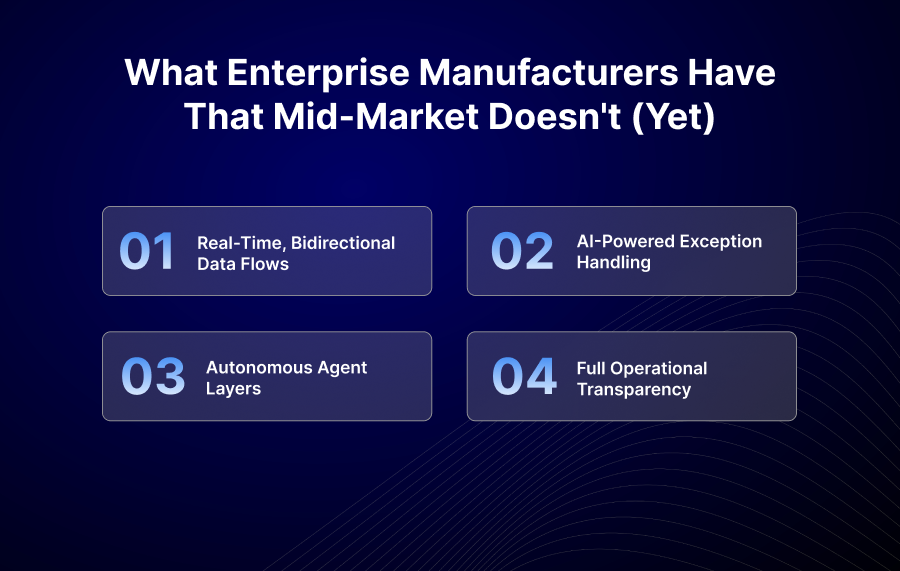
Enterprise manufacturers, the $500M to $5B tier, have been investing in ERP-adjacent automation for years. They have dedicated integration teams, custom middleware, and in-house AI engineering resources. What they have built looks like this:
- Real-time, bidirectional data flows between ERP and every connected system, eCommerce, CRM, marketplaces, 3PLs, and finance tools, with zero manual intervention.
- AI-powered exception handling that catches data anomalies, order discrepancies, and inventory mismatches at the moment they occur, not three days later.
- Autonomous agent layers that monitor business conditions, make decisions, and execute actions across systems without human supervision. When inventory drops below a threshold, a purchase order is created. When a customer’s credit status changes, the sales rep is alerted mid-deal. When an invoice doesn’t match the PO, it’s flagged and routed before anyone in finance even sees it.
- Full operational transparency where any stakeholder can query the system in plain English and get a clear explanation of what’s happening, why, and what the system did about it.
The competitive advantage this creates is structural. It’s not a slight efficiency improvement. It’s a different operating model.
The good news is that this advantage is no longer enterprise-only. The barrier to entry has collapsed. And the SAP ECC end-of-life deadline in 2027 is creating urgency across the mid-market to modernise the systems connected to their ERP, right now.
The Three AI Automation Layers: From Integration to Autonomous Operations

appse ai structures its approach around three progressive layers of operational intelligence, each building on the last, each deployable without replacing a single line of ERP infrastructure.
Layer 1: Structured Workflow Automation
This is the integration foundation. Real-time, bidirectional connectivity between your ERP and every platform you operate, Shopify, BigCommerce, Amazon, Walmart, ShipStation, Salesforce, HubSpot, with every transaction validated against ERP rules before execution.
This is not Zapier-style trigger-and-action automation. A Shopify order doesn’t simply arrive in SAP Business One. It arrives having been checked against the customer’s credit status, their pricing tier, current inventory availability across all warehouse locations, and any compliance requirements specific to that item or that customer. The ERP receives a transaction that is ready to fulfil, not a raw channel input that needs human review.
This layer alone eliminates the manual order import, the overnight inventory batch, the morning reconciliation, and the oversell incident that damages customer relationships.
Layer 2: AI-Enabled Workflow Automation
The second layer introduces intelligence into the automation. The headline capability, and the one that no competitor in the market currently offers, is the Autonomous Workflow Builder.
A business user, an Operations Director, an eCommerce Manager, a Buying Coordinator, describes what they need in plain English. The platform builds the full executable workflow. “When any SKU drops below 20 units and there is no open purchase order in the system, create a draft PO for the preferred supplier at the standard reorder quantity and notify the buying team.” The person who understands the operational problem owns the automation. No IT ticket. No developer dependency.
This is accompanied by SmartScript, which converts natural language into ERP-compatible data transformation logic, handling complex field mappings, multi-currency conversions, and business rule configurations without a line of code.
Layer 3: Autonomous AI Agents
This is the most sophisticated layer, 100+ pre-built AI agents organised across eight operational categories, each operating autonomously across connected ERP and platform data.
The Order-to-Cash Automation category includes 12 agents that cover the entire journey from customer order intake through cash collection. The Operations & Inventory category monitors stock levels in real time, predicts reorder points based on lead time and demand patterns, and automatically pauses advertising spend on out-of-stock SKUs, preventing wasted ad budget and lost revenue simultaneously.
Two platform capabilities tie everything together:
- AutoDetect, proactive, self-healing integration that monitors every data flow, identifies anomalies the moment they appear, and corrects them automatically before they cascade into operational failures.
- FlowInsight, every automated decision explained in plain language to any stakeholder, at any time, without a developer. Full governance. Full auditability. No black boxes.
Case Study 1: Nine Line Apparel - Turning Order Chaos Into Operational Excellence
Nine Line Apparel is a Savannah, Georgia-based patriotic apparel and accessories brand, and the kind of US mid-market manufacturer that represents appse ai’s ideal customer: a fast-growing, multi-channel operation running SAP Business One, selling through BigCommerce and Amazon, and fulfilling through ShipStation.
The challenge: As Nine Line’s order volumes grew across multiple channels, the manual processes that had held operations together at smaller scale began to break down. Order fulfilment was lagging behind demand. Customer satisfaction was suffering. The team was managing the gap between their storefront activity and their ERP manually, importing orders, updating inventory, and reconciling fulfilment data by hand.
The solution: appse ai connected SAP Business One, BigCommerce, and ShipStation in a bidirectional, real-time integration. Orders placed on BigCommerce or Amazon are automatically validated against ERP inventory and customer data, then created in SAP Business One without human intervention. Fulfilment updates from ShipStation flow back to the ERP and storefront in real time. Inventory levels across all channels remain synchronised continuously.
The outcome: Nine Line Apparel significantly improved order fulfilment speed and customer satisfaction. The team that had been spending significant hours each week on manual order processing was freed to focus on higher-value operational work. The ERP, which had been a system of record that teams worked around, became the operational backbone of the entire multi-channel operation.
“Rapidly growing companies, to get to that level of establishment, you need a solution like appse ai to bridge the connections between disparate systems.”, Robert Donnelly, CEO and Co-Founder, Nine Line Apparel
Case Study 2: African American Expressions, Mastering Multi-Channel Inventory at Scale
African American Expressions is a prominent online retailer specialising in culturally relevant products, operating across multiple sales channels simultaneously, their Shopify store, Amazon, and ShipStation for order fulfilment, all running against SAP Business One as their ERP backbone.
The challenge: Managing inventory accuracy, order efficiency, and data synchronisation across three distinct channels without integration is operationally unsustainable at scale. Manual processes were creating data inconsistencies, delayed order processing, and increasing operational overhead. The business was growing, but the systems behind it were not keeping pace.
The solution: appse ai integrated SAP Business One with Shopify, Amazon, and ShipStation, creating a single, ERP-governed operational layer across all three channels. Inventory positions in SAP flow to every connected storefront in real time. Orders from every channel arrive in SAP with ERP-validated data, ready to fulfil. Fulfilment status and shipping notifications sync back automatically.
The outcome: African American Expressions eliminated the manual reconciliation overhead that had been consuming their operations team. Inventory accuracy across channels improved dramatically. Orders from every channel were processed consistently, accurately, and at the speed the business needed to sustain growth.
What Autonomous Operations Look Like for a US Manufacturer in 2026

Beyond the integration foundation, the AI agent layer transforms how mid-market manufacturers actually operate on a day-to-day basis. Here are the specific workflows that appse ai’s agents are running for US manufacturers right now:
- Inventory Intelligence Agent: Monitors stock levels across warehouse locations in real time. When inventory for a SKU drops below a defined threshold, the agent identifies all active Google Ads and Facebook campaigns promoting that product, pauses them automatically, alerts the marketing team, and flags campaigns for reinstatement when stock is replenished. No weekend monitoring. No wasted ad spend on out-of-stock products.
- Order Fulfilment Intelligence Agent: Reads incoming purchase orders from email, EDI files, and B2B portal submissions. Extracts order data, validates against current ERP inventory, creates confirmed sales orders in SAP Business One, sends order confirmations to customers, and notifies the operations team, all in under 90 seconds.
- AI Financial Anomaly Detection Agent: Monitors all financial transactions continuously for patterns that deviate from established norms, duplicate payments, unusual vendor charges, reconciliation gaps. Alerts the finance team with severity-ranked findings before discrepancies compound.
- AI Sales Opportunity Discovery Agent: Monitors ERP transaction history and CRM data simultaneously. When a customer approaches an upsell threshold, ordering Product A six times but never Product B, the agent assembles a prioritised recommendation, checks current inventory, and pushes it to the sales rep’s workflow before their next customer call.
- AI Accounts Payable Intelligence Agent: Performs automated three-way matching across Purchase Orders, Goods Receipts, and Vendor Invoices. Flags discrepancies, routes for approval, and maintains a complete payment audit trail in the ERP, reducing what was previously hours of daily AP manual work to a near-automated process.
For a US mid-market manufacturer, these agents operate 24/7. Orders placed at 11pm are confirmed by midnight. Weekend inventory movements trigger automatic responses. Month-end close accelerates because reconciliation happens continuously, not all at once.
The Competitive Cost of Waiting: The ROI Calculation Framework

Every week a mid-market US manufacturer operates without ERP automation has a quantifiable cost. Here’s a framework to calculate it for your own operation:
- Manual Order Entry Cost: If your team manually processes 500 orders per week, at an average of 8 minutes per order, that’s 67 person-hours per week. At a fully loaded labour cost of $35/hour, that’s $2,345 per week, $122,000 per year, in direct cost for a process that appse ai automates entirely.
- Inventory Overselling Cost: Every oversell incident costs you the margin on the lost order, the customer service time to manage the customer, and frequently the customer relationship itself. For a $10M revenue manufacturer selling across two channels, a 1% oversell rate on 10,000 annual orders represents 100 incidents per year. At an average order value of $250, that’s $25,000 in direct revenue impact, before accounting for customer lifetime value.
- Manual Reconciliation Cost: The average mid-market finance team spends 3-5 days on monthly close reconciliation. At two finance FTE, that’s 6-10 person-days per month, up to 120 person-days per year, on a process that appse ai’s Bank Reconciliation, AR Collections, and Period-End Close agents reduce to a fraction of that.
- The appse ai ROI timeline: Most US mid-market manufacturers who implement appse ai report going live within hours for standard integrations, with a full multi-system deployment within days. At a starting price of $99/month, the platform pays for itself in its first week of operation, typically within the first batch of automatically processed orders.
Contrast this with legacy enterprise iPaaS alternatives. Workato starts at $60,000-$180,000 per year. Celigo’s enterprise contracts start at $20,000 per year. Both require developer-led implementation with timelines measured in months. appse ai goes live in hours, at a price point that works for a $10M manufacturer, not just a $1B enterprise.
Five Questions US Mid-Market Manufacturers Should Ask Before Choosing an ERP Automation Platform
Before investing in any ERP automation solution, mid-market US manufacturers should pressure-test the platform against these five questions:
1. Is it ERP-native or ERP-adjacent?
Does the platform treat your ERP as a peer application in a network of tools, or as the governing system of record that every other integration must answer to? Only ERP-native platforms, those that validate, enrich, and govern every transaction against ERP rules before execution, eliminate the reconciliation overhead at the source.
2. Can business users build and own automations without developer dependency?
If your operations team needs to raise an IT ticket every time they want to modify a workflow, the automation is creating a new bottleneck rather than removing one. The Autonomous Workflow Builder is appse ai’s answer to this, plain-English workflow creation owned by the people who understand the operational problem.
3. What happens when something breaks?
Generic iPaaS platforms detect errors reactively, after a failure has already impacted operations. appse ai’s AutoDetect monitors data health proactively, predicts bottlenecks before they cascade, and corrects anomalies automatically. For a manufacturer processing hundreds of orders daily, this is not a nice-to-have. It is the difference between resilient operations and operational chaos.
4. What does go-live actually look like?
Months-long implementation timelines are a legacy of enterprise iPaaS designed for IT-led deployment. appse ai ships with 500+ pre-built, production-tested connector templates. Most US mid-market manufacturers are live in hours or days, not quarters.
5. What is the total cost of ownership?
The subscription price is only one component. Enterprise iPaaS platforms that charge based on transaction volume or endpoint count create unpredictable cost scaling as your business grows. appse ai’s transparent, tiered pricing, starting at $99/month, scales predictably with your business, with no hidden consumption charges.
appse ai vs. the Alternatives: Why US Manufacturers Are Making the Switch
The US mid-market iPaaS landscape in 2026 offers no shortage of options, but most were not built for manufacturers. Zapier and Make.com are SaaS connectors, not ERP platforms. They have no understanding of SAP inventory structures, no ERP governance layer, and no ability to validate transactions against ERP business rules. They are appropriate for connecting marketing tools. They are not appropriate for running a manufacturing operation.
Workato and Celigo are powerful platforms, but they are enterprise platforms. Their pricing, their implementation requirements, and their developer-first architecture are designed for IT organisations with dedicated integration teams. A $25M US manufacturer does not have a dedicated integration team. They have an Operations Director who needs to automate a workflow before end of quarter.
appse ai occupies a category of its own: ERP-first, AI-native, mid-market accessible. It is the only platform that combines:
- Native ERP connectivity across all major mid-market ERPs (SAP Business One, Dynamics 365 BC, NetSuite, Sage 300)
- An Autonomous Workflow Builder that requires no developer for configuration
- 100+ pre-built AI agents across eight operational categories
- Self-healing AutoDetect monitoring and FlowInsight governance
- Transparent pricing from $99/month
- SAP Certified Partner status, the highest connector standard in the SAP ecosystem
- Average go-live measured in hours, not months
For a US mid-market manufacturer in 2026, the question is not whether to automate. The reshoring boom, the SAP ECC end-of-life deadline, and the competitive pressure from enterprise rivals have made that decision already. The question is which platform can deliver enterprise-grade AI automation at a price and timeline that works for a $20M manufacturer.
Ready to See AI ERP Automation Working in Your Operation?
appse ai is the ERP-first AI automation platform built for US mid-market manufacturers who are ready to compete at the level enterprise rivals have been operating for years, without replacing their SAP or Dynamics investment.
The demo is free. Go-live is measured in hours. And the operations team that’s currently spending Monday morning importing weekend orders? They could be doing something more valuable by Tuesday.
Frequently Asked Questions
AI ERP automation connects your existing ERP system (SAP Business One, Microsoft Dynamics, NetSuite) to your other business platforms, eCommerce, CRM, marketplaces, 3PLs, in real time, and then deploys AI agents that monitor conditions, make decisions, and execute actions autonomously across those connected systems. The result is operations that run continuously without manual intervention at every step.
No. appse ai works alongside your existing ERP, never in place of it. It embeds AI intelligence directly into your existing ERP-driven processes, turning manual workflows into autonomous operations without disrupting your current infrastructure.
Most standard integrations using pre-built connectors go live within hours. More complex, multi-system deployments are typically live within days. appse ai’s 500+ pre-built connector templates eliminate the blank-canvas implementation that makes legacy iPaaS deployments take months.
Zapier and Make.com are SaaS automation tools, they connect cloud apps and trigger simple actions. They are not built for ERP-driven manufacturing operations. They have no understanding of SAP Business One data structures, no ERP business rule validation, and no ability to govern transactions against ERP inventory, pricing, or credit data. appse ai is ERP-first by design: every transaction is validated against ERP rules before execution.
The Autonomous Workflow Builder is appse ai’s plain-English workflow creation capability. A business user, an Operations Director, eCommerce Manager, or Buying Coordinator, describes the process they want to automate in plain English. The platform builds the full executable workflow automatically. No developer. No IT ticket. No blank canvas. This capability is unique to appse ai, no named competitor in the iPaaS market currently offers it.
appse ai offers a Free plan, a Growth plan starting at $99/month, and an Enterprise plan with custom pricing. All plans include transparent pricing with no hidden consumption charges or endpoint fees. This compares to Workato ($60,000-$180,000/year) and Celigo ($20,000+/year) for comparable functionality.