





Quick Summary for time-pressed readers:
Workato is a powerful, enterprise-grade automation platform built for cross-department workflow orchestration at scale. It starts at $60,000-$180,000+/year, requires integration engineers to configure and maintain, and does not have native SAP Business One, Dynamics 365 Business Central, or Sage 300 data model knowledge. APPSeCONNECT is a professionally managed ERP integration and AI automation platform starting at $99/month, built natively for mid-market manufacturers and distributors, with predefined packages for 15 ERP systems that go live in hours to days. If your ERP is SAP Business One, Dynamics BC, NetSuite, or Sage 300, and your primary requirement is automating Orders, Inventory, Customers, Payments, and Fulfilment between your ERP and your eCommerce or CRM, skip to section three.
Most people who land on this page arrived for one of three reasons.
The first: you received a Workato quote and the number, somewhere between $60,000 and $180,000 per year, was significantly larger than your budget and your requirement. You are now asking whether Workato is actually what you need, or whether you were evaluated for an enterprise product when your problem is a mid-market one.
The second: your IT team or a consultant recommended Workato, and you are doing your own due diligence before approving the investment. You want an honest comparison that includes who Workato is genuinely built for and what the total cost of ownership actually looks like over three years.
The third: you have already started a Workato implementation, something is not working the way it was described, and you are looking for context on whether your experience is typical or whether you made a platform decision that does not fit your specific ERP requirement.
All three situations deserve a straight answer, not a comparison written to make one side look universally superior. Workato is an exceptional platform for specific use cases. It is a poor fit for others. This comparison names both accurately and lets you determine which situation you are in.
What Workato Is And the Market It Was Built to Serve
Workato is a cloud-based integration and automation platform that began as a recipe-based task automation tool and evolved into a full-featured enterprise iPaaS with API management, AI-driven workflow orchestration, and what Workato now calls agentic automation capabilities.
In 2025, Workato launched its Workato ONE platform, introducing Workato Genies, AI agents designed to analyse data, take autonomous actions, and orchestrate workflows across enterprise systems. The platform supports over 1,000 pre-built connectors and is used primarily by enterprise technology companies, SaaS organisations, and large cross-functional operations teams that need to automate workflows spanning HR, Finance, IT, Sales, and Marketing simultaneously.
Workato’s native strength is horizontal enterprise automation, connecting many systems across many departments for large organisations with dedicated integration and automation teams. It is not an ERP-first platform. Its connectors for SAP Business One, Dynamics 365 Business Central, Sage 300, and most mid-market ERPs are generic API connectors, not native integrations built with ERP-specific data model knowledge.
Gartner recognises Workato in its iPaaS Magic Quadrant. G2 users rate it 4.7/5 overall, with particularly strong scores from enterprise technology and SaaS companies. The pattern in reviews is consistent: Workato works very well for the buyer it was designed for. The dissatisfaction, and there is a significant thread of it in the reviews, comes from mid-market ERP users who discover that Workato’s generic connectors do not handle the specific document-level logic that SAP Business One and Dynamics BC require, and that the Ruby scripting requirement for advanced customisation was not mentioned prominently during the sales process.
What APPSeCONNECT Is - The Contrast That Matters
APPSeCONNECT was built from the opposite starting point. Where Workato began with horizontal task automation and later added ERP connectors, APPSeCONNECT began with ERP integration, specifically SAP Business One, and built outward from there over ten years of production deployments.
The result is a platform with fundamentally different architecture for ERP-connected use cases. APPSeCONNECT’s SAP Business One connector knows what a Business Partner object is, how it must be structured for Sales Order creation, what A/R Reserve Invoice + Incoming Payment document pairing means for bank reconciliation, and how multi-warehouse inventory commitment works differently from available stock. These are not fields in a schema that can be mapped generically. They are ERP-specific operational concepts that require specialist knowledge to implement correctly in production.
APPSeCONNECT is an SAP Certified Partner, a technical certification that validates the integration logic against SAP’s own specifications. Workato holds no equivalent SAP certification for Business One. The certification distinction is not a marketing differentiator. It is the technical reason why APPSeCONNECT’s SAP B1 integrations hold at 0.1% Business Partner mismatch rates under 1,500+ orders per day, while generic connector integrations, including those built on Workato, typically run 3-5% mismatch rates that generate manual error queues requiring daily operations team intervention.
The commercial model is the second fundamental difference. Workato is self-configured, your team or a Workato partner builds and maintains the integration. APPSeCONNECT predefined packages are professionally managed, the APPSeCONNECT team scopes, builds, configures, and manages the integration from day one. Your team’s role is requirement specification and go-live validation.
The Seven-Criteria Comparison
This is the head-to-head evaluation across the criteria that mid-market ERP buyers should actually be assessing.
Criteria | Workato | APPSeCONNECT |
|---|---|---|
Platform Origin | Horizontal task automation, evolved to iPaaS | ERP-first integration, built for manufacturers and distributors |
SAP Business One Native Logic | No generic API connector, no BP/document logic | Yes, SAP Certified, 10+ years B1-specific expertise |
Dynamics 365 BC Native Logic | No, generic connector, no posting group/dimension mapping | Yes, BC entity model, posting groups, dimension values, MTD-aligned |
Management Model | Self-managed, your team or Workato partner builds and maintains | Professionally managed, APPSeCONNECT team scopes, builds, manages |
Starting Price | $60,000-$180,000+/year (enterprise) · $15,000-$50,000/year (mid-market entry) | $99/month ($1,188/year) |
Pricing Model | Usage-based, costs grow with recipe runs, task volume, and connected apps | Fixed monthly, same price at 100 orders/day and 2,000 orders/day |
Go-Live Timeline | 4-16 weeks (implementation project with partner or internal team) | Hours to 3 business days (predefined package configuration) |
Developer Requirement | Ruby scripting for advanced workflows | None, professionally managed, no client-side developer required |
AI Automation Layer | Workato Genies, recipe-based workflow automation | appse ai, 100+ AI agents, Autonomous Workflow Builder, AutoDetect |
ERP Coverage | 1,000+ generic connectors across all systems | 15 ERP systems with native, certified integration logic |
Compliance Coverage | SOC 2, GDPR (general) | SOC 2 Type II, ISO/IEC 27001, GDPR, UK MTD, AU GST/BAS/Payday Super |
Three rows of that table require unpacking because they contain the information that Workato’s sales process does not typically surface until after a purchase decision has been made.
Row 1 – SAP Business One Native Logic
This is not a minor technical distinction. When Shopify sends an order to SAP Business One through a generic Workato connector, the connector pushes order data to the SAP API. What it does not do is understand that SAP Business One requires a Business Partner record to exist in a specific format before a Sales Order can be created. It does not know that the Incoming Payment document must be paired with an A/R Reserve Invoice, or that multi-warehouse stock commitment logic requires mapping at the item × warehouse level. Workato’s connector treats SAP Business One like any other database endpoint. SAP Business One is not any other database endpoint. The result of this mismatch is not an integration that works imperfectly, it is an integration that works at low order volumes and fails progressively as complexity increases.
Row 2 – Pricing Model
Workato’s usage-based pricing is one of the most consistent complaints in its G2 reviews. The pricing model charges based on recipe runs and task volume. At low automation volume, the cost is manageable. As your business grows, more orders, more inventory updates, more customer syncs, your Workato bill grows in parallel, with no ceiling below a renegotiated contract. Several G2 reviewers describe “significant pricing increases” as integration volume grew without corresponding contract discussions. APPSeCONNECT’s fixed monthly pricing means the cost at 2,000 orders per day is identical to the cost at 100 orders per day. For a growing distributor or manufacturer, this pricing architecture matters considerably.
Row 3 – Developer Requirement
Workato’s marketing positions it as a low-code platform accessible to business users. This is accurate for simple, departmental workflow automation. It is not accurate for complex ERP integration use cases. G2 reviews from ERP integration users consistently note that beyond basic field mapping, advanced Workato workflows require Ruby scripting, a programming language requirement that most operations directors and IT generalists are not equipped to handle. This is not a deficiency in Workato. Ruby scripting gives sophisticated developers significant power. It is a mismatch for the mid-market buyer who was told “low-code” and discovered “requires a developer” after signing a contract.
The Pricing Reality - Total Cost of Ownership Over Three Years
Workato does not publish pricing publicly. The figures below are sourced from publicly reported ranges on G2, Capterra, and third-party iPaaS research, corroborated by multiple buyer accounts. They represent mid-market deployments, not enterprise Fortune 500 contracts.
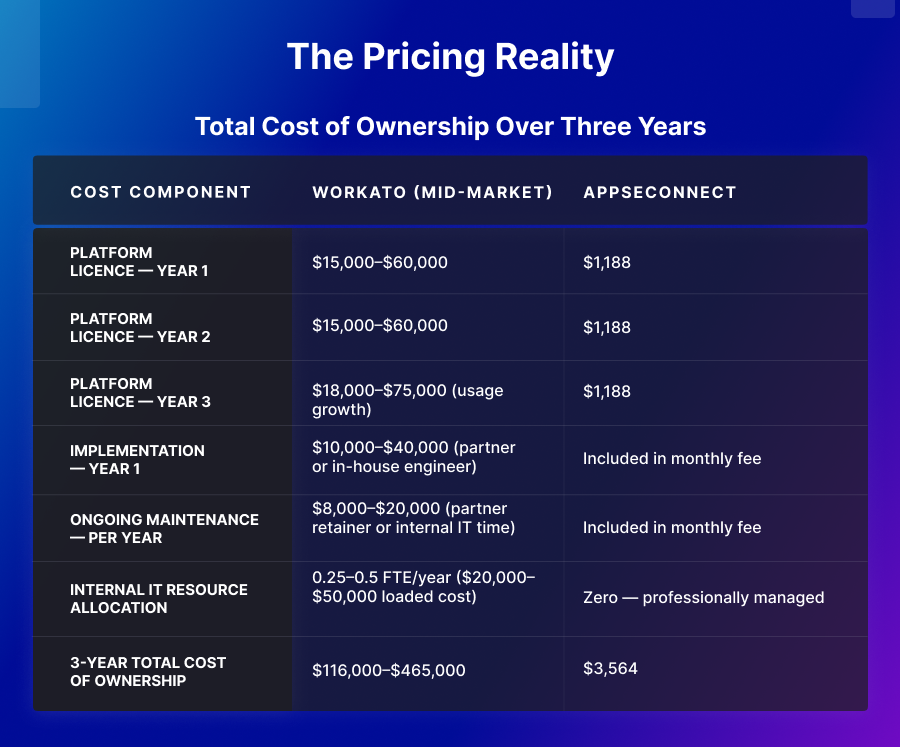
The range on the Workato side is wide because Workato deployments vary considerably in complexity. The APPSeCONNECT figure is not a range, it is a fixed cost across all three years regardless of order volume growth or integration complexity within the predefined package scope.
The comparison at the 3-year midpoint is approximately $290,000 vs $3,564 for a mid-market distributor running SAP Business One, Shopify, and Salesforce on five standard data flows.
That is not a case where one platform is marginally more expensive. It is a case where two entirely different commercial models are serving fundamentally different buyer profiles. Workato’s TCO makes sense for an enterprise organisation where integration is a strategic IT function requiring dedicated resource and maximum configurability. It does not make sense for an operations director at a £30M distributor who needs five data flows to work reliably so their team can stop doing manual order entry every morning.
What is your disconnected ERP actually costing you right now?
Use our ERP Integration ROI Calculator to see your annual cost of manual ERP management and your first-year return at $99/month.
The Ruby Problem - What G2 Reviews Tell You That Workato Sales Calls Do Not
This deserves its own section because it is the single most consistent source of post-purchase dissatisfaction among mid-market Workato buyers.
Workato markets itself as a low-code platform that empowers business users to build integrations without developer dependency. In its simplest use cases, connecting two SaaS tools, triggering a Slack message when a Salesforce opportunity closes, moving records between a CRM and a marketing platform, this is accurate. Business users can build these workflows using Workato’s recipe builder.
ERP integration is a fundamentally different category of complexity. Connecting SAP Business One to Shopify requires handling Business Partner lookup and creation logic, document chain sequencing, multi-warehouse inventory commitment, A/R Reserve Invoice structure, and tax code mapping at the document level. None of these are achievable with simple field mapping in Workato’s visual recipe builder.
The Workato solution to this complexity is its universal connector, which allows custom integration logic to be written, in Ruby. Ruby is a programming language. It is not a visual tool, not a low-code environment, and not something your operations manager or IT generalist can pick up in an afternoon.
From G2 reviews of Workato from mid-market ERP users, a consistent pattern emerges: “We were told it was low-code and then discovered we needed a Ruby developer.” “The recipe builder works for simple things but as soon as we needed to handle our SAP logic, we needed our developer involved constantly.” “The pricing model and the Ruby requirement were not explained clearly during the sales process.”
This is not a hidden flaw in Workato. For enterprise buyers with dedicated integration developers, Ruby scripting is a feature, it provides maximum customisation control. For mid-market buyers without that resource, it is a barrier that was not surfaced before the contract was signed.
APPSeCONNECT requires no scripting, no developer resource, and no internal IT configuration. The integration logic for SAP Business One, Dynamics BC, NetSuite, and Sage 300 is pre-built. The APPSeCONNECT team configures your specific ERP instance, your applications, your warehouse structure, and your business rules. Your team provides the business requirements. The team delivers a working integration.
What Mid-Market ERP Users Actually Need From Integration
The conversation about iPaaS platforms is often dominated by enterprise use cases, connecting 50 systems across HR, Finance, Marketing, IT Operations, and Supply Chain simultaneously. That is a legitimate enterprise automation problem, and Workato is well-positioned to solve it for organisations with the budget and technical team to match.
Mid-market manufacturers and distributors have a different problem. It is not about connecting 50 systems. It is about connecting two to four systems, ERP, eCommerce, CRM, and sometimes a 3PL or shipping platform, and making five data flows work correctly in real time.
These five data flows are: Orders flowing from the channel into the ERP as correctly structured documents. Inventory flowing from the ERP to the channel in real time to prevent overselling. Customer records creating correctly in the ERP from channel buyers. Payments creating with the correct document structure for finance reconciliation. Fulfilment status flowing back to the channel when the ERP processes delivery.
That is the entire integration requirement for the vast majority of mid-market distributors and manufacturers. Five data flows. Two to four systems. Real-time. Professionally managed.
Workato can technically connect all of these systems. The challenge is that connecting them generically, without ERP-specific data model knowledge, produces integrations that work at 20 orders per day and begin to surface errors at 50 orders per day, with systematic failures at 200+ orders per day as Business Partner mismatches, document chain errors, and API rate limit problems compound in the SAP B1 or Dynamics BC environment.
APPSeCONNECT solves exactly this problem. Its predefined packages are not simplified versions of a broader integration platform. They are purpose-built for these five data flows in these specific ERPs, tested across 5,000+ production deployments, and managed by specialists who have seen every variant of SAP B1 configuration, Dynamics BC dimension structure, and Shopify order type that exists in mid-market operations.
Production Evidence - Not Hypothetical Scenarios
Every claim in this comparison is supported by production outcomes. These are not simulations or projected results.
Nine Line Apparel – USA
Nine Line Apparel processes 1,500+ orders per day across SAP Business One, BigCommerce, and ShipStation. Before APPSeCONNECT, their previous connector, a generic integration, ran a Business Partner mismatch rate of 3-4%. At 1,500 orders per day, that is 45-60 orders per day falling into a manual error queue requiring operations team intervention.
After APPSeCONNECT’s SAP B1-native tripartite integration:
- Business Partner mismatch rate: 0.1% (down from 3-4%)
- Workflow success rate: 90% sustained in production
- Orders per day handled automatically: 1,500+
- Manual order entry remaining: zero
“The APPSeCONNECT team was very quick to respond to changes in direction and always handled these changes as a priority. They were able to handle multiple touch points across all aspects of our ERP.” – Robert Donnelly, Nine Line Apparel
Richardson Sports – USA (Global)
Richardson Sports runs SAP Business One managing 8,000+ active B2B accounts globally across Magento B2B, with 7,500 SKUs synchronised. Customer-specific pricing, a different price list per account in SAP Business One, flows correctly to every Magento account on every order. Zero manual pricing intervention. Zero order rejections due to incorrect pricing. This is precisely the scenario where a generic Workato connector cannot handle the SAP B1 price list → B2B eCommerce portal mapping logic, because that mapping requires understanding SAP’s price list object structure, not just reading a price field from an API.
All Marine Spares – Australia
All Marine Spares is an Australian marine parts distributor whose operations team was spending 10-20 hours per week on manual ERP management before APPSeCONNECT integration. The integration recovered AU$65,000-$131,000 per year in operational capacity, time redirected from data entry to customer service and business development.
“We are saving significant time weekly in our business” – Jason Mitchell, Managing Director, All Marine Spares
When Workato Is the Right Choice
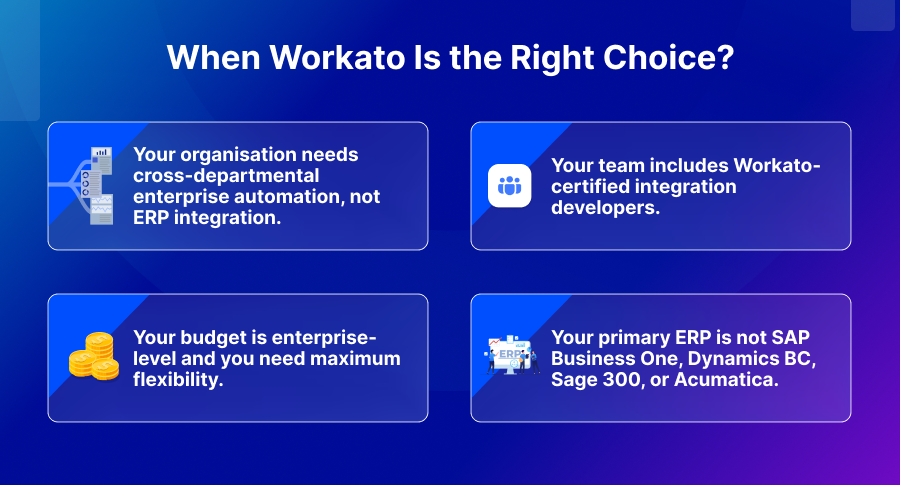
Clarity about when a competitor is genuinely better serves the reader and builds the trust that drives conversion. Workato is the right choice in the following scenarios.
Your organisation needs cross-departmental enterprise automation, not ERP integration
If your requirement spans HR, Finance, IT Operations, Marketing, and Sales simultaneously, connecting Workday, ServiceNow, Salesforce, Marketo, and Slack in interconnected workflows, Workato’s recipe-based approach and 1,000+ connector library is purpose-built for this. APPSeCONNECT’s predefined packages are scoped for ERP + application integration. They are not a horizontal enterprise automation platform.
Your team includes Workato-certified integration developers
If you have dedicated integration engineers comfortable with Ruby scripting and Workato’s recipe builder, the platform’s configurability becomes a genuine advantage. Custom transformation logic, branching conditional workflows, and sophisticated error handling are all achievable with the right resource behind the platform.
Your budget is enterprise-level and you need maximum flexibility
If your integration strategy is a multi-year, multi-system programme with an annual budget in the $60,000-$200,000 range, Workato’s enterprise feature set, AI orchestration, API management, B2B/EDI capabilities, returns value at that investment level.
Your primary ERP is not SAP Business One, Dynamics BC, Sage 300, or Acumatica
Workato’s generic connectors work reasonably well for ERPs where the integration complexity is lower, systems with more straightforward API structures and less document-chain dependency. If your requirement is connecting Salesforce to a simple SaaS tool, Workato’s native Salesforce capability is strong.
When APPSeCONNECT Is the Right Choice
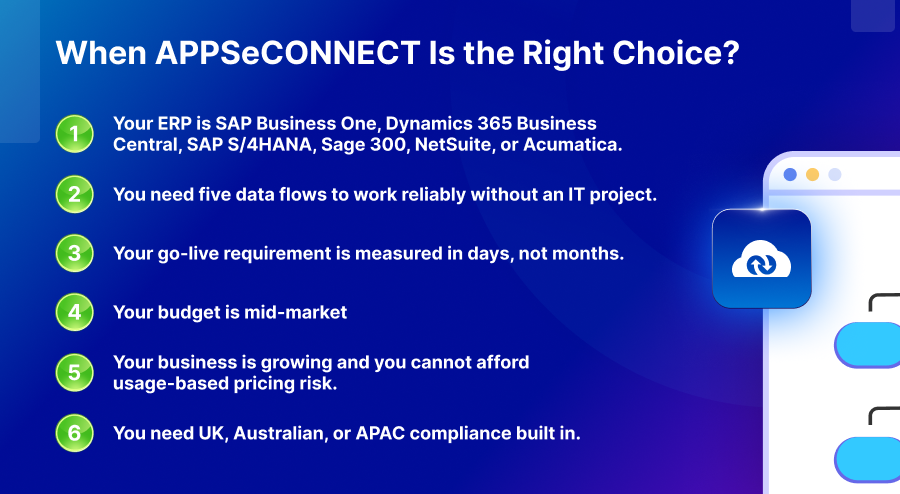
Your ERP is SAP Business One, Dynamics 365 Business Central, SAP S/4HANA, Sage 300, NetSuite, or Acumatica
These ERPs require connector logic that understands their specific data models, Business Partner objects, document chains, posting groups, dimension values, price list structures, and API version compatibility. APPSeCONNECT has built and certified this logic across all 15 ERP systems over ten years of production deployments.
You need five data flows to work reliably without an IT project
Orders, Inventory, Customers, Payments, Fulfilment. If that is your requirement, and for most mid-market distributors and manufacturers it is, APPSeCONNECT’s predefined package was built specifically for this problem. It does not need to be configured from scratch. It needs to be applied to your specific ERP instance.
Your go-live requirement is measured in days, not months
The predefined package means the core integration architecture is already built and tested in production. Configuration covers your specific warehouse structure, customer price lists, and ERP version. That takes hours to three business days, not the 4-16 week implementation project that a Workato deployment requires.
Your budget is mid-market
The $99/month starting price is not a limited or stripped-down offering. It is the full predefined integration package for your ERP + application combination, with professional management included. The business case for integration at this price point is straightforward, most mid-market distributors recover the annual cost in the first week of eliminating manual order entry.
Your business is growing and you cannot afford usage-based pricing risk
Fixed pricing at $99/month means your integration cost is identical whether you process 100 orders per day or 1,500. For a growing manufacturer or distributor, this pricing architecture protects your margins as volume scales.
You need UK, Australian, or APAC compliance built in
APPSeCONNECT’s UK packages include HMRC Making Tax Digital VAT code mapping, UK GDPR-compliant data processing, and post-Brexit multi-currency handling. Australian packages include GST/BAS configuration and Payday Super reform readiness effective July 2026. These are included in the standard managed service, not sold as compliance add-ons.
The AI Automation Comparison - appse ai vs Workato Genies
Both platforms have invested significantly in AI-driven automation. The strategic vision and the practical application are different in ways that matter to mid-market buyers.
Workato Genies are AI agents designed to operate within Workato’s enterprise automation ecosystem. They can analyse data across connected systems, take conditional actions based on that analysis, and orchestrate workflows autonomously. Workato’s Agent Studio allows developers to build custom AI agents that integrate with enterprise systems. Workato’s Enterprise MCP (Model Context Protocol) connects AI agents to enterprise data sources. These are sophisticated capabilities built for organisations with integration developers and enterprise AI strategies.
appse ai APPSeCONNECT’s AI automation layer that operates at the business process level for mid-market ERP operations. The 100+ pre-built AI agents are designed to automate specific operational workflows without requiring developer configuration. The eight agent categories map directly to the operational processes that mid-market manufacturers and distributors run every day:
- Order-to-Cash agents (12): Sales order processing, fulfilment, revenue recognition, dispute resolution
- Procure-to-Pay agents (10): Purchase requisition, PO creation, 3-way match, payment scheduling
- Finance and AP/AR agents (11): Invoice matching, payment reconciliation, credit management, month-end close
- Operations and Inventory agents (9): Stock replenishment, warehouse optimisation, demand forecasting, returns
- Sales, CRM and Customer agents (9): Lead scoring, quote generation, account health monitoring, churn prediction
- Production and Manufacturing agents (8): Production scheduling, BOM management, quality hold, OEE monitoring
- Reporting, Analytics and AI agents (8): Exception reporting, KPI dashboards, anomaly detection, performance analytics
- HR, Expense and Compliance agents (6): Expense approval, policy compliance, payroll validation, audit trail
The Autonomous Workflow Builder allows a business user to describe a desired workflow in plain language. The system builds the workflow automatically, no developer, no Ruby scripting, no recipe builder. A distribution manager can describe “When a purchase order is approved in SAP Business One, create a corresponding record in our supplier portal and notify our logistics team” and have that workflow operational within minutes.
AutoDetect is APPSeCONNECT’s proactive monitoring system that identifies integration failure patterns before they compound. It does not wait for a failed order to appear in an error queue. It recognises the conditions that precede failure, a specific Business Partner mismatch pattern, an API rate limit approaching threshold, a warehouse mapping configuration beginning to drift, and alerts the managed service team before the failure occurs.
The distinction between the two AI approaches is the buyer they serve. Workato Genies serves enterprise IT teams building sophisticated cross-system automation strategies. appse ai serves operations directors and finance managers at mid-market manufacturers and distributors who want specific business processes to run autonomously without building them from scratch.
Addressing the Real Objection - "Is APPSeCONNECT as Capable as Workato?"
The honest answer to this question depends entirely on what “capable” means for your specific requirement.
If capable means “can connect 1,000+ applications with custom transformation logic across HR, IT, Finance, and Marketing in a single enterprise automation platform”, Workato is more capable for that use case than APPSeCONNECT’s predefined packages.
If capable means “can create a correctly structured SAP Business One Sales Order from a Shopify order in real time, handle Business Partner matching without creating duplicates, pair the Incoming Payment with an A/R Reserve Invoice carrying the gateway transaction ID, and push the confirmed delivery tracking back to Shopify when the SAP B1 Delivery document is posted”, APPSeCONNECT is more capable than Workato for that use case. Significantly more capable. Not because Workato’s platform cannot in theory connect these systems, but because APPSeCONNECT’s SAP B1-certified connector has the ERP-specific knowledge built in that Workato’s generic connector requires Ruby scripting and custom configuration to approximate.
Capability is always relative to requirement. The question to ask is not “which platform is more capable in absolute terms” but “which platform is more capable for my specific ERP integration requirement at my specific scale and budget.”
For 5,000+ mid-market manufacturers and distributors running the 15 ERPs APPSeCONNECT supports natively, that answer has been consistent across ten years of production deployments.
What G2 Users Say - The Unfiltered Pattern
Rather than paraphrasing competitor weaknesses, here is the structured pattern across public G2 reviews of both platforms as of early 2026.
Workato – recurring positive review themes: Comprehensive workflow automation capability. Strong for SaaS-to-SaaS departmental automation. Good recipe library for standard use cases. Strong customer success engagement. AI features genuinely useful for enterprise automation planning.
Workato – recurring negative review themes (particularly relevant for mid-market ERP buyers): Pricing: “Costs increased significantly as we scaled our automation volume.” “The usage-based model made budgeting difficult.” “Pricing was not transparent until contract negotiation.”
Ruby requirement: “We were told it was low-code but needed a Ruby developer for our ERP logic.” “The recipe builder works for simple flows but complex ERP scenarios required scripting.” “Ruby dependency was not communicated clearly in the evaluation.”
ERP complexity: “Our SAP connector required significant custom work.” “Dynamics integration needed more configuration than expected.” “Support for our ERP was less mature than the SaaS connectors.”
Implementation time: “Go-live took considerably longer than projected.” “We needed a Workato partner which added significant cost and timeline.”
APPSeCONNECT – recurring positive review themes (G2 Winter 2026 Leader): ERP-specific expertise. SAP Business One integration reliability. Fast go-live timeline. Managed service quality, specifically the response time and proactivity of the APPSeCONNECT team. Finance team satisfaction with payment document structure. AutoDetect’s proactive error prevention.
Making the Decision - A Direct Three-Question Framework
These three questions will resolve the comparison for most mid-market buyers.
Question 1: What is your core integration requirement?
- Cross-department enterprise automation spanning HR, IT, Finance, Marketing, and Sales simultaneously → Workato is designed for this. Evaluate based on budget and team capability.
- ERP + eCommerce, ERP + CRM, or ERP + 3PL/shipping integration → APPSeCONNECT’s predefined packages are purpose-built for this. Workato requires custom configuration to approximate the same result.
Question 2: Do you have a Ruby-capable integration developer or a Workato implementation partner budgeted?
- Yes, available and budgeted → Both platforms are viable. Evaluate on ERP fit and total cost.
- No, operations director or IT generalist is managing this → APPSeCONNECT’s professionally managed model is the correct fit. Workato’s self-managed model requires a resource profile that most mid-market organisations do not have.
Question 3: Is your integration budget under $10,000 per year?
- Yes → APPSeCONNECT is the only platform in this comparison that delivers full ERP integration capability within this budget. Workato cannot be deployed at this price point for a mid-market ERP integration use case.
- No, budget is $40,000+/year → Both platforms are within budget. Evaluate on ERP fit, management model, and whether you need horizontal enterprise automation or ERP-specific integration.
The Conversion Decision
If you reached this section, the comparison has given you what you need to make a directional decision.
If your ERP is SAP Business One, Dynamics 365 Business Central, Sage 300, Acumatica, or NetSuite, and your requirement is five data flows working reliably, professionally managed, at a mid-market price point, APPSeCONNECT is the platform built for your situation. Workato is not.
If you are still in evaluation and want confirmation that the predefined package covers your specific ERP, application, warehouse configuration, and geography before committing to any platform, fill in the integration requirement form below. An integration specialist who works specifically with your ERP will confirm your scope, go-live timeline, and exact pricing within one business day. There is no obligation, no discovery call framing, and no generic platform demo. It is a scope confirmation relevant to your specific situation.
If you are already on Workato and the Ruby requirement, the usage-based pricing growth, or the SAP/Dynamics connector limitations have become operational problems, contact the team to discuss a structured transition. The conversation starts with your existing integration scope and what a managed replacement would look like.
Frequently Asked Questions
Yes, for mid-market manufacturers and distributors running SAP Business One, Dynamics 365 Business Central, NetSuite, Sage 300, or Acumatica. APPSeCONNECT is a professionally managed, ERP-native integration platform starting at $99/month. Workato starts at $15,000-$60,000/year for mid-market deployments, requires integration engineers or a Workato partner to configure and maintain, and does not have native SAP Business One or Dynamics BC data model knowledge. For ERP + eCommerce or CRM integration in the mid-market, APPSeCONNECT is purpose-built for the use case Workato requires significant customisation to address.
Workato is priced for enterprise organisations with dedicated integration teams, complex multi-system automation requirements, and annual software budgets that accommodate $60,000-$180,000 in platform spend. The pricing reflects its enterprise positioning and its usage-based model that scales with automation volume. APPSeCONNECT’s $99/month pricing reflects a predefined, professionally managed package for specific ERP + application integration, five core data flows, professionally managed, fixed price regardless of order volume. The two platforms serve different market segments with different commercial models.
Workato offers a SAP Business One connector, but it is a generic API connector without native SAP B1 data model knowledge. It does not natively handle Business Partner matching logic, A/R Reserve Invoice + Incoming Payment document pairing, multi-warehouse inventory commitment, or SAP B1 document chain sequencing. These require custom Ruby scripting to approximate in Workato. APPSeCONNECT’s SAP B1 connector handles all of these natively, built against SAP’s certified integration specifications as an SAP Certified Partner.
Workato charges based on recipe runs and task execution volume. As your business grows, more orders processed, more inventory updates, more customer records synced, your Workato costs grow in parallel. Several mid-market Workato users report significant and unexpected pricing increases as integration volume scaled with business growth. APPSeCONNECT’s fixed $99/month pricing is identical at 100 orders per day and 2,000 orders per day. For growing businesses, fixed pricing provides budget predictability that usage-based pricing cannot.
APPSeCONNECT predefined packages go live in 2 hours to 3 business days. Workato implementations for mid-market ERP integration typically require 4-12 weeks with a certified Workato implementation partner or an in-house integration engineer. The difference is the predefined package architecture, APPSeCONNECT’s core SAP B1, Dynamics BC, or NetSuite integration logic is already built. Configuration covers your specific ERP instance, applications, and business rules, not building the integration from scratch.
APPSeCONNECT holds SOC 2 Type II certification, ISO/IEC 27001 certification, and operates in full compliance with GDPR and UK GDPR. For Australian operations, it supports ATO data residency requirements. These certifications are at the same standard as enterprise iPaaS platforms. APPSeCONNECT’s SOC 2 Type II specifically validates that security controls are operating effectively over time, not just designed correctly at a single point in time.
No. As part of the professionally managed service, APPSeCONNECT monitors and maintains API compatibility across ERP and application version updates. When SAP releases a Business One update or Shopify modifies its API, APPSeCONNECT’s team handles the integration-side updates. With a self-managed Workato deployment, your team or Workato partner is responsible for identifying and resolving API compatibility issues when they occur.
If your Workato deployment is primarily ERP + eCommerce or ERP + CRM integration for mid-market operations, SAP Business One, Dynamics BC, NetSuite, or Sage 300 connecting to Shopify, BigCommerce, WooCommerce, Salesforce, or HubSpot, then APPSeCONNECT’s predefined packages can handle the same integration scope with significantly lower cost, ERP-native connector logic, and professional management. The transition is structured: APPSeCONNECT scopes your existing integration, maps it to the predefined package, and manages a parallel run validation before cutting over. Contact the team to discuss the specifics of your Workato replacement.