






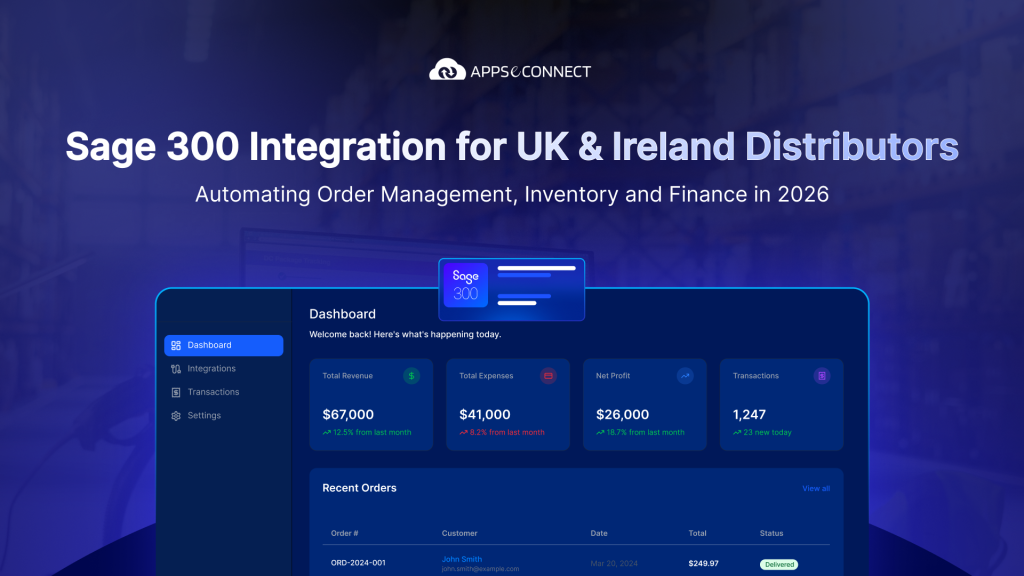
Sage 300 is still a strong ERP for many distributors across the UK and Ireland. It handles finance well, supports multi-currency work, and gives teams a steady base for daily operations. The real problem is not Sage 300 itself. The problem starts when orders, stock, payments, fulfilment, and customer data are all moving through other systems that do not stay connected to it.
At APPSeCONNECT, we solve that gap with ERP-first integration. APPSeCONNECT is the integration platform, and appse ai is the AI capability layer of APPSeCONNECT. Together, they help businesses connect Sage 300 with Shopify, WooCommerce, payment tools, logistics systems, and other platforms so the business can run with less manual work, cleaner stock visibility, and stronger finance control.
The Sage 300 Landscape in the UK and Ireland: Who Uses It and Why Integration Matters
Sage 300 has been part of the mid-market for a long time across the UK and Ireland. Many distributors, importers, industrial suppliers, construction-related sellers, and multi-entity businesses still rely on it as the main finance and ERP system. That is one reason Sage 300 remains a trusted finance core for these businesses. It handles the general ledger well, supports more than one company, works across currencies, and gives finance teams a structure they trust.
But the way these businesses operate in 2026 goes beyond what the ERP was originally built to handle. A distributor may run Sage 300 as the finance core while also using Shopify or WooCommerce for ecommerce, email and phone for trade orders, external warehouse or fulfilment partners, payment tools, and separate payroll software. Each one may do its job well, but if the systems do not stay connected, the team ends up doing the same work again in different places.
That is where the real cost starts. An order comes in through Shopify, and someone still has to create or check it in Sage 300. Stock changes in the warehouse, but the store is still showing an older number. Customer details are updated in one platform, but not in the other. Finance then has to pull numbers from several places before it can trust what the books are saying. The systems are all running, but the operation still depends heavily on manual work.
This is the common pattern we see at APPSeCONNECT. A business may be at £5 million in revenue or at £50 million, but the pressure points often look the same. Order entry takes too long. Inventory and storefront numbers drift apart. VAT treatment is checked too late. Finance closes slower than it should. That is why Sage 300 integration UK Ireland projects are no longer only about convenience. For many businesses, they are now core operational work.
Order entry overhead
Take order entry as one example. A distributor can process hundreds of orders each week across trade accounts, direct ecommerce, and repeat buyers. If those orders still need manual handling before they become Sage 300 Sales Orders, the business is spending paid time on work that should already be automated. That is not only a labour problem. It is also a speed problem. The order is already behind before the warehouse has even seen it.
Inventory discrepancies
Inventory is another obvious pain point. Sage 300 often holds the most accurate stock position, but the ecommerce storefront shows what was true some time ago. That gap is where oversells begin. The customer places the order because the website says the item is there, while the ERP already knows it is not. Then the business has to cancel, explain, refund, or repair the relationship. Good Sage 300 inventory sync UK setups are not just technical improvements. They protect trust and save margin.
VAT treatment errors
VAT treatment is another reason integration matters more now. UK businesses cannot afford to let tax handling drift between the storefront and the ERP. If orders are moved by hand, VAT codes are more likely to be applied late, inconsistently, or incorrectly. That creates extra finance work later, especially when the team is already under pressure to keep records clean for Making Tax Digital.
Finance close overhead
Finance close also becomes harder when the data is scattered. A team may need to pull sales data from Shopify, payment records from another system, and stock-related costs from somewhere else before it can even begin to close the period properly. That is not a good use of finance time. It delays reporting and makes the whole business slower to understand what actually happened.
This is why APPSeCONNECT treats Sage 300 as the centre of the process. We connect the systems around it so orders, stock, customers, payments, and fulfilment stay closer to one shared truth. Then appse ai adds AI-led monitoring, exception handling, and better visibility on top of that connected flow. The result is not only cleaner data. It is a calmer operation with much less repair work in the background.
Case Study: PPE Online — Reduced Manual Work, Aligned Systems
PPE Online is a useful example because it shows the kind of problem many distributors in the UK and Ireland already have. The business runs a Shopify storefront alongside Sage 300, with Sage acting as the ERP and finance system of record. On paper, that looks like a sound setup. In real day-to-day work, the gap between the two systems created more manual effort than it should have.
The Challenge
Before APPSeCONNECT, PPE Online had to manage the movement between Shopify and Sage 300 in a more manual way. Orders placed online needed extra effort before they were properly reflected in the ERP. Inventory had to be watched more closely because the store and Sage were not always aligned. Financial records also needed more work before period-end reporting could be handled with confidence. The business had the right systems, but the systems were not behaving like one process.
This kind of problem is easy to underestimate because it builds slowly. One team member spends time checking orders. Another keeps an eye on stock mismatches. Finance spends extra time before reporting. Nobody may call it a crisis, but the business still keeps losing time to work that should not exist. That is exactly the kind of hidden cost APPSeCONNECT is built to remove.
The Solution
Our APPSeCONNECT Sage 300 and Shopify integration automated the main data flows between the two systems. Shopify orders could move into Sage 300 as Sales Orders with the right structure. Inventory updates could move from Sage 300 back to Shopify so the storefront stayed more current. Customer data could also stay more aligned between the systems instead of drifting apart. This gave PPE Online a cleaner operating flow without forcing the team to keep bridging the gap by hand.
Once the integration was live, the result was straightforward. PPE Online reduced manual work, improved inventory alignment, and kept Shopify and Sage 300 much closer together throughout daily operations. That meant the team no longer had to spend the same amount of effort on data movement and checking. Instead, they could focus more on service, products, and growth.
The Outcome
There was a finance benefit as well. When sales and order records move into Sage 300 in a cleaner way, reporting becomes easier. That matters for VAT handling, period-end review, and general confidence in the numbers. For distributors in the UK and Ireland, that is one of the most practical reasons Sage 300 ecommerce integration matters. It is not only about the online store. It is about what finance has to do later because of the online store.
PPE Online shows the value of this clearly. The business did not need a bigger team. It needed a better system flow. APPSeCONNECT created that integration base, and appse ai adds an AI capability layer on top so teams can watch those flows more easily, identify issues faster, and keep the connected environment more stable over time.
Key Sage 300 Integration Use Cases for Distributors in the UK and Ireland
The clearest place to start is order management. When a customer places an order on Shopify or WooCommerce, the order should move into Sage 300 automatically as a Sales Order. That includes the account name, addresses, item lines, freight, order date, totals, discounts, and customer details. If this still has to be entered manually, the business is repeating work that should already be handled by the system. This is one of the core strengths UK businesses expect from Sage 300 Shopify integration.
Order Management: Shopify/WooCommerce to Sage 300
Tax handling is also part of that order flow. It is not enough to move the order amount alone. The order has to carry the right VAT treatment into Sage 300 as well. APPSeCONNECT helps make sure VAT-inclusive and VAT-exclusive pricing is handled in line with the item’s setup in Sage 300, so the Sales Order created in the ERP reflects the right tax position from the start.
Guest orders matter too. Many businesses still get orders from customers who have not created a full account. The integration should still be able to move that order into Sage 300 cleanly instead of making the team create records manually just because the customer did not sign up in a certain way.
Customer Sync: Bidirectional
Customer sync is another major use case. New customers created on Shopify or WooCommerce can be created in Sage 300 with their address and contact details. Existing Sage 300 customer records can also sync back to the ecommerce platform. That matters for businesses running both B2C and B2B activity because customer data can become messy quickly if each side is being updated in isolation. Better customer sync means less duplication, fewer corrections, and cleaner account handling.
Inventory Management: Sage 300 to Shopify/WooCommerce
Inventory management is one of the most visible wins. Product data such as item codes, descriptions, and prices can move from Sage 300 to the ecommerce store, and stock levels can update as inventory changes in the ERP. If the business has several stock locations, APPSeCONNECT can map one or more Sage 300 warehouses to ecommerce inventory positions. This gives customers a more current view of availability and helps the team avoid the oversell problem that comes when the store is working from stale data.
For distributors with seasonal demand, this is especially useful. A product may move quickly for a short period, and a delayed update is enough to create a chain of cancellations and customer frustration. Strong Sage 300 inventory sync UK processes help prevent those problems before they start.
Fulfilment Status: Sage 300 to Shopify/WooCommerce
Fulfilment updates are another key part of the cycle. When a delivery is processed in Sage 300, the ecommerce platform should reflect that change automatically. Customers should not have to wait for someone to update the order status by hand. When tracking or shipping confirmation flows back to the store, the customer experience becomes smoother and the support team gets fewer “where is my order?” questions.
Financial Reconciliation
Then there is payment and financial reconciliation. Orders paid through the ecommerce platform need to show up inside Sage 300 with the right payment status so the finance team does not have to cross-check every record against bank or payment data manually. This matters because finance already carries enough pressure at period-end. A connected payment flow helps reduce that load and gives the team a much cleaner base to work from.
These use cases matter because they connect the whole business, not just one department. Order handling, customer records, stock visibility, fulfilment status, and finance all affect each other. APPSeCONNECT connects those flows around Sage 300 as the system of record. appse ai then adds another layer of support by helping teams watch live data movement, spot exceptions earlier, and keep the connected environment running with less manual checking and stronger day-to-day control.
UK-Specific Compliance Considerations: MTD and VAT
For businesses in the UK and Ireland, integration is not only an operations issue. It is also a compliance issue. The cleaner the data is when it enters Sage 300, the easier it is for finance to keep VAT and reporting work under control later. That is why APPSeCONNECT does not treat tax as an afterthought inside the order flow.
Making Tax Digital readiness
Making Tax Digital has changed the pressure on finance teams. It is not enough to gather everything together at the end of the period and hope the numbers line up. Businesses need cleaner digital records through the whole reporting cycle. That means the VAT treatment attached to each ecommerce order must already be right when it enters Sage 300, not corrected in a rush before the submission deadline.
This is one of the most important reasons for Sage 300 MTD compliance work. APPSeCONNECT helps carry VAT logic from Sage 300 into Shopify or WooCommerce order flows so the tax position remains more consistent. The business is not relying on an operator to remember the right treatment at the point of manual entry. Instead, the ERP logic stays closer to the transaction from the beginning.
That matters because VAT problems often do not look dramatic on day one. They show up later when the finance team starts preparing reports and sees that one channel has treated a group of transactions differently from another. By then, the time pressure is already higher, and the fix takes longer than it should. A better integration flow reduces that pressure by helping the business stay cleaner throughout the quarter.
Multi-currency handling
Multi-currency is another important point. Many distributors across the UK and Ireland work with suppliers or customers beyond one domestic market. GBP may be the base currency in Sage 300, but the business may also handle EUR and other currencies. APPSeCONNECT supports that mapping so ecommerce orders and related transactions can move into Sage 300 in a way that still keeps the financial picture structured and more dependable.
Post-Brexit customs documentation
There is also a practical point around post-Brexit landed costs. Some UK distributors still need to manage freight, insurance, and import-related costs carefully across product lines. If those costs are being handled manually or outside the ERP for too long, inventory valuation and finance reporting both become harder to trust. APPSeCONNECT supports landed cost allocation as part of the broader integration approach, so those costs can be handled in a more consistent and reviewable way inside Sage 300.
This is one of the reasons we say APPSeCONNECT is different from a generic app automation tool. We are not simply moving store data into the ERP. We are making sure the ERP-first logic of tax, financial treatment, and record accuracy stays at the centre of the process. appse ai then adds AI-led support on top of that by helping monitor VAT treatment and identify unusual patterns before they become reporting problems.
APPSeCONNECT Sage 300 Connector Capabilities
APPSeCONNECT’s Sage 300 connector is not limited to Shopify alone. It is designed to support the wider operating environment that distributors across the UK and Ireland actually use. That may include ecommerce platforms, CRM tools, logistics partners, and finance or payment tools sitting around the ERP.
On the ecommerce side, APPSeCONNECT supports Shopify, WooCommerce, Magento or Adobe Commerce, BigCommerce, Amazon, and eBay. On the CRM side, it supports tools such as Salesforce, HubSpot, and Zoho CRM. On the logistics side, it supports platforms such as ShipStation, ShipBob, FedEx, and DHL. It can also connect to payment and finance tools such as Stripe, PayPal, and Xero in businesses running mixed finance processes.
What matters most is that Sage 300 remains the system of record. We do not treat the ERP as one more app in a loose chain. APPSeCONNECT makes the ERP the governing layer and validates key transactions against Sage 300 before the rest of the flow moves forward. That ERP-first control is one of the biggest reasons the platform works well for distributors, not just for light online stores.
The pre-built Sage 300 and Shopify connector includes the core mappings most businesses need, including orders, customers, inventory, and fulfilment. It also includes VAT mapping aligned with UK handling needs, support for more than one warehouse, and one-click package installation to shorten the go-live time. The ProcessFlow builder then allows the team to shape the workflow further without turning the whole project into a blank-canvas development job.
appse ai builds on top of this with AI-led capabilities that help distributors run the connected setup more smoothly. appse ai adds AI-led monitoring and visibility that help teams spot inconsistencies earlier, review payment-related issues faster, and manage connected processes with less manual checking.
This matters because integration is not only about getting data from point A to point B. It is also about reducing the exception-handling burden after go-live. APPSeCONNECT provides the integration layer, while appse ai helps teams monitor, manage, and improve that connected flow over time.
Implementation Timeline and Pricing for Distributors in the UK and Ireland
A lot of distributors delay integration because they assume it will take months and involve a large technical project. That is not how APPSeCONNECT works. Standard Sage 300 and Shopify integrations often go live within hours when the pre-built connector and normal data flows fit the business. More complex cases, such as multi-channel setups or special VAT handling, usually go live within days instead of dragging into long custom projects.
That speed comes from starting with tested packages, not from rushing a half-built setup. The main order, customer, inventory, and fulfilment mappings are already there. The team then shapes the details that matter to the business using the ProcessFlow builder. This makes the project much more practical for mid-market distributors who need a working result quickly but still want room for adjustment.
Pricing
Pricing starts at $99 per month, which sits at a much more realistic level for the mid-market than the large enterprise platforms many teams compare against first. There are no per-transaction fees or endpoint charges increasing the cost as more systems are connected. This clear pricing is one of the practical advantages of APPSeCONNECT for distributors in the UK and Ireland.
UK compliance configuration
The compliance-related configuration is also part of the standard connector approach, not a separate add-on. MTD-aligned VAT flow, GBP-based multi-currency handling, and landed cost support are built into the way the connector is configured. appse ai capabilities then sit on top of that base for businesses that want stronger AI-led monitoring and visibility across finance, compliance, and reconciliation processes.
For many distributors, the most important thing is not just the price. What matters most is speed to value. The business wants to stop losing hours every week to work that should not exist. APPSeCONNECT is built to solve that quickly and cleanly, without forcing the team into a long implementation that creates another operational problem before the first one is solved.
Connect Sage 300 to Your UK and Ireland Ecommerce Operation
If your Sage 300 environment is still disconnected from your ecommerce channels, APPSeCONNECT can help bring the operation back into one cleaner flow. We built APPSeCONNECT for distributors that need real-time inventory sync, cleaner order movement, stronger VAT handling, and less manual finance overhead without a long custom project.
APPSeCONNECT is the ERP-first integration platform, and appse ai is the AI capability layer that helps make the connected environment easier to watch and manage. Together, they give distributors in the UK and Ireland a practical way to reduce manual work and run Sage 300 as the true operating core again.
Frequently Asked Questions
It means Shopify orders can move into Sage 300 with VAT handling aligned to the ERP setup, which helps finance work from cleaner data throughout the period. That makes MTD-related reporting easier because the data is more consistent from the start.
APPSeCONNECT supports multi-currency movement between Shopify or WooCommerce and Sage 300, with GBP as the base currency where needed and exchange handling for EUR and other currencies.
Standard integrations usually go live within hours using the pre-built connector. More complex cases, such as multi-channel or special VAT logic, typically go live within days.
One or more Sage 300 warehouses can be mapped to ecommerce inventory locations. The business can choose how it wants availability shown, whether as a single quantity, combined stock, or another setup that fits the operation.
Beyond Shopify and WooCommerce, APPSeCONNECT also supports Sage 300 connections with Magento or Adobe Commerce, BigCommerce, Amazon, and eBay. appse ai works on top of that ERP-first integration base.
Accordion Content
Accordion Content
Accordion Content
Accordion Content
Accordion Content