





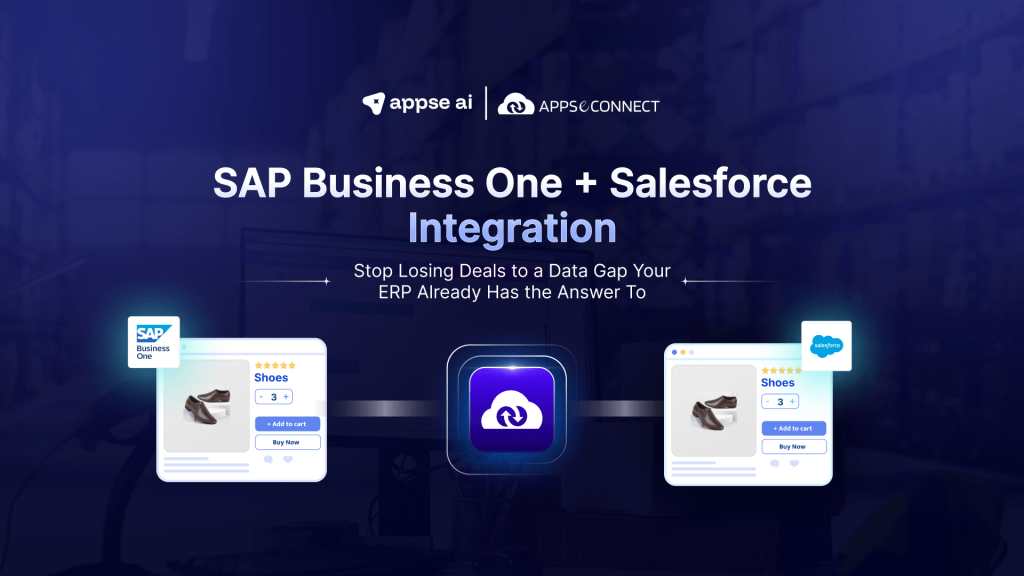
Your sales rep just closed a £180,000 deal. She promised delivery in 12 days, standard lead time based on what she’s seen before. The deal is logged in Salesforce. Champagne emoji in the team Slack.
Except SAP Business One tells a different story. That product line has been on backorder for three weeks. Nobody told Salesforce. Nobody could, the two systems have never been connected.
The customer finds out on day 13 when they call to ask about tracking. They don’t renew. They don’t refer. They leave a Google review.
This is not a sales problem. This is not a warehouse problem. This is a disconnected systems problem, and it is happening in your business right now, in some variation of this story, every single week.
|
$12.9M
Average annual cost of poor data quality (Gartner) |
67%
of B2B sales reps make decisions on stale CRM data (Forrester) |
60+ hrs
per month lost to manual SAP-Salesforce reconciliation in a typical mid-market business |
$99/mo
APPSeCONNECT managed integration, where the fix starts |
The Specific Ways a Disconnected SAP and Salesforce is Damaging Your Business Right Now
Most businesses know their ERP and CRM are not connected. What they underestimate is where the damage actually shows up, not in an obvious system failure, but in a hundred small friction points that quietly compound:
- Sales reps are quoting on gut feel because real-time SAP inventory isn’t visible in Salesforce
- Finance runs month-end reconciliation between Salesforce deal values and SAP invoices, typically 2-3 days of manual work
- Customer service toggling between two screens to answer a simple ‘where is my order?’ question
- CRM pipeline data that looks healthy but does not account for SAP backorders, credit holds, or fulfilment constraints
- New customer records created in Salesforce requiring manual re-entry into SAP, 20 to 40 minutes per customer
- Won deals sitting in Salesforce for 24-48 hours before anyone in operations knows to act on them
REAL SCENARIO – The Sales Director’s Board Pack It’s the Thursday before the board meeting. Your Sales Director is building the quarterly forecast. She pulls Salesforce pipeline data, it shows £2.1M of Q4 deals in “Commit.” What it doesn’t show: three of those accounts have open, overdue invoices in SAP that have triggered credit holds. Two of the products in the biggest deal are on 6-week back-order. The forecast lands on the board table. The questions start. She doesn’t have answers. Nobody connected the systems that would have given them to her.
|
REAL SCENARIO – The Operations Manager on a Monday Morning It’s 8:47am. The Operations Manager opens her email to find 14 Salesforce-to-SAP handoff emails from Friday afternoon. Each one is a closed deal that needs to become a SAP sales order. She starts entering them. By 11am, she’s on number 9. There are four errors from last week she’s still fixing. The warehouse is asking for fulfilment instructions on orders she hasn’t processed yet. This is every Monday. |
What APPSeCONNECT's SAP Business One + Salesforce Integration Actually Delivers
APPSeCONNECT is not a self-serve connector. It is a professionally managed, ERP-first integration platform, built by a team that has been implementing SAP integrations for over a decade. When we connect SAP Business One and Salesforce, we don’t just map fields. We map your business.
Bidirectional, Real-Time Data Flow
- Salesforce opportunities convert to SAP B1 sales orders automatically on deal close – zero manual handoff
- Real-time SAP inventory availability pushed into Salesforce – reps see live stock levels before every quote
- Customer master data stays synchronised across both platforms – one record, always current
- SAP invoice and payment status visible in Salesforce – your reps know the account health before every call
- Credit hold status from SAP surfaced in Salesforce, no more selling to accounts in financial arrears
- Delivery and fulfilment updates from SAP pushed back to Salesforce, CRM always reflects operational reality
The Transformation – Before and After APPSeCONNECT
BEFORE APPSeCONNECT
| AFTER APPSeCONNECT
|
Why Zapier, Make, and Generic Connectors Fail on SAP Business One
You will find dozens of tools that claim to connect SAP and Salesforce. Most of them will give you a basic contact sync and call it an integration. When your business logic gets involved, multi-location inventory, SAP document chains, Salesforce opportunity stages with conditional logic, they fall apart.
Here’s what actually separates APPSeCONNECT from tools like Zapier, Make, n8n, and even enterprise platforms like Celigo and Jitterbit:
Feature | Generic Tools (Zapier / Make / n8n) | APPSeCONNECT + appse ai |
SAP B1 Schema Depth | Maps surface fields only, no native SAP logic | 10+ years of native SAP B1 knowledge, business partners, item masters, document chains, price lists, all mapped correctly |
Bidirectional Sync | One-directional or fragile custom builds required | True bidirectional, SAP to Salesforce and Salesforce to SAP, configurable per entity and per business rule |
Business Logic | Rule-based triggers only, no ERP context awareness | Configurable business rules: credit checks, pricing logic, order routing, stock thresholds built into the flow |
Self-Healing | Failed syncs silently dropped or require manual retry | AutoDetect proactively identifies and self-heals broken flows before they cascade into order errors |
Implementation Model | Self-serve, your IT team builds, owns, and fixes | Fully managed, APPSeCONNECT team scopes, configures, tests, and supports |
ERP-First Architecture | Generic API connections, SAP is just another source | ERP-first platform, SAP is the system of record, everything integrates around it |
Price Predictability | Per-task pricing that scales unpredictably with volume | From $99/month, fixed scope, predictable cost, no surprise scaling charges |
Beyond Integration: appse ai - The AI-Powered ERP Automation Platform That Changes Everything
Most integration tools stop at connecting systems. appse ai goes further, it turns your connected SAP + Salesforce environment into an autonomous, AI-powered revenue engine that works for you 24 hours a day. appse ai is APPSeCONNECT’s AI-powered ERP automation platform, built specifically for mid-market companies that have invested seriously in ERP but have not yet been able to deploy AI against those systems. The platform levels the playing field: giving companies like yours the same AI transformation capability that enterprise businesses pay millions for, at a mid-market investment. |
ERP systems were never originally designed for AI. Most AI initiatives in mid-market businesses fail to deliver impact because they operate around the ERP, not inside it. appse ai is the only platform purpose-built to put AI to work inside your ERP-connected processes, where the real business value lives.
appse ai – Three Levels of AI-Powered ERP Automation | ||
L1 | Structured Workflow Automation | Point-to-point automation between SAP B1 and Salesforce, orders, inventory, customers, invoices, all flowing without human touch. Reliable, predictable, always on. |
L2 | AI-Enabled Workflows | The Autonomous Workflow Builder lets business users describe what they want in plain English, and appse ai builds the workflow. SmartScript converts natural language into transformation code. No developer, no delays. |
L3 | Enterprise AI Agents | 20+ pre-built AI agents that execute autonomous decisions across Finance, Revenue & Growth, Operations, Customer Experience, and Supply Chain. AutoDetect self-heals broken flows before they fail. FlowInsight explains every workflow in plain language. Your ERP works for you, even when no one is watching. |
What appse ai’s AI Agents Do For a SAP + Salesforce Business Specifically
- Sales Intelligence Agent: Monitors your Salesforce pipeline in real time. Cross-references SAP inventory availability, delivery lead times, and payment history. Proactively surfaces deal risk, before your rep makes a promise your ERP can’t keep.
- Revenue Forecasting Agent: Analyses SAP order backlog, open quotes in Salesforce, and historical conversion rates. Generates real-time revenue forecasts that reflect what SAP knows, not just what Salesforce shows.
- Customer Health Agent: Tracks SAP invoice aging, payment patterns, and order frequency for every Salesforce account. Alerts your customer success team to at-risk accounts before they churn, automatically, without a manual report.
- AutoDetect – Self-Healing Integration: Monitors every data flow between SAP and Salesforce. When a sync fails or an anomaly is detected, it diagnoses and corrects the issue automatically, no IT ticket, no data loss, no one finding out at month-end.
- Autonomous Workflow Builder: No other platform offers this. Describe the automation you want in plain English, ‘When a deal closes in Salesforce, create a SAP order and notify the warehouse’, and appse ai builds the workflow. Business users drive automation. Technical skills not required.
appse ai vs. The Market – What No Competitor Offers The Autonomous Workflow Builder is unique to appse ai. Zapier, Make, Workato, Celigo, n8n, Alluvia, and Boomi all require users to manually build workflows, step by step, field by field. appse ai is the only platform where a business user describes what they need in plain language, and the AI builds it. Combined with 20+ pre-built AI agents, model-agnostic AI (bring your own OpenAI, Gemini, or Anthropic model), and an ERP-first architecture, appse ai is the only AI automation platform that was built from the ground up for the way mid-market businesses actually operate. |
Is This Integration Right for Your Business?
APPSeCONNECT’s SAP Business One + Salesforce managed integration is built for:
- Mid-sized manufacturers, distributors, and professional services firms running SAP Business One as their ERP
- Businesses with active Salesforce deployments (Sales Cloud, Service Cloud, or Revenue Cloud) and growing deal volumes
- Operations and Sales leaders who are tired of managing a manual handoff process between CRM and ERP
- Finance teams that need SAP invoice and payment data visible in Salesforce for credit management and upsell decisions
- IT Directors who want an integration that their team doesn’t have to build, maintain, or fix
- CEOs and COOs at £5M-£100M businesses who want AI transformation without replacing their ERP investment
Not sure if this fits your setup? Book a free 30-minute scoping call. We will review your SAP Business One version, your Salesforce setup, the data entities you need to sync, and give you a fixed-scope quote, with no obligation. Most mid-market SAP + Salesforce integrations are live in 4-8 weeks. Some are faster. We will tell you exactly what yours will look like, before you commit to anything. |
Ready to Connect SAP Business One and Salesforce?
Every week you run disconnected systems is another week of lost hours, avoidable errors, and deals at risk. The integration exists. The AI automation layer exists. It starts at $99/month.
The question is not whether to do this. The question is how quickly you want it live.
|
Three ways to start today Book a 30-min integration consultation, we scope your setup and quote you on the call Request a live product demo, see SAP + Salesforce sync in real time Chat with a specialist, answer your specific SAP version and Salesforce configuration questions now |
Frequently Asked Questions
The most reliable approach for mid-market businesses is a managed integration platform like APPSeCONNECT. It handles bidirectional, real-time sync of customers, orders, inventory, invoices, and payments between SAP B1 and Salesforce, without custom development or self-serve tools. Implementation is professionally managed and typically live within 4-8 weeks.
APPSeCONNECT’s managed integration packages start at $99/month. This is a professionally delivered service, not a self-serve connector. Final pricing depends on the number of entities being synced, transaction volumes, and specific configuration requirements. A free scoping call will produce a fixed-scope quote.
Yes. APPSeCONNECT supports real-time and near-real-time sync of SAP Business One inventory availability into Salesforce, so sales reps can see accurate stock levels before quoting, eliminating promises that operations can’t keep.
Yes. APPSeCONNECT can be configured to trigger automatic SAP sales order creation when a Salesforce opportunity reaches a defined stage (e.g., Closed Won), with full line-item detail, pricing, and customer mapping, zero manual entry.
APPSeCONNECT is an ERP-first platform with native SAP Business One schema knowledge, understanding document chains, business partners, item masters, and pricing logic that generic tools like Zapier or Make cannot handle natively. APPSeCONNECT is also a managed service, not self-serve, with implementation, configuration, and support handled by the APPSeCONNECT team.
appse ai is APPSeCONNECT’s AI-powered ERP automation platform, the only platform with an Autonomous Workflow Builder that lets business users describe automations in plain English and have AI build them. It adds 20+ enterprise AI agents (including Sales Intelligence, Revenue Forecasting, and Customer Health agents) that work autonomously across your SAP + Salesforce environment, plus AutoDetect self-healing and FlowInsight plain-language workflow explanation. It is the AI transformation layer purpose-built for ERP-connected businesses.
Yes. APPSeCONNECT can surface SAP Business One customer credit status and account hold flags inside Salesforce, giving your sales team real-time visibility into account financial health before progressing a deal.
APPSeCONNECT supports SAP Business One on both HANA and SQL databases, and is compatible with cloud and on-premise SAP B1 deployments. Contact us with your version details for confirmation.
Accordion Content
Accordion Content