





Many US wholesale distributors already know their systems are not working together well. Orders come in through one channel, inventory sits in another, finance works from a third system, and customer service ends up checking all of them just to answer a simple question. The business keeps moving, but it moves with extra friction every day. That friction feels normal after a while, which is exactly why it becomes expensive.
At APPSeCONNECT, we see this every day across distribution businesses running ERP, B2B ecommerce, marketplaces, warehouse tools, payment systems, and shipping platforms. appse ai is the AI capability layer of APPSeCONNECT. APPSeCONNECT provides the ERP-first integration foundation, and appse ai adds AI-led monitoring, automation, exception handling, and workflow intelligence on top of it. When these systems stay disconnected, the cost becomes significant. It spreads across order entry, inventory accuracy, finance close, customer service, returns, and lost revenue. That is the real $2.3M problem, and for many US distributors, it is already hiding in plain sight.
The Five Hidden Cost Centers in a Disconnected Distribution Operation
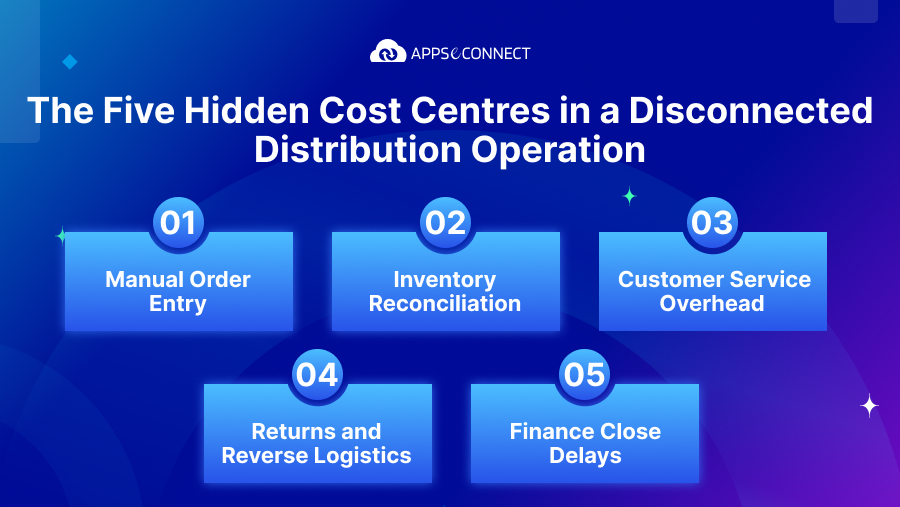
Most CFOs and COOs know the business is losing time somewhere. They can feel it in delayed closes, repeated order work, and the number of people involved in fixing simple mistakes. What they often do not have is a clear breakdown of where the loss actually occurs. When we work with distributors at APPSeCONNECT, these are the same five cost centers that show up again and again.
Cost Center 1: Manual Order Entry
Manual order entry is usually the first leak. Orders arrive from email, a B2B portal, an ecommerce store, a marketplace, or a sales rep, and then someone has to move that order into the ERP manually. That may sound like a normal admin step, but at wholesale volume it becomes an expensive operating habit. Even when the order is entered correctly, the team is still spending paid time on work that should have happened automatically.
The bigger issue is not only the labor cost. It is the delay. A manually entered order is already delayed the moment it is placed. If the order comes in after hours or during a heavy morning batch, the gap widens further. That delay affects picking, allocation, backorder handling, and customer updates. A disconnected order process slows the whole business before fulfillment even starts. When APPSeCONNECT connects order channels directly to ERP, that gap closes. appse ai then adds AI-led validation and routing so orders are not just moved faster, but also checked more intelligently before the team ever has to touch them.
Cost Center 2: Inventory Reconciliation
Inventory is where many distributors lose both money and trust. The ERP may say one thing, the B2B portal may show another, and a marketplace account may display a third number. The team then spends hours comparing them, adjusting them, and trying to decide which one is actually right. That is not just a reporting issue. It is an operational issue that affects sales, planning, and customer service at the same time.
This gets worse when the business holds stock across multiple warehouses or sells through several channels at the same time. A stale number on one channel leads to oversells. A delayed update causes split shipments. A missing warehouse sync creates the false idea that stock is available when it is already committed elsewhere. Inventory errors are not only frustrating. They directly damage margin and customer confidence. APPSeCONNECT solves this by making ERP the governing source and keeping stock movement synchronized across channels. appse ai then helps monitor the health of those flows and surface unusual changes before the team finds them the hard way.
Cost Center 3: Customer Service Overhead
Disconnected systems create support work that should never exist. A customer asks where their order is, but the service team cannot see the latest shipment status because tracking updates have not flowed back into the core system. A B2B buyer questions a price because the portal shows one rate and the invoice shows another. A payment is captured, but the finance team still does not see the correct record in the ERP. None of these problems begin in customer service, but customer service still has to carry the burden of explaining them.
That overhead is expensive because it draws in more than one team. Sales gets pulled into pricing disputes. Finance checks invoice history. Operations checks the warehouse or shipment status. Support becomes the place where the failure finally surfaces, even though the actual cause sits somewhere in the integration gap. Better integration reduces service tickets by fixing the source, not by asking the support team to work faster. This is one reason APPSeCONNECT is built around ERP-first data movement. Once the systems stay in step, the service team stops spending so much energy on preventable questions.
Cost Center 4: Returns and Reverse Logistics
Returns look simple from the outside, but they become messy very quickly in a disconnected setup. A return starts on the portal or through a customer request, then someone has to create the right authorization in ERP, receive the returned goods correctly, issue the credit note, and make sure stock and finance both reflect what happened. If each of those steps sits in a different system or depends on manual handoff, the process slows down and the chance of error rises.
This matters more now because returns volumes have increased across ecommerce and hybrid wholesale operations. When the business grows but returns still move through email threads, spreadsheet trackers, or separate manual updates, the reverse logistics process becomes one more hidden drain on time and margin. A connected returns flow cuts delays, reduces missed credits, and keeps stock and finance aligned during the most error-prone part of the order cycle. APPSeCONNECT helps connect those steps back to ERP, and appse ai adds AI-led monitoring so exception cases do not pile up silently.
Cost Center 5: Finance Close Delays
Finance teams often feel the cost of disconnection last, but they feel it hardest. At the end of the period, they are the ones forced to gather data from sales channels, portals, marketplaces, warehouse records, and payment tools before they can even start closing. The close becomes less about reviewing the numbers and more about rebuilding them. That is a poor use of finance capacity, especially in a mid-market business where the team is already lean.
A long close cycle does more than create pressure inside finance. It also delays better decision-making. When leadership has to wait ten or twelve days to get a reliable view of the last period, they are running the business on old information. Supplier timing, cash flow planning, margin review, and channel performance analysis all suffer. A faster close is not just a finance benefit. It gives the business a more current and reliable view of performance. APPSeCONNECT helps bring source data into ERP sooner and more cleanly, while appse ai helps identify mismatches, missing records, and exception patterns before they become month-end chaos.
Ready to See How Much You're Actually Losing?
Many distributors know they have inefficiencies, but very few put a number on them. That is why the problem stays hidden for so long. When you add together manual order work, stock mismatches, customer service overhead, return handling, and close delays, the cost is often far higher than the team expected. For a multi-channel distributor, the real cost can easily move past a few hundred thousand dollars and then keep climbing as complexity grows.
We encourage businesses to calculate their own cost of disconnection instead of relying only on generic benchmarks. That is exactly why we created the ERP integration ROI calculator within appse ai. It gives wholesale distributors a practical way to enter their own order volume, team size, and channel mix so they can see what the problem looks like in their own operation. Once the cost is visible, the case for ERP automation becomes much easier to understand.
Case Study: Richardson Sports — B2B Distribution at Scale Requires ERP-First Integration
Richardson Sports is one of the clearest examples of what B2B distribution looks like when scale meets complexity. Founded in Springfield, Oregon, in 1970, the company built a major presence in the team headwear market and now serves thousands of accounts with a large product catalog. This is not a business that outgrew spreadsheets last year. It is a serious wholesale operation with complex account structures, pricing needs, and product movement.
That is exactly why the Richardson story matters. When a distributor is managing around 8,000 active B2B customers and 7,500 active SKUs, the ecommerce layer cannot sit outside ERP as a separate universe. Pricing, account structure, inventory visibility, and order movement all need to stay tied back to the business system that governs them. This is the kind of B2B ecommerce ERP integration that US wholesale distributors actually need. The portal cannot be treated as just a front end. It has to be connected to the ERP-first operating model.
The Challenge
Richardson used SAP Business One as its ERP and Magento for its B2B ecommerce experience. Magento made sense because the business needed a strong B2B portal with company accounts, admin roles, contact users, and sales rep access. But without integration, this structure created a significant amount of repeated manual work.
- Every ecommerce order had to be entered into SAP Business One manually. That meant real data entry overhead at scale.
- Inventory in Magento was not updating in real time from SAP, so B2B buyers could see stock that was already unavailable.
- Lead times for out-of-stock items were also not flowing from ERP to the portal, which meant buyers were making decisions without seeing accurate replenishment information.
- Customer-specific pricing was another major issue. In B2B distribution, price is not a simple public number. It often depends on the customer, the agreement, the account hierarchy, and the sales relationship.
Without ERP-first integration, the portal could not keep those pricing structures aligned consistently. That created risk for both the customer experience and the back-office team.
The appse ai Solution
At APPSeCONNECT, we approached this as an ERP-first B2B integration problem, not as a basic storefront sync. APPSeCONNECT integrated Magento with SAP Business One so that the portal could actually reflect the account structure, pricing logic, and inventory reality the business needed. appse ai then added an AI capability layer for monitoring, anomaly detection, and clearer visibility into how those workflows performed.
Distributor company accounts, company admins, contact persons, and sales rep access could all be created in Magento from SAP data. This meant the B2B portal reflected the structure already governed in ERP instead of forcing staff to maintain account logic in two places. Orders placed by the right users on behalf of the right accounts could move more cleanly back into SAP Business One.
Customer-specific pricing could also be maintained from SAP inside the portal. That was critical because it meant B2B buyers saw the price they were actually meant to see, not a stale or generic version. Inventory and lead times for out-of-stock products were synchronized from SAP as well, which gave Richardson a more accurate storefront and reduced the mismatch between customer expectation and actual stock position.
This is where APPSeCONNECT’s ERP-first approach matters most. We did not treat the ERP like an afterthought. We built the portal around ERP truth, which is exactly what a wholesale distributor at this scale needs.
The Outcomes
The results were concrete. Richardson was able to list 7,500 active SKUs in Magento with automated, real-time synchronization.
- Manual data entry and duplication across the order cycle were removed.
- Sales and inventory management became more efficient because the systems no longer had to be updated separately.
- The customer experience improved too, especially for B2B buyers who rely on accurate stock, correct pricing, and a portal that reflects their actual account setup. That matters because in B2B distribution, trust is built through operational reliability just as much as through sales relationships.
When the portal finally reflects ERP truth, the business becomes easier to buy from.
Richardson’s case is a strong reminder that ERP integration for US wholesale distributors is not about complex architecture. It is about making sure the portal, the pricing, the orders, and the stock all stay tied to the same operating model.
Case Study: The Amazon Multi-Location Inventory Problem
A second major problem in wholesale distribution shows up when a business sells on Amazon while also running direct channels. The issue is not simply “inventory sync.” The issue is multi-location inventory sync. If a distributor holds stock across multiple SAP Business One warehouses, those positions need to map correctly to the right Amazon locations. If that does not happen, the business ends up with stale listings, wrong availability, and a much higher risk of oversell.
Without integration, teams usually fall back on exports and uploads. They pull warehouse data from SAP, shape it for Amazon, upload it, and then hope the timing holds long enough for the stock picture to remain true. But by the time the upload is done, the stock position may already have changed again. That is not a stable operating model. It is a repeated manual race against movement.
APPSeCONNECT handles this by making SAP Business One the source of truth and mapping warehouses to Amazon locations in real time. When stock moves in SAP, the related Amazon location is updated accordingly. That means receipts, shipments, and allocations do not wait for a manual upload to be reflected in the marketplace. For distributors managing fast-moving inventory across channels, this removes one of the most expensive blind spots in the whole operation.
This is also where appse ai adds practical value. It helps monitor those warehouse-level syncs and surface unusual patterns or failures faster, so the team is not left discovering inventory issues only after customers place orders. In a wholesale environment, that kind of AI-supported visibility matters because the cost of stale stock does not stay small for long.
What Order-to-Cash Automation Looks Like in Practice
Order-to-cash sounds like a finance phrase, but for a wholesale distributor it is really the full operational journey from the moment an order enters the business to the moment the payment is properly reflected. If that journey is manual, every step drags. Orders wait. Pricing is checked twice. Inventory is rechecked. Invoices are delayed. Cash visibility gets weaker. This is why order-to-cash automation for US distributors is not a narrow finance project. It is a full operating model upgrade.
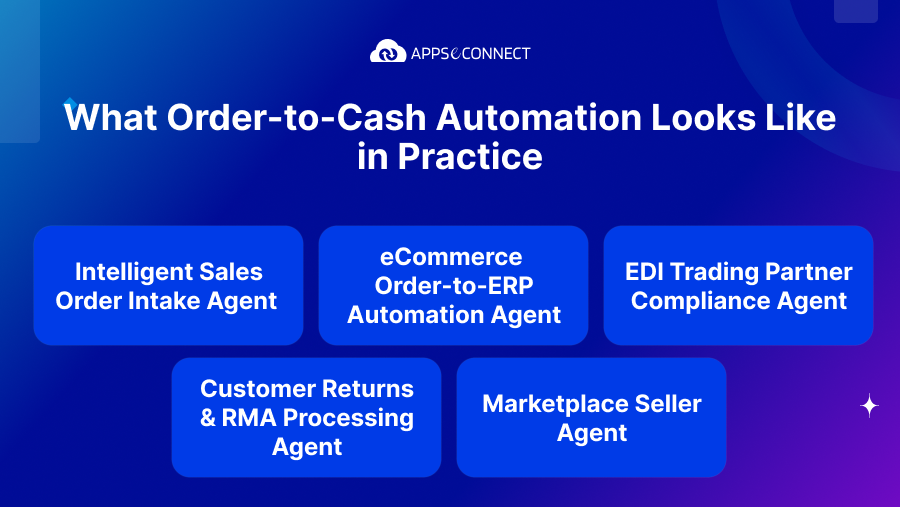
Within APPSeCONNECT, appse ai includes an Order-to-Cash category made up of AI capabilities built for this journey.
- Intelligent Sales Order Intake Agent: One of the most valuable is the Intelligent Sales Order Intake Agent. It reads incoming orders from places such as email, portal submissions, marketplace channels, or EDI files, then validates those orders against ERP logic before confirming them. That means the Monday morning order pile can turn into a list of validated, ready-to-process orders instead of a manual entry project.
- eCommerce Order-to-ERP Automation Agent: The eCommerce Order-to-ERP Automation Agent supports the flow from connected online channels directly into SAP Business One. It helps make sure customer pricing, inventory availability, and credit rules are checked before the order is fully accepted. That matters because the order should not simply move faster. It should move correctly.
- EDI Trading Partner Compliance Agent: The EDI Trading Partner Compliance Agent helps distributors working with large retail or wholesale partners that require EDI formats and strict document handling. Non-compliance here can lead to chargebacks and repeated manual fixes, so automation becomes a direct way to protect margin.
- Customer Returns & RMA Processing Agent: The Customer Returns and RMA Processing Agent then helps on the reverse side of the journey, automating the returns path instead of forcing each step into manual review.
- Marketplace Seller Agent: Then there is the Marketplace Seller Agent, which helps keep pricing and inventory aligned across marketplaces such as Amazon, Walmart, or eBay using ERP as the governing source. This matters because marketplace problems often begin as data problems. When pricing and stock remain clean across channels, the business protects both revenue and account health.
Together, these capabilities show what ERP automation looks like in practice. It is not one giant abstract AI promise. It is a series of ERP-first workflows that remove manual work, cut delay, and give teams a more stable day-to-day process.
The ROI Model: Calculating Your Integration Return in 90 Days
The return on ERP automation becomes clearer once the business stops thinking about it as “software” and starts looking at the work it removes.
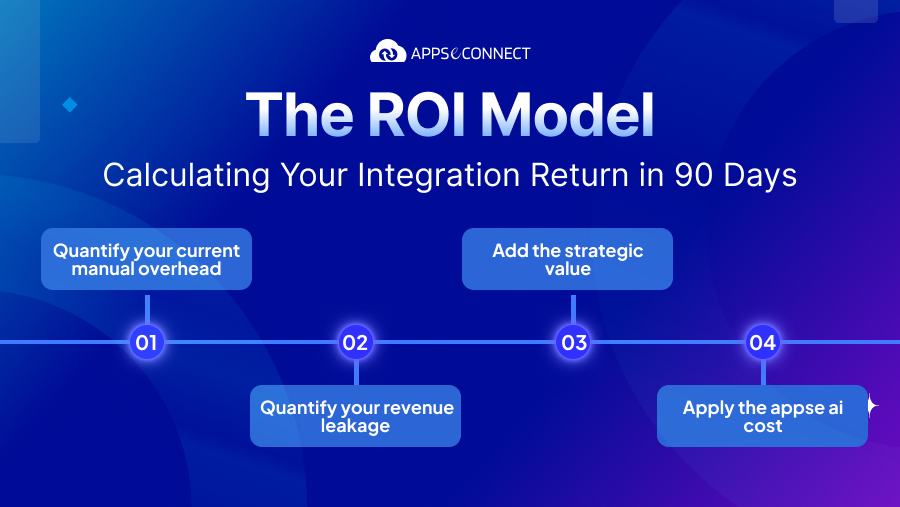
- Step 1: The first step is to count the current manual overhead. How many hours each week go into order entry, stock reconciliation, customer service calls caused by mismatched records, and finance checking between channels and ERP? Once those hours are multiplied by real labor cost, the number usually becomes significant very quickly.
- Step 2: The second step is to count revenue leakage. Oversells, pricing disputes, stale stock, and delayed invoice handling are not only annoying process issues. They create real margin loss. A distributor that cancels orders because inventory is wrong or spends time correcting customer pricing is not simply working inefficiently. It is leaking value directly through the operating model.
- Step 3: The third step is to look at how speed changes once automation is in place. Orders placed at night do not wait until morning to enter ERP. Customers get cleaner updates. Finance receives better period-end data sooner. Leadership gets a clearer picture of the business earlier in the month. These gains are harder to measure than manual hours, but they matter because they change how the company operates, not just how it reports.
- Step 4: Then comes the cost side. APPSeCONNECT starts at a price point mid-market distributors can actually work with, and appse ai adds AI capabilities without forcing them into an enterprise-scale budget. For many wholesale businesses, the actual cost of integration stays well below the cost of continuing to run disconnected processes. That is why the payback period is often measured in weeks or a few months, not in years.
We have seen this pattern repeatedly across wholesale distribution environments. Once the business calculates manual overhead, revenue leakage, and the cost of delayed decisions together, the ERP automation ROI becomes much easier to defend. It stops being a technology spend and starts looking like what it really is: a direct operating improvement.
Implementation Reality: Go Live in Hours, Not Months
One of the biggest reasons distributors delay automation is the belief that ERP integration is always a long, painful, IT-heavy project. That used to be true far more often than it is today.
- Step 1 – Connect your systems: With APPSeCONNECT, the process is much more practical because we start with a large library of pre-built, production-tested connectors and workflows shaped for real ERP, ecommerce, marketplace, and logistics combinations.
That means a distributor does not have to begin with a blank page. If the business runs SAP Business One and Magento, SAP Business One and Amazon, or a broader B2B ecommerce ERP setup for the US market, there is already a tested starting point. The team can connect systems, apply workflow logic, and adjust mappings through our ProcessFlow environment instead of spending months defining the whole integration pattern from zero. - Step 2 – Build your workflows: The second part is workflow design. appse ai adds AI capabilities to this layer so teams can build and monitor flows more easily, describe what they need in plain terms, and keep closer watch on what happens after go-live. That does not remove the need for planning. It means the work becomes more practical and less dependent on custom development.
- Step 3 – Go live and monitor: The third part is monitoring. AutoDetect and FlowInsight give teams visibility into data health, failed records, and workflow behavior. That matters because an integration is only valuable if it stays dependable after launch. Go-live is important, but steady operation is what creates the real return.
For distributors processing hundreds of orders a day across multiple channels, delay has its own cost. Every extra day spent on manual order work, stale inventory handling, and repeated reconciliation is another day of preventable loss. That is why faster deployment matters so much in this market.
Get Your Free Integration Assessment
At APPSeCONNECT, we work with wholesale distributors by first understanding their actual operating model. That means understanding which systems are involved, where the manual work sits, where orders slow down, where inventory falls out of step, and what finance is still repairing by hand. That picture usually becomes clear very quickly once the right questions are asked.
That is why our integration assessment is practical. We do not begin with long slides or a generic sales deck. We begin with the actual system landscape, the current pain points, and a first estimate of what the business is losing through disconnection. In many cases, that alone is enough to show where the biggest value lies.
If your team wants to see what disconnected ERP systems are really costing you, APPSeCONNECT can help map that clearly. appse ai then shows how AI capabilities can sit on top of that integration foundation to reduce manual work, surface issues earlier, and make the whole environment easier to manage.
Book your free US distribution integration assessment today.
Frequently Asked Questions
The number depends on order volume, channel mix, team size, and how much manual work still exists. For many distributors, the combined cost of manual order entry, stock reconciliation, service overhead, returns handling, and slow finance close can easily reach hundreds of thousands of dollars per year and, in more complex environments, can pass into the millions.
It means connecting the full order journey from intake through fulfillment, invoicing, and payment in a way that removes repeated manual work. APPSeCONNECT provides the ERP-first integration base, and appse ai adds AI capabilities that help validate, monitor, and automate those flows more intelligently.
APPSeCONNECT maps each SAP Business One warehouse to the related Amazon inventory location so that stock movements in ERP can update Amazon in real time. This helps remove manual uploads and reduces oversell risk caused by stale marketplace inventory.
The return depends on the current level of manual work and data mismatch, but the common gains usually come from labor savings, cleaner inventory, fewer pricing disputes, faster close cycles, and less revenue leakage. Many distributors see a strong return within the first quarter once the main manual bottlenecks are removed.
Custom integration usually takes longer, costs more, and creates ongoing maintenance work every time a connected platform changes something. APPSeCONNECT gives distributors a production-tested ERP-first integration foundation, and appse ai adds AI capabilities such as monitoring, exception support, and workflow intelligence on top of it. That gives businesses a faster and more practical path than starting from scratch.