





Are you still relying on legacy middleware to carry out various business operations? Not sure how exactly you are going to bring down increasing IT expenses? Well, this is a signal for you to bring about transformation in your operations and embrace iPaaS.
Here, in our blog, we are going to talk to you about SAP ECC Legacy Middleware Cost Reduction with iPaaS. We will also tell you how you can choose APPSeCONNECT’s iPaaS platform and cut down your integration cost by around 50%.
When Does Integration Become a Cost Center?
According to The CIO Magazine, 70% of IT leaders say legacy systems significantly limit their ability to integrate AI and modern technologies.
SAP ECC has long served as one of the most reliable ERP solutions for companies willing to streamline their operations. However, with the advancements made in the field of technology, using traditional integration technology for integrating SAP ECC with other applications in your environment has been a cost-intensive process.
Various costs associated with traditional integrations:
- Maintaining legacy systems
- Ensuring data security and governance
- Addressing scalability requirements
At this stage, integration stops being a strategic enabler and becomes a recurring cost center. Instead of driving revenue or agility, legacy SAP ECC integrations consume operating budgets through infrastructure maintenance, middleware licensing, custom development, and unplanned downtime. For CIOs and finance leaders, integration costs shift from one-time projects to permanent OPEX drains.
So, if you are still using traditional integration for running SAP ECC, it is high time that you make a shift to iPaaS. Otherwise, every quarter that passes could be costing you a lot more than you can think. This will not only help you in mitigating the rising cost but will also ensure that all the ERP requirements are addressed.
Legacy Middleware in SAP ECC Environments:
According to Gartner, by 2025, companies will spend 40% of their IT budgets on maintaining technical debt.
SAP ECC has long served as the most crucial tool for thousands of organizations that depend on ERP solutions for their various business operations. It can be used to manage critical business processes like procurement, manufacturing, human resources, and finance. The integration middleware that is used to connect SAP ECC to other applications in the business environment has been equally important.
Traditional middleware platforms like SAP Process Orchestration (PO) and SAP Process Integration (PI) became standard integration infrastructure for SAP ECC environments. These platforms were designed for an era where integration primarily involved connecting the various on-prem applications within a controlled data center in the environment.
In SAP ECC environments, legacy middleware tightly couples integration logic with ERP upgrades, enhancement packs, and custom ABAP changes. Every ECC update triggers regression testing across interfaces, increasing dependency on specialized SAP skills. Over time, this creates integration sprawl, where maintaining middleware becomes more expensive than extending business capabilities.
For years, the model served as an ideal means of integrating the various applications. However, with time, the integration needs of companies began to evolve. So, they started looking for more advanced solutions for reducing SAP ECC middleware costs and ensuring smooth business operations. That’s when the need for more advanced iPaaS solutions started to take shape.
| A retail firm in the U.S. was compelled to shut down its business altogether, as the company was no longer able to deal with financial constraints associated with rising infrastructural costs. |
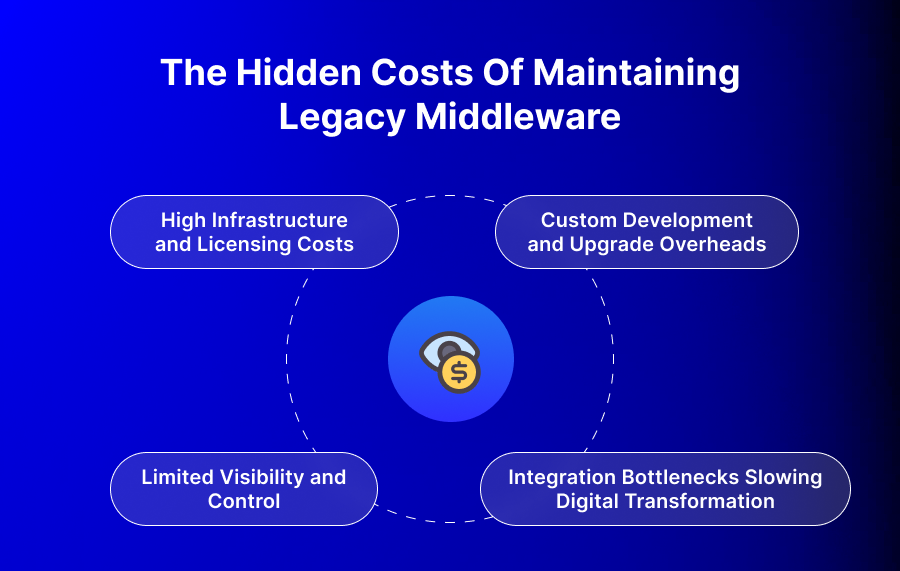
The Hidden Costs of Maintaining Legacy Middleware:
According to McKinsey, companies that go beyond basic cloud adoption and strategically integrate cloud across their operations could unlock as much as $3 trillion in value globally.
High Infrastructure and Licensing Costs:
Maintaining the infrastructure for legacy SAP systems is often costly for organizations that are operating under a tight budget. A lot of companies also often overlook the real cost of maintaining legacy systems, which includes the cost of operating system licences, databases, and resources.
To support your outdated systems, it is inevitable that you cover all these additional expenses. Legacy infrastructure also requires frequent maintenance to continue to operate optimally. The maintenance can take the form of patching, customization, or operational downtime, all of which can turn out to be really expensive for organizations.
Custom Development and Upgrade Overheads:
Legacy systems are often dependent on custom development to meet your exact integration needs. Custom development may contribute to increased legacy middleware integration costs. They can also impact your ability to perform operations in a smooth and streamlined manner.
The various hardware and software components associated with legacy systems also need to be upgraded regularly. This involves pumping money into technology that might not have a future outside the exact use case of your company. These upgrades also do not drive any value for the business and only increase the recurring cost.
Limited Visibility and Control:
Now this is yet another drawback associated with maintaining legacy systems in your business environment. The complexities associated with these systems often lack visibility. Because of a lack of visibility and control, you do not have a complete idea of what exactly is happening in the backend. This exposes you to several restrictions. The limited visibility also often translates to hidden costs.
The various problems that may arise during the integration process easily go undetected, leading to delayed order processing, incomplete data transfer, failed transactions, etc. In this way, this lack of visibility can easily break down the integration and cause your business to suffer from significant losses.
Integration Bottlenecks Slowing Digital Transformation:
Legacy systems often hold companies back from adapting quickly to changing market demands and ensuring digital transformation. A lot of companies have to work around the deficiency of an infrastructure that no longer fits their purpose. This kind of integration can stunt growth and expansion.
A lack of scalability and flexibility makes handling growing data volumes challenging. Businesses may also have to deal with slow performance, security costs, and daily inefficiency. This can further slow down the digital transformation rate and cause organizations to ultimately fall back in the rat race.
Collectively, these hidden costs compound over time. What begins as manageable middleware maintenance evolves into a fragile, high-risk integration landscape, where every change increases cost, slows execution, and limits innovation. For SAP ECC users, these costs remain largely invisible until integration failures impact revenue, customer experience, or compliance.
Quantifying the Impact: Why Costs Keep Rising?
For a very long time now, SAP ECC has been serving its purpose. However, today, it acts more like a bottleneck than a business driver. With rising infrastructure support costs, outdated infrastructure, and limited scalability and flexibility, holding on to traditional integration for running ECC simply means falling behind agile competitors. Every quarter spent delaying the inevitable will add complexity and increase the cost of the migration.
Beyond the regular costs, there are a lot of other legacy middleware integration costs involved as well, in which using legacy middleware can cause you to drain your resources. This includes the necessity of hiring SAP consultants, educating the end users, and the risk of downtime. This can further affect the total cost of ownership of legacy middleware in your business environment.
Other than that, there are costs associated with lack of business productivity, which can further drain your resources and cause you to spend a significant amount of money on a daily basis. From a total cost of ownership (TCO) perspective, SAP ECC legacy middleware costs grow across four dimensions: infrastructure, licensing, human capital, and risk exposure. As integration complexity increases, organizations experience exponentialnot linear, cost growth, making long-term maintenance financially unsustainable. There are security costs involved as well. All these costs will continue to rise with every passing day. Your system will become more vulnerable to threats. The migration is also going to become more expensive.
Some of the major reasons behind rising costs of maintaining legacy systems include:
|
iPaaS: A Cost-Efficient Alternative to Legacy Middleware
While legacy middleware integration can turn out to be really expensive owing to the high infrastructural costs, increased licensing fees, and enhanced need for customization, iPaaS can be used to significantly reduce the costs associated with legacy integration. It serves as a growth accelerator for business, not just a cost-cutter. These iPaaS solutions provide you access to flexibility, scalability, and automation. Unlike legacy middleware that requires upfront infrastructure investments and ongoing license renewals, iPaaS follows a consumption-based model. Organizations pay only for integration usage, eliminating sunk costs and aligning integration spend with actual business growth. This financial elasticity is critical for SAP ECC environments managing fluctuating transaction volumes.They can help you unlock the potential to utilize advanced technology, which allows businesses to integrate various software solutions seamlessly.
Unlike traditional integration methods where companies are locked into rigid systems, iPaaS allows customers to customize the integration based on their business needs. This shift gives companies the flexibility to choose best-in-class tools for managing their integrations. It also leads the way for iPaaS cost savings for SAP ECC.
A retail firm in the U.S. recently made a switch from legacy middleware to iPaaS. Within a year, the company began to witness extraordinary growth in its operations. Its revenue generation also increased significantly. |
How iPaaS Reduces Integration Costs by 50%?
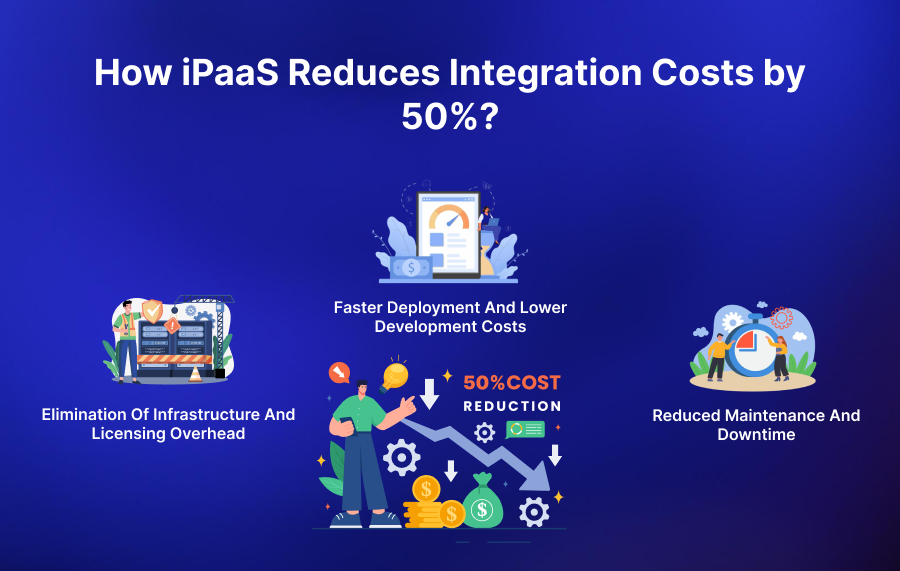
Here are some of the ways in which you can achieve SAP ECC Legacy Middleware Cost Reduction with iPaaS:
Elimination of Infrastructure and Licensing Overhead:
The cloud-based architecture of iPaaS solution helps you to save up significantly on infrastructure costs. Being a cloud-native solution, in iPaaS, you only need to pay for the services that you actually use. This allows you to save up significantly on expensive hardware and software-related costs. The entire integration can be covered within a budget.
The subscription-based model further makes iPaaS one of the most cost-effective SAP ECC integration solutions. It allows you to ensure that you are able to gain access to advanced integration tools without having to strain your budget. You also do not have to deal with any kind of licensing overhead as the services are offered to you by the iPaaS provider itself.
Faster Deployment and Lower Development Costs:
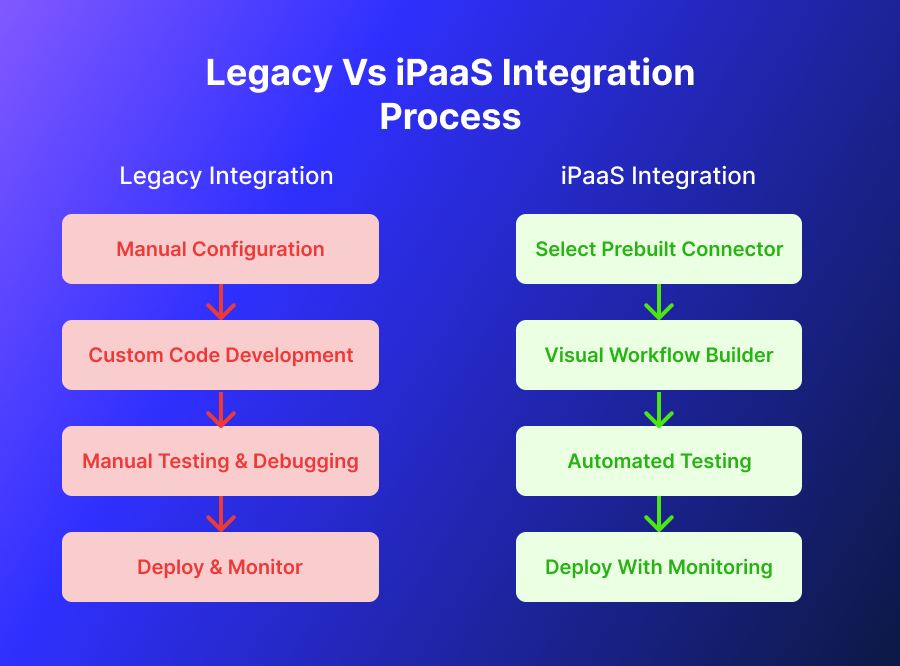
iPaaS platforms can offer faster deployment. This is achieved through several tools like prebuilt connectors, templates, workflows, etc. With these advanced features, iPaaS can be used to reduce the development time by 60 to 75%. This leads to enhanced cost savings.
The iPaaS platform also comes with a visual development environment. This helps increase developer productivity. The developers need to spend less time writing code. This productivity directly translates to cost savings. In fact, organizations have been able to report 30 to 40% reduction in development cost through iPaaS integration.
Reduced Maintenance and Downtime:
You can significantly reduce maintenance costs by 50% with iPaaS integration. The iPaaS provider will take full responsibility of maintenance. This includes performing security patches, ensuring performance optimization, and maintaining the available infrastructure. All these remain extremely transparent to customers.
Platform upgrades may lead to significant business downtime. This can again be reduced with iPaaS integration. The monitoring and management capabilities further help reduce maintenance burden. iPaaS also comes with automatic failover between redundant architecture which further helps reduce downtime to a significant extent.
For SAP ECC teams, this translates into fewer emergency transports, reduced BASIS intervention, and lower incident resolution times. Integration issues that previously required manual investigation across IDocs, RFC queues, and middleware logs are now resolved through centralized dashboards, directly lowering operational support costs.
Simplified Change Management:
iPaaS can be used to significantly reduce integration cost through a streamlined change management process. When businesses evolve, traditional integration requires expensive testing, constant developer intervention, and lengthy deployment cycles. iPaaS offers low-code visual interfaces, which allow companies to easily modify their workflows and mappings without much expertise.
Version control and rollback capabilities can also help eliminate error. The automated testing also reduces overall implementation time by 50%. The changes deployed are instantly replicated across various systems. This further eliminates the need for multiple point-to-point integrations. The agility also means faster adaptation to market changes.
For SAP ECC environments, simplified change management reduces regression risk during upgrades and seasonal business changes. Integration updates can be deployed without impacting core ERP stability, significantly lowering the cost of ongoing optimization.

A manufacturing firm was able to reduce its infrastructure-related costs by 60% by switching to iPaaS from traditional integration solutions. Before iPaaS, the company was dealing with:
Post iPaaS, the company experienced:
|
Evaluating ROI: The Long-Term Financial Case:
Your ROI from integration will depend heavily on the following factors
For CFOs, iPaaS delivers predictable integration costs and measurable reductions in IT overhead. For CIOs, ROI comes from faster delivery cycles, lower technical debt, and improved governance. Operations leaders benefit from fewer disruptions and improved process continuity, turning integration into a measurable business asset.
- Integration complexity: Companies with comparatively simpler integration requirements typically achieve stronger ROI because of consolidation opportunity and stable landscape.
- Current state assessment: The age of existing middleware, technical debt severity, and skill availability can also impact the ROI significantly.
- Organizational readiness: Cloud adoption maturity, change management capability, and IT adoption model also impact the business ROI.
Here’s how iPaaS reduces SAP ECC integration costs:
- iPaaS solutions reduce integration costs by 40-55% compared to legacy middleware maintenance.
- Subscription models ($50K-$300K annually) eliminate 60-75% of infrastructure overhead and reduce staffing needs by 30-50%.
- iPaaS delivers 3-5x faster integration development, reducing time-to-market by 50-70%. Scalability increases 200-400%.
- Five-year TCO analysis shows iPaaS delivers 45-65% cost savings versus legacy maintenance, with 25-35% advantages over on-premise modernization.
Transform Integration Costs Into Growth Investments
For all those companies that are spending tons on a regular basis on maintaining legacy middleware, it is high time that you make initial investments in iPaaS and enjoy a lifetime of enhanced performance. With iPaaS, you will not only be able to enjoy significant cost cuttings but you will also be able to take one step ahead towards achieving digital transformation. Your organizational goals will be well addressed. You will also be able to offer better services to the end users.
By reallocating integration spend from maintenance to innovation, organizations unlock faster digital initiatives, new sales channels, marketplace integrations, analytics platforms, and automation workflows, without increasing IT costs. Integration becomes a growth multiplier rather than a financial burden.
Maintaining a legacy environment may lead to:
All these challenges can be addressed if you make a switch from legacy middleware to advanced iPaaS solutions. |
However, let me tell you that you can only enjoy maximum benefits from iPaaS if you choose a reliable iPaaS platform for meeting your integration needs.
APPSeCONNECT is one such platform, which comes with enhanced capabilities for supporting iPaaS integration for SAP ECC. Its capabilities extend beyond traditional integration features. APPSeCONNECT is also known for its enhanced security. It ensures that the vital data remains protected at all times. It can also give a significant boost to your overall business operations. It also helps in eliminating legacy middleware with iPaaS.
APPSeCONNECT’s SAP ECC integration capabilities include:
- Supported SAP ECC objects: IDoc, BAPI, RFC
- Prebuilt connectors for: Shopify, Salesforce, Magento, Amazon, WMS systems
- Real-time monitoring and retries
Related Read: Integrating SAP ECC with Amazon Seller Central via APPSeCONNECT
Conclusion:
So, as you can see, by making a shift from legacy middleware to iPaaS, you can not only walk the path towards digital transformation, but your overall business expenses also reduce significantly. iPaaS also allows you to streamline your business processes and acquire better visibility of your operations. Also, if you are willing to enjoy enhanced benefits from this technological shift, then it is high time that you reach out to the experts at APPSeCONNECT and avail of their services.
For SAP ECC-driven enterprises, continuing with legacy middleware is no longer a neutral choice, it is a financial risk. iPaaS provides a clear path to cost control, operational resilience, and long-term scalability, positioning integration as a strategic advantage rather than a sunk cost.
Frequently Asked Questions
Legacy middleware in SAP ECC typically refers to traditional integration platforms such as SAP PI/PO that connect ECC with external systems. These platforms rely on on-prem infrastructure, custom development, and manual maintenance, making them costly and inflexible compared to modern iPaaS solutions.
Maintaining legacy middleware for SAP ECC involves recurring infrastructure costs, software licensing fees, specialized SAP skill dependency, frequent patching, and high downtime risk. Over time, these expenses grow faster than business value, turning integration into a long-term cost center.
iPaaS reduces SAP ECC integration costs by eliminating on-prem infrastructure, removing license renewals, minimizing custom development, and automating maintenance. Cloud-based pricing and prebuilt connectors significantly lower total cost of ownership compared to legacy middleware.
Yes. iPaaS can fully replace SAP PI/PO for most SAP ECC integration scenarios, including IDoc, BAPI, RFC, and API-based integrations. iPaaS provides greater scalability, faster deployment, and lower long-term costs while maintaining enterprise-grade security.
iPaaS operates on a cloud-native, subscription-based model. This eliminates the need for servers, databases, OS licenses, and middleware upgrades required by legacy SAP ECC integration platforms, reducing infrastructure and licensing costs by 60-75%.
Yes. iPaaS uses low-code/no-code tools, reusable templates, and standardized connectors, reducing custom development effort by 30-60%. SAP ECC upgrades no longer require extensive interface rework, lowering ongoing upgrade and regression testing costs.
iPaaS provides centralized dashboards, real-time monitoring, error alerts, and automated retries. This visibility allows SAP ECC teams to identify issues instantly, reduce failed transactions, and avoid costly business disruptions caused by hidden integration failures.
Most organizations see measurable ROI within 6-12 months after switching from legacy middleware to iPaaS. Savings come from reduced infrastructure spend, lower maintenance effort, faster deployment, and improved operational efficiency.
Absolutely. iPaaS decouples integrations from the ERP core, allowing SAP ECC and S/4HANA systems to coexist. This reduces migration risk, avoids rework, and protects integration investments during and after the transition.
Start by assessing your current middleware expenses, infrastructure footprint, maintenance effort, and downtime impact. An iPaaS cost assessment can identify immediate savings opportunities and provide a clear roadmap to reduce SAP ECC integration costs by up to 50%.