





The UK food and beverage sector is under pressure from every side. Costs are rising, labour is harder to find, and teams are being asked to do more without letting quality, stock control, or customer service slip. For manufacturers running SAP Business One with WooCommerce, Shopify, or wholesale channels, that pressure gets worse when orders, inventory, purchasing, and finance are still moving through manual steps between systems.
At APPSeCONNECT, we see this clearly across the UK mid-market. APPSeCONNECT provides the ERP-first integration foundation, and appse ai is the AI capability layer of APPSeCONNECT. Together, they help food and beverage manufacturers connect ERP to their sales, warehouse, supplier, and finance systems so the business can grow without adding the same level of manual work. This is the kind of ERP automation food and beverage manufacturers in the UK need now, and it is what makes AI-led ERP automation feel practical instead of theoretical.
The Five Operational Bottlenecks Holding Back Growth for UK F&B Manufacturers
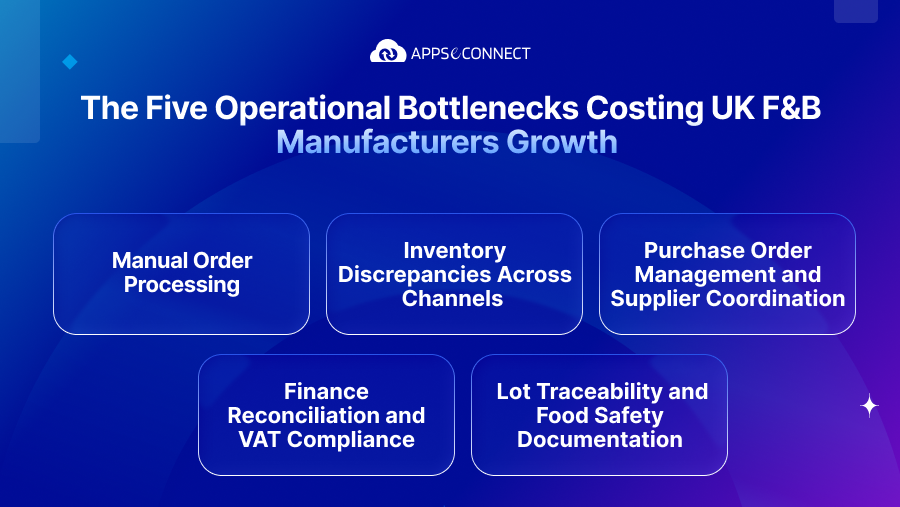
Most UK food and beverage manufacturers do not fail because the ERP is weak. They struggle because the ERP is left to work on its own while the rest of the business runs through disconnected tools. Orders come in through ecommerce and wholesale channels, stock moves through the warehouse, purchase orders are raised when shortages appear, VAT treatment must stay correct, and batch records must remain traceable. When these steps are not connected back to SAP Business One, the business keeps paying for the same manual effort again and again.
Bottleneck 1: Manual Order Processing
A typical UK brewery, drinks producer, or specialist food brand often sells across several channels at once. It may have a WooCommerce or Shopify store for direct buyers, a wholesale order flow for trade accounts, and sometimes an external portal or EDI feed as well. Without proper integration, those orders do not move into SAP Business One cleanly. Someone still has to enter them, check them, or import them in delayed batches. That means the order is already behind before the warehouse even sees it.
The cost of that manual work is real, but the delay is just as damaging. A business that wants to scale cannot keep treating every new order as another admin task. When orders move automatically into ERP, the team gets time back and the order cycle starts faster. This is one reason SAP Business One and WooCommerce integration matters so much for UK manufacturers trying to grow without expanding the admin team.
Bottleneck 2: Inventory Discrepancies Across Channels
Inventory is one of the biggest pain points in food and beverage manufacturing because stock is not only quantity. It is timing, freshness, production planning, and channel accuracy all at once. SAP Business One may hold the most accurate stock picture, but if WooCommerce, Shopify, or wholesale channels are not receiving that picture quickly enough, customers start buying from numbers that are already old.
That causes oversells, service issues, delayed fulfilment, and unnecessary customer contact. The risk gets even worse around seasonal or limited-release products, where a small stock error can turn into a real lost sales moment. The kind of inventory automation UK manufacturers need is really about trust. Buyers need to trust what they see, and the operations team needs to trust that the channel and the ERP are still telling the same story.
Bottleneck 3: Purchase Order Management and Supplier Coordination
Food and beverage manufacturers depend on supplier timing far more than many other businesses. Ingredients, packaging, and production inputs cannot always wait. Many come with lead times, minimum order quantities, or seasonal supply constraints. If replenishment decisions are still based on manual stock checks and delayed awareness, the team is always reacting later than it should.
A connected ERP setup changes that. When stock drops to a certain level, the system can help trigger the next action instead of waiting for someone to notice the shortage on a spreadsheet or during a warehouse check. This is where manufacturing automation becomes practical for UK manufacturers in 2026. The business does not need more people to keep watching the same stock positions all day. It needs cleaner automation tied to the ERP.
Bottleneck 4: Finance Reconciliation and VAT Compliance
Finance in UK food and beverage businesses carries a special burden because product tax treatment is not always simple. Some products are zero-rated, some are standard-rated, and the logic has to remain consistent across direct sales, trade orders, and any connected channel. When orders move into SAP Business One through manual steps, VAT errors become far more likely. Those problems may stay hidden during the day, but they show up later when the finance team is trying to prepare reports and keep VAT treatment correct.
This is also where digital VAT reporting pressure becomes more visible. If ecommerce, payments, and ERP do not stay aligned, finance ends up turning every reporting period into a repair project. A better integration model makes VAT handling steadier and period-end finance much easier to manage.
Bottleneck 5: Lot Traceability and Food Safety Documentation
For food and beverage manufacturers, traceability is not optional. Batches, production runs, expiry windows, and source records all matter. When systems are disconnected, lot traceability becomes a manual documentation job, and that puts extra pressure on both quality and operations teams. Every missing record or late update weakens the confidence the business should have in its own process.
Synchronising ERP, production, inventory, and fulfilment records makes traceability part of the daily operating flow. It creates a reliable audit trail and gives teams easier access to historical records without rebuilding documentation by hand.
Case Study: Renegade Brewery - Automating Operations, Enabling Global Expansion
Renegade Brewery is a strong example of what this looks like in real life. It is a UK craft brewery operating in one of the most competitive parts of British manufacturing. Like many businesses in this space, it was using SAP Business One as the ERP backbone and WooCommerce as the ecommerce channel. That gave the business the right systems on paper, but it did not automatically give them a clean operating flow.
For a brewery with growth ambitions, that matters a lot. Once order volume rises and the business starts thinking about broader distribution and international demand, the cost of manual admin work becomes much harder to carry. You cannot keep scaling while the team is still spending large parts of the week moving orders and checking whether systems match.
The Before State
Before APPSeCONNECT, Renegade was managing the gap between WooCommerce and SAP Business One through manual effort. Orders did not move automatically into ERP. Inventory updates were not flowing cleanly back to the store. Fulfilment data needed human intervention to stay current. These were not side problems. They were part of the daily routine.
That meant the team was spending time on data movement instead of growth work. In a brewery environment, that lost time matters because the business needs people thinking about production, customers, sales channels, suppliers, and expansion. Manual data transfer is one of the least valuable ways to use that capacity. The real cost was not just inefficiency. It was the loss of attention from more valuable work.
The Integration and Outcomes
APPSeCONNECT connected SAP Business One and WooCommerce in both directions so Renegade’s order-to-fulfilment flow could move as one process. Orders from WooCommerce were validated and created inside SAP Business One automatically. Inventory levels moved back out so the storefront could show a more current picture. Fulfilment updates returned to WooCommerce without the team having to push them manually.
This changed more than the speed of order handling. It changed what the team could focus on. Richard Grew from Renegade Brewery described APPSeCONNECT as easy to use and praised its visual process flow mapping and team support. That matters because automation only creates value when the people running the business can understand it and trust it. The gain was not only efficiency. It was a steadier operating model that gave the brewery room to scale.
That is where APPSeCONNECT’s ERP-first approach matters. We did not approach Renegade’s case as a light ecommerce sync. We treated SAP Business One as the operating core and then built the connected WooCommerce flow around it. The case shows the value of ERP-first integration. appse ai can extend that kind of operating model with AI-led visibility and workflow support.
What AI-Powered ERP Automation Looks Like for UK F&B Manufacturers
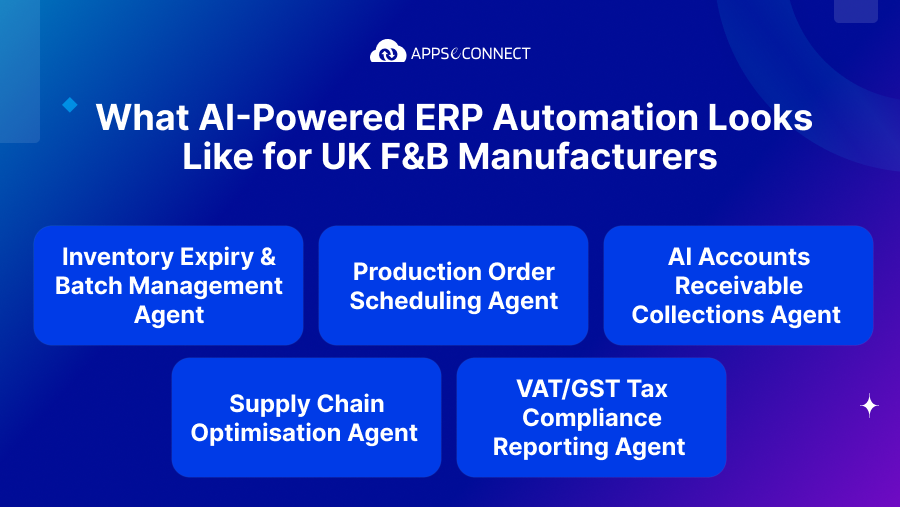
AI-powered ERP automation only matters if it helps real work move more cleanly. At APPSeCONNECT, we do not treat AI as a separate layer floating outside the ERP. APPSeCONNECT creates the connected data flow, and appse ai adds AI capabilities that help monitor, guide, and automate the next level of work inside that ERP-driven setup.
- Inventory Expiry & Batch Management Agent: One useful example is inventory expiry and batch management support. In food and beverage manufacturing, stock is not only in stock or out of stock. It also has batch dates, shelf life, and rotation rules. This capability helps monitor expiry and batch status across stock locations, so near-expiry goods can be flagged earlier and stock can be drawn in the right order. That reduces the need for constant manual batch checking and helps support FIFO or similar rules in a more dependable way.
- Production Order Scheduling Agent: Another example is production order scheduling support. This helps connect sales demand back to production planning. If order velocity increases on key items, this capability can identify the production impact, review raw material availability, and support draft production recommendations. This is highly relevant for UK manufacturers that need production scheduling to respond faster to changing demand without waiting for delayed manual review.
- AI Accounts Receivable Collections Agent: AI support for accounts receivable collections is valuable for manufacturers selling on wholesale terms. Many UK food and beverage businesses extend 30, 60, or 90-day terms to trade buyers. Managing that manually takes time, especially before period-end. This capability helps monitor ageing, organise summaries, and support cleaner follow-up. That frees finance to focus on decisions instead of only on chasing status updates.
- Supply Chain Optimisation Agent: Supply chain optimisation support adds another layer. It helps monitor supplier timing, ingredient availability, and logistics movement against customer commitments. In a post-Brexit environment where ingredient and packaging supply can be more sensitive to delay or cost change, this matters a great deal. It turns the supply chain from something the team only reacts to into something they can watch more actively.
- VAT/GST Tax Compliance Reporting Agent: Then there is VAT compliance reporting support, which is especially useful for UK food and beverage manufacturers dealing with mixed VAT treatment. It helps spot inconsistencies in VAT handling across connected channels and ERP records early, before they become a reporting-period problem. This gives finance a cleaner base and removes part of the quarter-end pressure that manual classification creates.
These capabilities matter because they show what appse ai actually is. It is built to work inside the same ERP-driven operating model. It is the AI capability layer of APPSeCONNECT, designed to make connected ERP operations smarter, more visible, and easier to scale.
The Compliance Layer: Lot Traceability, Food Safety, and VAT in an Integrated Environment
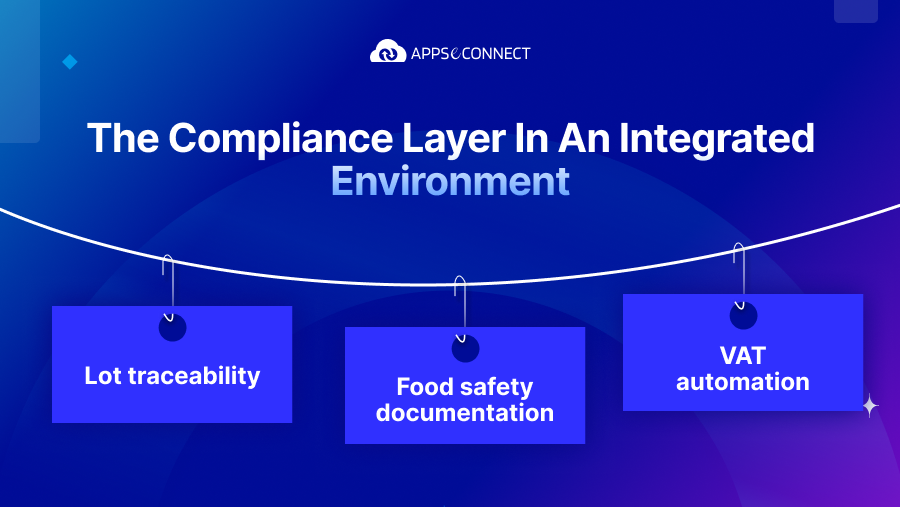
Compliance in food and beverage cannot be treated as a separate back-office task. It is built into daily operations. Batch history, product movement, production records, and VAT handling all need to stay correct while the business is running, not only when someone is preparing a file for review. That is why disconnected systems are such a problem in this sector. The compliance burden rises because every important record has to be rebuilt by hand later.
- Lot traceability: APPSeCONNECT helps solve that by making ERP the base for connected process flow. When lot and batch information moves through production, inventory, and fulfilment in one connected environment, traceability becomes a built-in system capability instead of a manual documentation exercise. This is one of the clearest operational advantages of ERP-first integration in food manufacturing.
- Food safety documentation: Food safety information also needs to stay consistent across the connected environment. Product status, quality holds, and supporting product documentation need to be accessible and consistent. If one channel or workflow is out of step, the business ends up depending on people to close the gap. appse ai helps support this by watching for data consistency issues across the connected environment, which means problems can be noticed earlier instead of surfacing during an audit or customer issue.
- VAT automation: VAT handling is another important part of this compliance layer. UK food products can sit across more than one VAT category, so the business needs stable tax treatment from the point where the transaction first enters the ERP. If that work is left to manual interpretation after the fact, the risk of inconsistency rises. APPSeCONNECT ties the ecommerce and wholesale data flow back to ERP tax logic, while appse ai helps identify suspicious patterns or mismatches earlier.
That is why we see compliance and efficiency as the same project in this sector. A cleaner integration flow does not only make the business faster. It also makes the business more controllable and easier to review.
The Headcount Equation: How Automation Replaces Manual FTEs Without Redundancy
When people hear “scale without adding headcount,” it can sound harsh. In UK food and beverage manufacturing, the reality is usually the opposite. The sector is already dealing with a labour gap. The problem is not that businesses have too many people. The problem is that they cannot always find enough people, and the people they do have are spending too much time on work that should not be manual in the first place.
That changes the meaning of automation. APPSeCONNECT and appse ai do not remove the need for people. They remove the need for people to spend their day moving data between systems, checking repeated exceptions, and rebuilding records that should already exist. That is a very different use of automation. The business still needs strong operations, finance, quality, and supply chain people. It just needs them working on higher-value tasks.
When orders flow directly into SAP Business One, the operations team can focus less on entry and more on service and planning. When AR follow-up is better organized, finance can spend more time on cash strategy and review. When expiry and batch checks are monitored more continuously, quality teams can focus on the actual exceptions instead of repeating the same review work every day. That is the real headcount equation: not fewer people, but better use of the people the business already has.
In a sector where vacancy rates were reported at 3.9% in the Food and Drink Federation’s Q1 2025 report, this matters a lot. A company that tries to solve every growth problem by hiring more staff will hit a limit faster than one that removes low-value manual work first. That is why the ERP automation that UK food and beverage manufacturers need is becoming such a practical growth decision in 2026.
Renegade Brewery and the Broader Pattern of SAP Business One Integration Success
Renegade Brewery is not the only business showing this pattern. A second APPSeCONNECT case from outside food and beverage shows the same SAP Business One integration pattern. SAP Business One was the ERP backbone, Shopify was the storefront layer, and customer-specific data had to move correctly between them. Without proper integration, pricing and order handling became unreliable and manual.
APPSeCONNECT solved that by creating an ERP-first flow where the systems stopped operating as separate worlds. Once SAP Business One, Shopify, and the related pricing logic stayed aligned, the team could stop spending time on repeated fixes and start focusing more on growth and customer service. Columb McCluskey of Trimwel said clearly that APPSeCONNECT’s support and system knowledge were central to making that happen.
The reason these cases matter together is that the sectors are different, but the pattern is the same. In both cases, the ERP was already in place. The real weakness sat in the disconnected systems around it. Once APPSeCONNECT connected those systems, the businesses moved from a manual, fragmented process to a much more stable one. appse ai extends that same ERP-first model with AI-driven workflow support.
That is why we say the success pattern is consistent. Whether it is a UK brewery, a sign and print distributor, or another mid-market manufacturer, the real shift happens when isolated system capability becomes one connected operating flow. The integration is what turns ERP from a record-keeping tool into a real operating advantage.
Implementation: From First Conversation to Live Workflows
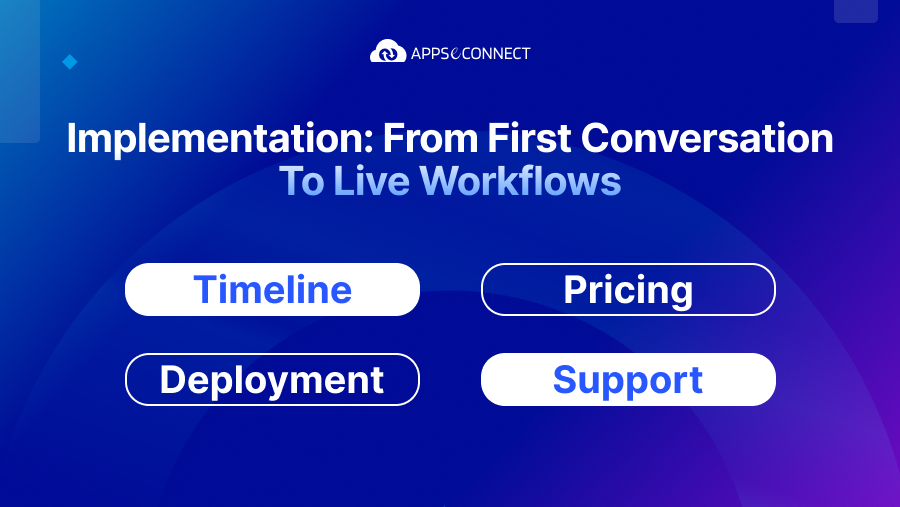
The first question most UK manufacturers ask is simple: how long will this take, and how hard will it be? That is a fair question because older integration projects often did take too long and cost too much. At APPSeCONNECT, we have worked hard to make that process more practical.
- Timeline: Standard SAP Business One and WooCommerce or Shopify integrations often go live within hours or days when the business can use pre-built connectors and ProcessFlow templates. More complex projects, such as those involving 3PLs, EDI, or specific lot-traceability requirements, naturally take longer, but they are still typically measured in days or weeks rather than in long enterprise-style programs.
- Deployment: Cloud, on-premise, or hybrid, depending on your SAP Business One installation type and your data sovereignty requirements. For UK F&B manufacturers with on-premise SAP B1, appse ai’s on-premise connector deployment ensures no disruption to the existing ERP architecture.
- Support: Every appse ai customer has access to platform documentation, the ProcessFlow visual builder for workflow modifications, and implementation support from a team with deep SAP Business One expertise, including UK-specific configurations for VAT, Making Tax Digital, and food safety compliance data flows.
- Pricing: Ready-to-deploy APPSeCONNECT packages start at $99 per month. Pricing for broader setups depends on the systems, workflows, and AI capabilities involved. APPSeCONNECT also supports cloud, on-premises, and hybrid deployment, which matters because many SAP Business One environments in the UK are still not fully cloud-only. The result is a faster path to value without asking the business to rebuild its whole architecture first.
The Cost of Not Automating
The cost of manual processing is becoming harder for UK manufacturers to absorb as margins tighten. Every avoidable manual task or inventory error directly erodes profitability in a market where costs often outpace revenue growth. Achieving long-term sustainability now requires a level of operational precision that manual workflows simply cannot provide.
The labour shortage makes the problem worse. When the sector already struggles to find enough people, manual work stops being just inefficient and starts becoming a growth limit. If the operations team is tied up entering orders, checking stock discrepancies, and pushing data between systems, the company has less room to expand without breaking its own process.
There is also a compliance cost. VAT handling, lot traceability, and food safety documentation all become harder when systems stay isolated. These are not nice-to-have records. They are part of how the business proves control. Manual processes can still work at a small scale, but they become harder to defend as complexity rises.
Then there is the strategic cost. The manufacturers that automate now will move into the next phase of growth with better stock accuracy, cleaner customer experience, shorter finance cycles, and stronger operational control. Manufacturers that wait will carry those manual weaknesses into the next phase of growth. They will add more volume on top of them and find that the pressure compounds in the wrong direction. That is why the cost of waiting is not neutral. It grows quietly until it becomes hard to ignore.
See How appse ai Works for UK Food & Beverage Manufacturers
If you run SAP Business One in a UK food and beverage manufacturing business, APPSeCONNECT can show you how to connect that ERP to your ecommerce, wholesale, finance, and operational systems in a way that actually reduces manual overhead. appse ai then adds the AI capability layer that helps keep those flows more visible, more reliable, and easier to manage.
Book a 30-minute UK sector demo with APPSeCONNECT and we will walk through how the platform supports cleaner order flow, better inventory control, stronger VAT handling, and more scalable operations for food and beverage manufacturers.
Frequently Asked Questions
The biggest challenges are usually manual order processing, stock mismatch across channels, slow purchase order creation, VAT handling across mixed food categories, and the need for lot traceability and food safety records. APPSeCONNECT with appse ai addresses all of these through ERP-first integration and AI-led support.
APPSeCONNECT provides bidirectional integration between SAP Business One and WooCommerce. Orders can move into SAP automatically, inventory can sync back out continuously, and fulfilment updates can return to the storefront. UK pricing, VAT handling, and trade processes can also be supported within that wider ERP-driven flow.
appse ai supports the APPSeCONNECT integration base by helping monitor the movement of batch and lot data through production, inventory, and fulfilment workflows. This helps manufacturers keep a stronger digital trail without relying so heavily on manual checks.
Ready-to-deploy APPSeCONNECT packages start at $99 per month. Broader pricing depends on the systems connected, the workflows required, and the level of AI capability needed.
It removes low-value manual work from the people the business already has. Orders, stock checks, AR follow-up, batch monitoring, and finance-related tasks can move with far less manual effort. That means the same team can focus more on growth, suppliers, customers, quality, and planning.