






The U.S. iPaaS market has emerged as an integral component in the digital transformation journey of companies across various industries in the United States. As companies increasingly adopt cloud-based solutions, the demand for secure, scalable, and seamless integration platforms has also increased. Currently, the U.S. iPaaS market is valued at several billion dollars. It is also expected to grow steadily over the next few years. This is mainly going to be driven by the rapid increase in the use of IoT devices, big data analytics, and the need for real-time data integration.
Manufacturing contributes $2.9 trillion to the US economy. This staggering figure represents the value added by the sector, equivalent to about 10% of the nation’s GDP. The market significance is also underscored by the rapid digital adoption among government agencies, Fortune 500 companies, and innovative startups, all of which are looking forward to bringing about operational efficiency in their business. However, the U.S. integration market is not without its challenges. So, here we are going to take a look at some of the major challenges that the U.S. integration market is facing. We will also take a look at how iPaaS for U.S. manufacturers can be used to solve the various problems associated with system integration and APPSeCONNECT’s relevance in this context.
The Integration Challenges in U.S. Manufacturing:
Integrating the disparate systems across your applications and data sources across U.S. manufacturing companies is no small feat. Instead, it requires a great deal of effort. Sometimes, the integration may give rise to challenges that create significant barriers that limit the company’s ability to leverage the power of integration.
So, here we are with some of the manufacturing integration challenges U.S. that businesses in the U.S. manufacturing sector face on a daily basis:
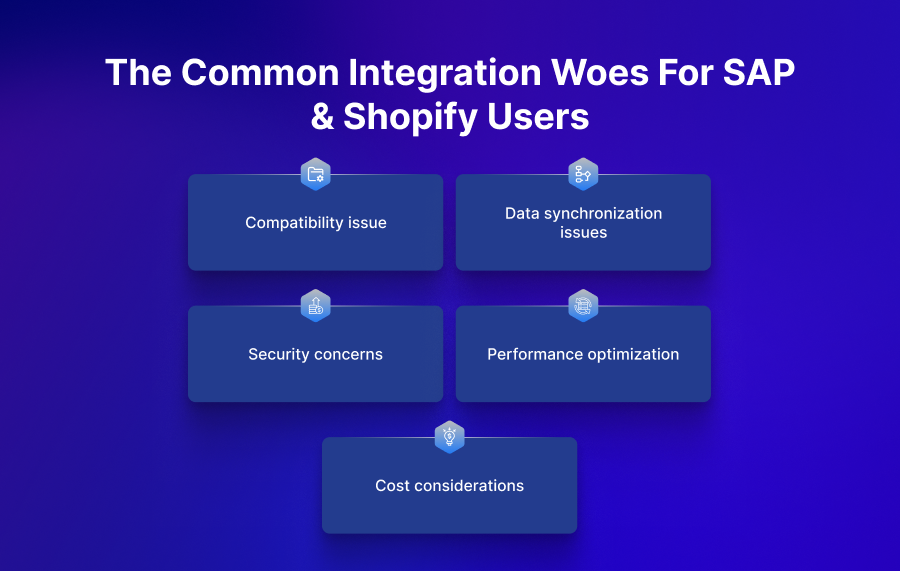
Compatibility issue:
U.S. manufacturers use software solutions like ERP, MES, etc., each of which is designed on different platforms. When the systems are required to work together, they can cause several challenges because of the use of different technologies and versions. This can make it complex for the manufacturers to collaborate with one another.
Data synchronization issues:
In the U.S. manufacturing industry, keeping data synchronized across systems is extremely crucial. The centralized data is used for production schedules, inventory management, and quality assurance. However, there is a difference in how data is structured on different platforms. This can lead to errors and system slowdowns.
Security concerns:
U.S. manufacturers deal with data related to product designs, customer information, production processes, etc. Integrating third-party applications may increase the risk of data breaches or unauthorized access. This especially happens when the required security measures are not applied, and compliance requirements are not followed.
Performance optimization:
Manufacturing processes often rely on real-time data processing and efficient system performance. Integrating different applications can strain resources and slow down business processes. This can impact operational efficiency. This further highlights the need for an integration solution to ensure that operational efficiency is maintained.
Cost considerations:
Integration solutions for U.S. manufacturers require a high cost for customization, license, etc. Ongoing expenses like upgrades and maintenance will also have to be taken care of. So, to ensure financial sustainability, companies must opt for one such integration solution that allows them to operate without causing any business hindrance.
Related Read: iPaaS and Intelligent Document Processing: A Complete Guide
Why Are the U.S. Manufacturers Turning to iPaaS?
iPaaS for U.S. manufacturers offer a lot of business benefits. So, let us take a quick look at what exactly those benefits are and how they can bring about significant development to the U.S. manufacturing industry:
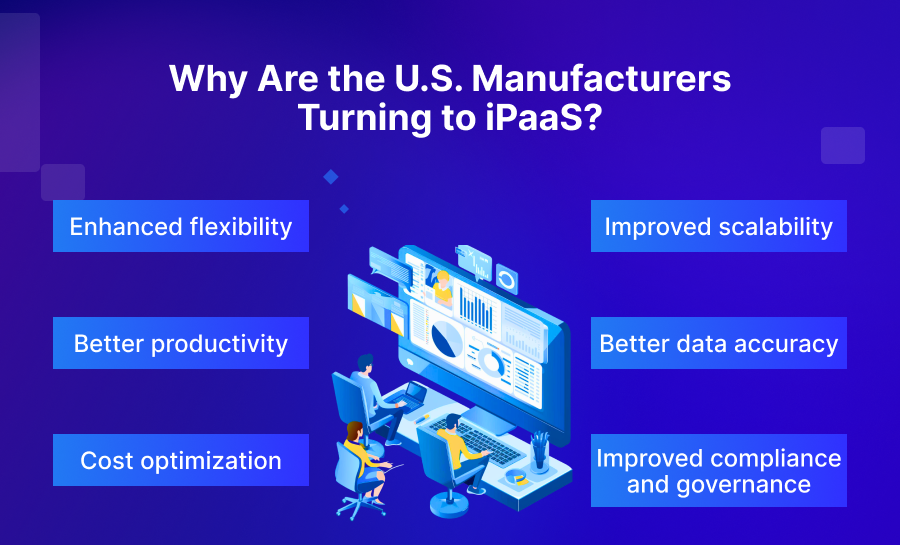
Enhanced flexibility:
With iPaaS, the U.S. manufacturers can enjoy enhanced flexibility. They can connect the various systems in their business environment using pre-built connectors and other advanced tools. This allows them to ensure that the various business operations are streamlined and the business also achieves maximum growth.
Improved scalability:
With iPaaS adoption in U.S. manufacturing, adding new systems to the existing integration framework becomes a simple affair. All you need is to create a new connection to the central hub, and the new system will immediately start connecting with all other systems. This makes your company extremely agile and future-ready to accommodate unique business needs.
Better productivity:
By automating workflows and manual tasks, iPaaS can be used to accelerate production cycles and minimize dependencies on various labor-intensive processes. This not only reduces lead time but also improves productivity by allowing resources to focus on various strategic initiatives rather than only focusing on routine operations.
Better data accuracy:
The real-time data synchronization facilitated by iPaaS ensures that vital information remains integrated across the various systems. This synchronization eliminates data discrepancies and errors which may arise due to outdated information or manual data entry. This further enhances the decision-making process.
Cost optimization:
Manufacturing process automation with iPaaS can reduce operational costs by putting an end to redundancies and inefficiencies. By reducing workflows, optimizing resource allocation, and minimizing downtime, manufacturers can achieve significant cost savings across logistics, production, and maintenance operations.
Improved compliance and governance:
In today’s regulatory environment, ensuring compliance with the various industry standards and maintaining proper data security measures is paramount. iPaaS allows manufacturers to enforce standardized workflows and ensure regulatory compliance across the various systems. By implementing various security measures, iPaaS helps enhance the governance framework. It also protects the sensitive data from any kind of unauthorized access.
How does iPaaS Support Manufacturing Workflows?
Here’s how iPaaS for U.S. manufacturers can be used to support the various critical workflows in the manufacturing environment:
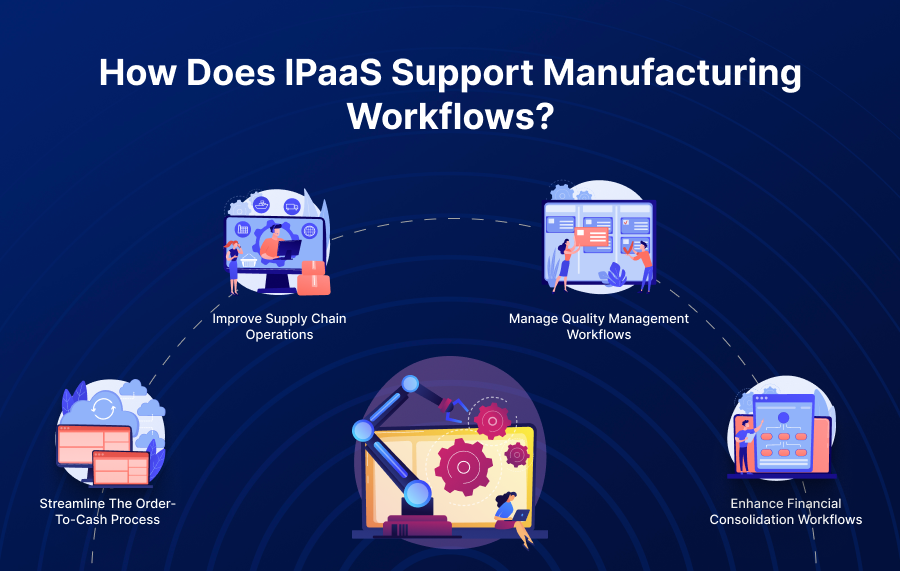
Streamline the order-to-cash process:
Integration solutions for U.S. manufacturers can significantly streamline the order-to-cash process. Whenever a customer places an order through any eCommerce portal or a sales team enters a record in a CRM system, iPaaS automatically synchronizes the data with the ERP system. This helps trigger production planning workflows. As the production progresses and the manufacturing system updates the order status, iPaaS also updates the same in the customer-facing systems. This offers the customers real-time visibility of the order. They are also able to perform their operations in a smooth and streamlined manner.
Improve supply chain operations:
This is yet another way how iPaaS supports manufacturing workflows. As you know, the manufacturers require real-time visibility into inventory shipment status and various quality metrics. iPaaS can be used to connect the supplier system with internal procurement and production planning tools. This allows for automated purchase order transmission and shipment notification. Whenever any kind of supply chain disruption occurs, the integration provides early warning. That way, you can take the necessary steps and prevent any kind of hindrance.
Manage quality management workflows:
Now this is yet another place where iPaaS adoption in U.S. manufacturing has proved itself to be extremely effective. iPaaS can be used for quality management in the U.S. manufacturing sector. iPaaS platforms capture inspection data from various manufacturing systems and coordinate corrective actions across ERP, supplier management, and documentation systems. Various notifications are also sent to the stakeholders so that the root cause analysis can be performed on any quality disputes which are observed.
Enhance financial consolidation workflows:
iPaaS can be used for financial consolidation across the various systems. When iPaaS integrates ERP and financial reporting, various cost-related data, including production cost, labor hours, material consumption, etc., are automatically added into the financial system. This allows for accurate cost accounting. It also helps prevent the manual data reconciliation process, thereby paving the way for better monitoring. The financial data also remains transparent across the various systems.
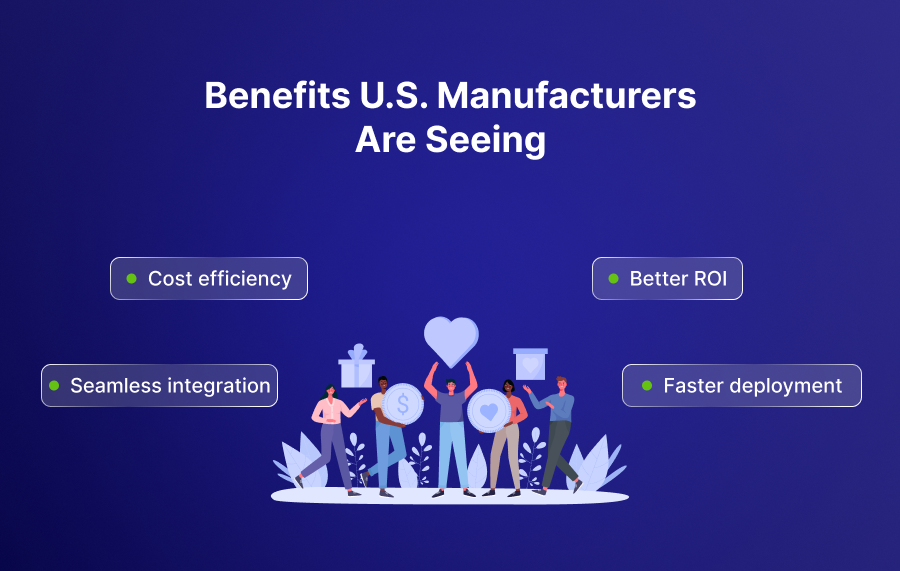
Benefits U.S. Manufacturers Are Seeing:
Here are some of the major benefits of iPaaS for U.S. manufacturers:
Seamless integration:
iPaaS can be used to seamlessly integrate the various systems across your manufacturing environment. This ensures that you no longer have to deal with siloed data and processes. Your various business operations can be streamlined. Your overall efficiency also increases.
Cost efficiency:
By integrating all the disparate systems into a unified platform, iPaaS can reduce IT overhead. It also saves on development resources, infrastructure costs, and ongoing maintenance costs.
Faster deployment:
The iPaaS platform offers various advanced tools and pre-built connectors, which allow for rapid deployment. This allows manufacturing companies to launch their integration quickly, which further improves productivity.
Better ROI:
With iPaaS integration, manufacturing companies can witness better ROI from their business operations. Their revenue generation experiences an excellent boost. The companies are also able to gain an edge over their competitors.
U.S. Manufacturers Example:
Now, here are a few instances where U.S. manufacturers have witnessed significant improvements in their business operations after adopting iPaaS:
Example 1:
United Sports Brand, one of the primary manufacturing brands in the sports sector, was able to achieve prime order synchronization with Microsoft Dynamics GP by opting for iPaaS integration. Earlier, the company was facing various challenges integrating Buy with Prime (BWP)models from Shopify into Microsoft Dynamics GP. This was especially true with mixed orders. APPSeCONNECT’s iPaaS solution helped the United Sports Brand keep track of its inventory and financial posting clearly. This allowed for smooth operations for all their Amazon fulfilled transactions.
Click here to read the full case study!
Example 2:
The integration of Sage 300 and WooCommerce allowed Merola Tiles to eliminate manual order entry. The company was able to enjoy immediate inventory updates and overall workflow synchronization. This resulted in a faster order fulfillment process. The stock visibility improved considerably; both the customers and operations teams began to enjoy a better experience. The company’s revenue generation also increased significantly within a very short tenure.
Click here to read the full case study!
Example 3:
WaterTech Corporation, an extremely renowned company in the U.S., faced multiple operational challenges because of manual processes and a lack of integration between its ERP systems and eCommerce platform. APPSeCONNECT’s iPaaS integration allowed the company to overcome the various challenges and streamline its various workflows. As a result, the company was able to take its business to extraordinary heights, and that too within a very short time. Its business ROI also increased significantly.
Why APPSeCONNECT Fits U.S. Manufacturing Needs?
APPSeCONNECT is the ideal iPaaS for U.S. industrial businesses belonging to the U.S. manufacturing sector. It helps manufacturing companies streamline their various operations and improve the manufacturing process. With APPSeCONNECT’s enhanced set of features, prebuilt connectors, and automated workflows, companies belonging to this particular sector can automate their various processes, enjoy seamless operations, and also minimize challenges related to manual labor and inefficiencies.
APPSeCONNECT can also address your unique integration needs and design the solutions accordingly. This can further help you in taking your business to extraordinary heights.
Final Thoughts:
So, if you are on the lookout for an ideal iPaaS for U.S. manufacturers to streamline the various operations of your manufacturing firm, then it is high time that you reach out to the experts at APPSeCONNECT and avail of their services.
Frequently Asked Questions
There are several factors which are accelerating iPaaS adoption, like the rise of Industry 4.0 and smart manufacturing, increased demand for cloud applications, labor shortages, need for automation, etc
Common systems include ERP, manufacturing execution systems, warehouse management systems, CRM platforms, etc.
Some of the ROIs include faster order-to-cash cycles, improved inventory accuracy, better decision-making, and reduced system downtime.