





From 6 April 2026, Making Tax Digital for Income Tax starts for sole traders and landlords with qualifying income over £50,000, and the threshold then drops to £30,000 from 6 April 2027. That means more frequent digital reporting, stronger record-keeping, and much less room for weak or delayed data flow between systems.
Even where a business is not directly in that first wave, the direction is clear: stronger digital record-keeping and cleaner connected data are becoming harder to ignore.
At APPSeCONNECT, we see the same problem again and again. The ERP may be strong, but the systems around it are still disconnected. Shopify, WooCommerce, payment tools, freight platforms, customs data, and finance processes all sit outside the ERP and force teams to patch the gap by hand. APPSeCONNECT is the integration platform, and appse ai is the AI capability layer of APPSeCONNECT. Together, they help UK mid-market businesses connect the ERP to the systems around it, reduce manual checking, and keep records cleaner for both operations and compliance. APPSeCONNECT is trusted by 5,000+ businesses worldwide.
Making Tax Digital for Income Tax: What It Really Means for Businesses Running ERP Systems
A lot of people still talk about Making Tax Digital as if it is only a filing task. It is not. For a business running SAP Business One, Sage 300, or another ERP with several connected tools around it, this is really a data problem. Filing is the last step. The hard part is keeping the data right before that point.
A UK distributor or manufacturer rarely runs on a single system. Sales can come from Shopify or WooCommerce. Customer data may sit in CRM. Payment details may sit in gateways or bank tools. Costs and stock live in ERP. Payroll often runs somewhere else. If these systems are not connected properly, the finance team ends up collecting numbers from several places and trying to make them agree before each quarterly submission.
That is where the pressure starts. Missing fields, wrong tax treatment, and delayed updates do not always look serious when they first happen. But once the reporting period closes, they all land on the finance team at once. The team is then not just preparing the submission. It is rebuilding the business picture from scattered records.
For many mid-market businesses, this is already costing days every quarter. A finance manager or controller ends up pulling online sales data, checking bank settlements, reviewing ERP records, and matching everything back to the same number. That is not the kind of work that should still be manual in 2026.
The real lesson is simple. MTD should not be treated as a narrow finance deadline. It should be treated as the point where the business finally fixes the gap between ERP and the systems around it. Once those records move into the ERP in a cleaner and more timely way, the filing step becomes much easier. appse ai strengthens that by helping businesses monitor data movement, flag mismatches, and keep the process more stable through the whole period, not just at the end.
The Post-Brexit Supply Chain Data Problem
MTD is the compliance pressure. Post-Brexit supply chain work is the daily operating pressure that makes the same problem worse. Since the UK left the EU, many businesses have had to deal with more customs records, more shipping data, more import and export checks, and more VAT handling across borders. HMRC guidance makes clear that import, export, customs, and VAT records need to stay accurate across the full movement of goods.
Mid-market businesses often struggle with disconnected systems that complicate financial reporting. While the ERP stores purchase orders and inventory costs, customs and freight data are frequently siloed in spreadsheets or external portals. This means the business must still manually gather information from multiple places before it can trust its final landed cost and tax calculations.
Managing supplier invoices has become more difficult in the post-Brexit environment. Different formats and frequent manual checks on VAT, duties, and freight charges create bottlenecks. Manually inputting this data into Sage 300 or SAP Business One often leads to mismatches. This inefficiency creates significant risk; a single error in a VAT code or customs charge immediately affects financial reporting, product pricing, and stock valuation. As long as systems stay disconnected, it becomes harder to maintain one accurate record through the fulfilment cycle.
That is why APPSeCONNECT treats this as one connected problem instead of several small ones. The ERP should not sit at the end of the chain waiting for someone to explain what happened. It should sit at the centre, with the right data flowing into it from the start. appse ai then adds AI-driven checking, reconciliation support, and clearer visibility into where the process is breaking down. Manual checking is no longer enough when the process itself is this fragmented.
Case Study 1: Trimwel LTD - B2B Distribution, Custom Pricing, and the Integration Imperative
Trimwel LTD is a strong example of what this looks like in real business terms. The company operates in the sign and print trade across the UK and Ireland and works with brands such as Metamorph, 3M, Contravision, and IC2. In that kind of B2B distribution setup, pricing accuracy, stock visibility, and dependable order handling are not nice extras. They are basic operating needs.
The challenge: Before APPSeCONNECT, Trimwel was running SAP Business One and Shopify as separate systems. That meant orders placed in the store still needed manual work before they became clean ERP records. Inventory in SAP was not always reflected fast enough or accurately enough in Shopify. That alone would have been a big problem. But Trimwel also had another layer: customer-specific pricing managed through a third-party pricing tool alongside SAP Business One.
That pricing logic was central to how the business served its trade customers, but it was not moving cleanly into the storefront order flow. That meant customers could see the wrong price, place the order, and then trigger manual correction work for the team. In B2B, that kind of pricing error is more than an admin issue. It affects trust, margin, and the wider dealer relationship.
The solution: APPSeCONNECT solved this by connecting SAP Business One and Shopify in both directions and by also bringing the third-party pricing tool into the flow. That meant the portal could reflect the actual price logic the business was already using instead of a rough or out-of-date version of it. Orders could move into SAP Business One with the right account structure, the right customer information, and the right pricing. Inventory could move back to the storefront with much better timing. The business no longer had to correct the same order in multiple systems.
The outcome: The result was a clear jump in operating efficiency. Real-time data movement replaced repeated manual handling. Customer-specific pricing became more dependable. Inventory visibility improved. The team could focus more on service and growth instead of chasing the same data gap across ERP and Shopify. As Columb McCluskey, Sales Director at Trimwel LTD, put it, APPSeCONNECT’s support and system knowledge were central to making that integration work.
The Trimwel case shows why generic app links are not enough. A B2B distributor does not only need orders to move. It needs pricing, account structure, and stock logic to stay aligned too. APPSeCONNECT provides that ERP-first integration base, and appse ai adds AI capabilities that make those live flows easier to monitor and manage over time.
Case Study 2: Renegade Brewery - UK Manufacturing, Global Ambition, Automated Operations
Renegade Brewery shows the same pattern in manufacturing. It is a UK craft brewery using SAP Business One as its ERP and WooCommerce as its direct and trade storefront. Like many growing manufacturers, it had the right systems in place, but the systems were not working together well enough to support the next stage of growth.
The challenge: Before APPSeCONNECT, the gap between SAP Business One and WooCommerce created daily manual work. Orders had to be handled with more manual effort than necessary. Inventory was harder to keep fully aligned. Fulfilment updates did not move back as smoothly as the business needed. In a steady domestic operation, that is already frustrating. In a business with global ambitions, it becomes a real limit.
The problem was not that the team lacked effort. The problem was that too much of that effort was going into moving data between systems. That meant less time for product work, customer relationships, international growth planning, and the higher-value parts of the business that actually move a brand forward.
The solution: APPSeCONNECT solved this by connecting SAP Business One and WooCommerce in a cleaner, ERP-first flow. Orders placed on WooCommerce could be validated against SAP pricing and stock logic, then created in the ERP without the same manual handoff. Inventory updates could move back to the storefront with better timing. Fulfilment updates could return to WooCommerce without someone having to push them manually after the fact. That removed a layer of low-value work from the whole operation.
The outcome: Renegade’s team then had room to focus on more important work. Richard Grew from Renegade Brewery described appse ai as easy to use, visually clear, and professionally supported. That matters because integration only creates real value when the people using it can understand what is happening and trust the process behind it.
This case proves a simple point. Businesses do not only need automation to save time. They need it so growth does not force them to keep adding manual admin just to stay in control. APPSeCONNECT provides the connected ERP flow. appse ai adds the AI-driven support that helps teams manage those live flows with less noise and more confidence.
The Finance Automation Layer: MTD Compliance Built Into Operations
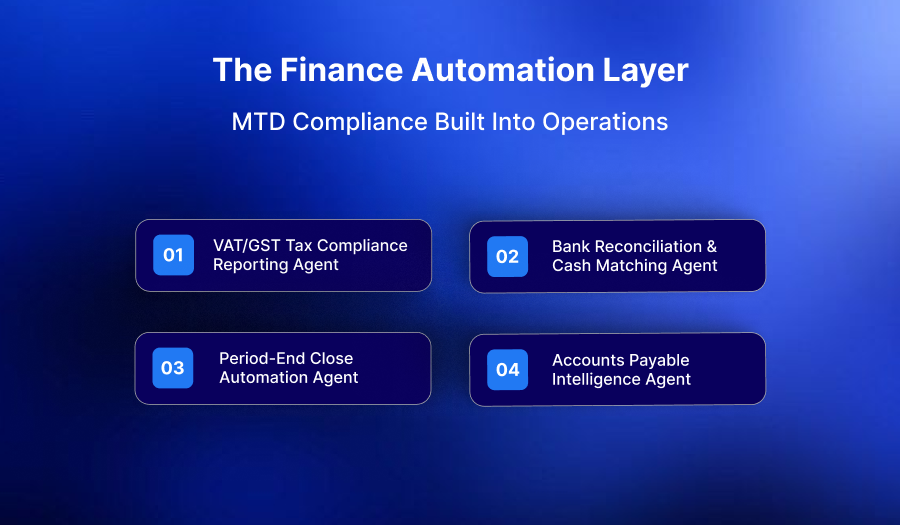
The best response to MTD is not to build one more filing process. The better response is to make finance data cleaner every day, so the quarter-end job becomes lighter by default. That is how APPSeCONNECT and appse ai approach the finance side.
- VAT/GST Tax Compliance Reporting Agent: The first part is AI-driven VAT monitoring. When sales, refunds, cross-border transactions, and channel data move through several systems, VAT treatment can drift without anyone noticing right away. appse ai supports AI-led VAT checking across connected records so the finance team can see unusual treatment sooner, not only when quarterly reporting is already due. That means fewer last-minute fixes and better confidence in the numbers.
- Bank Reconciliation & Cash Matching Agent: The second part is AI-driven bank and cash matching support. Payment data often arrives from gateways, banks, and ecommerce channels in different shapes and at different times. APPSeCONNECT helps bring those records back into the ERP flow, while appse ai supports reconciliation by highlighting mismatches and helping finance see what still needs review. This is especially useful in multi-currency or multi-channel environments where manual matching would otherwise take hours.
- Period-End Close Automation Agent: The third part is AI support for period-end close. Many mid-market finance teams lose days each quarter just trying to get one clean view of the numbers before they can actually review them. appse ai helps reduce that burden by supporting the collection, alignment, and checking of records coming from connected systems. This does not remove the finance team from the process. It removes a large part of the repeated data-gathering work that slows the process down. Quarter-end becomes a controlled review process instead of a scramble.
- Accounts Payable Intelligence Agent: The fourth part is AI support for accounts payable matching. Post-Brexit supplier invoices, freight costs, and goods receipts often create more work than the team expects. APPSeCONNECT keeps those records closer to the ERP, and appse ai helps by supporting matching and highlighting exceptions that need attention. That helps reduce duplicate work, reduces payment mistakes, and gives finance a stronger basis for VAT and cost review.
This is what we mean by finance automation built into operations. It is not a separate automation layer sitting outside the ERP. It is APPSeCONNECT’s ERP-first integration flow with appse ai adding AI-led support on top, so finance can work from cleaner records through the full period instead of trying to rescue the process every quarter.
Why UK Mid-Market Businesses Would Choose appse ai Over Generic iPaaS Tools
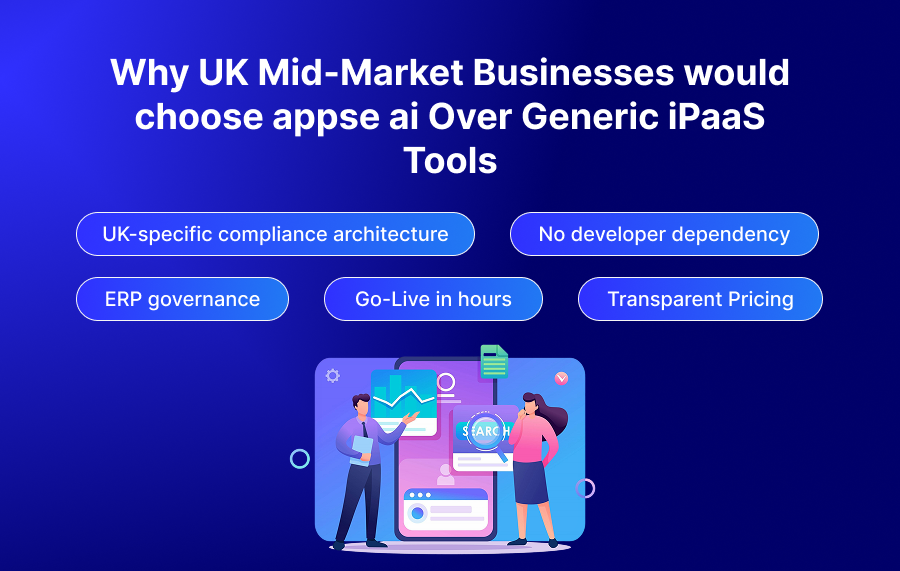
Many generic automation tools can connect cloud apps. That is useful for light tasks. But UK distributors and manufacturers running SAP Business One or Sage 300 do not have a light task. They need pricing, stock, VAT, landed cost, account logic, and finance records to stay tied back to ERP. That is a very different job.
- ERP governance: The first difference is ERP control. Generic tools often treat ERP like one more app in the chain. APPSeCONNECT does not. It treats ERP as the governing system of record. That means the main business logic still sits where the business expects it to sit. Pricing, stock, account status, and finance rules can all be validated against ERP instead of being improvised in separate tools. In short, ERP remains in control of core business logic.
- UK-specific compliance architecture: The second difference is fit for the UK operating environment. MTD, VAT handling, multi-currency trade, and post-Brexit supply chain detail create a very specific kind of pressure. APPSeCONNECT is built to support businesses operating in that kind of environment, not just general app-to-app automation. appse ai then adds AI-led support where businesses need it most, such as tax checking, reconciliation support, and finance workflow visibility.
- No developer dependency: The third difference is ease of use. Mid-market businesses usually do not have large internal integration teams. They need something the operations or finance side can actually work with. APPSeCONNECT’s ProcessFlow model and appse ai’s AI-driven support make it easier to shape and run workflows without turning every change into a heavy development project.
- Transparent pricing: The fourth difference is pricing and access. APPSeCONNECT offers ERP integration packages starting at $99 per month, with pre-built, professionally managed implementations instead of heavy custom projects. That matters because many mid-market businesses do not need a huge enterprise platform. They need something they can actually approve and use.
- Go-live in hours: The fifth difference is proven adoption, with APPSeCONNECT trusted by over 5,000 businesses worldwide. For mid-market companies choosing between a generic connector and an ERP-first platform, this scale of adoption confirms the product is proven in real-world operations. This track record demonstrates that the platform is built for live business environments rather than just small-scale demos.
Implementation Reality: Compliance-Ready in Days, Not Months
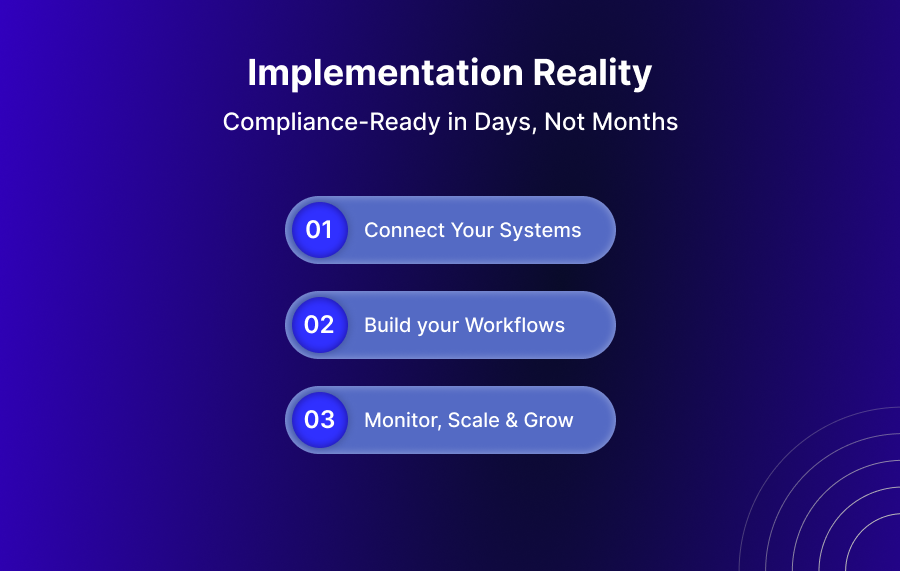
A lot of businesses still assume ERP integration means a long, heavy project. That is often because they are thinking of older custom middleware work, where everything began from scratch. APPSeCONNECT is built differently. The goal is to get the business from disconnected systems to a working flow quickly, without asking it to rebuild its whole stack first.
APPSeCONNECT uses a guided, fast rollout model built around connect, configure, and go-live steps. In practice, that means a UK business can start with pre-built connectors for ERP, ecommerce, CRM, and logistics systems instead of trying to design the entire integration pattern from zero.
Step 1 – Connect your systems: The first step is connection. The business links SAP Business One, Sage 300, Shopify, WooCommerce, and any other systems involved.
Step 2 – Build your workflows: The second step is shaping the workflow so it fits the way the business actually operates.
Step 3 – Monitor, scale, and grow: The third step is going live and then monitoring the health of the flow. Many of these packages start at $99 per month and are built for faster rollout than traditional large-scale projects.
This speed matters because the MTD deadline is not theoretical anymore. A business that waits too long is not just delaying a technology upgrade. It is choosing to carry the same manual quarter-end pressure for another cycle. Going live in days, not months, changes that decision completely.
appse ai strengthens the go-live process too. Once the integration is active, it helps the team see where the process is healthy, where something is drifting, and what needs attention. That is important because a fast launch only matters if the business can then run the live environment with confidence.
The Strategic Imperative: MTD as the Catalyst for Operational Transformation
MTD is easy to treat as a tax project. That would be the smaller way to look at it. The better way is to see it as the point where a business finally fixes the wider process it already knew was weak. The same disconnected systems that make quarterly reporting painful are usually the ones making order flow, stock accuracy, and finance close harder every week.
That is why the real value of this work goes beyond compliance. Once the ERP is connected to ecommerce, finance, payments, customer systems, and logistics tools in a cleaner way, the business starts running from one stronger version of the truth. The finance team gets cleaner records. The operations team gets fewer manual handoffs. Customers get more accurate pricing and stock. Leaders get numbers they can trust sooner.
This is where APPSeCONNECT and appse ai work together well. APPSeCONNECT provides the integration base that keeps ERP at the centre. appse ai adds the AI capability layer that helps check the flow, spot mismatches, and reduce the need for manual repair work. Compliance becomes easier because the operation itself is cleaner.
That is why UK mid-market businesses should not treat MTD as only a filing burden. It is also a chance to fix the same system gap that is already costing them time and control. The businesses that move now will not only be better prepared for quarterly digital reporting. They will also operate with more control and less manual friction.
Ready to Make Your UK Business MTD-Ready and Operationally Excellent?
If your SAP Business One, Dynamics 365, or Sage 300 system is still sitting apart from your ecommerce, finance, and logistics tools, APPSeCONNECT can help close that gap. APPSeCONNECT provides an ERP-first integration platform, and appse ai adds the AI capability layer that supports cleaner reconciliation, better data consistency, and less manual checking across the whole flow.
Book a UK-focused ERP integration consultation and see how APPSeCONNECT and appse ai can help make your operations more MTD-ready and easier to manage at the same time.
Frequently Asked Questions
APPSeCONNECT helps connect ERP with the systems that create tax-relevant records, and appse ai adds AI-led support for VAT checking, reconciliation, and finance review so the data is cleaner through the quarter.
APPSeCONNECT supports SAP Business One for UK integration needs, including ERP-led connections with ecommerce, finance, and logistics systems.
The key need is cleaner data flow. Orders, payments, VAT treatment, and related records should move from Shopify into Sage 300 in a way the finance team can trust without rebuilding everything by hand later.
It adds more customs, VAT, supplier invoice, and landed-cost data to the process. If that information stays outside ERP, finance and operations carry more manual work and more risk of mismatch.
APPSeCONNECT uses a guided rollout model with ready-to-deploy packages, so implementations can move much faster than traditional custom projects.
APPSeCONNECT integrations start at $99 per month with clear package-based pricing built for faster approval and rollout.