



DOWNLOAD THE FREE EBOOK
Why Your Business Is Missing Out If D2C & Marketplace Is Not Your Immediate Strategy
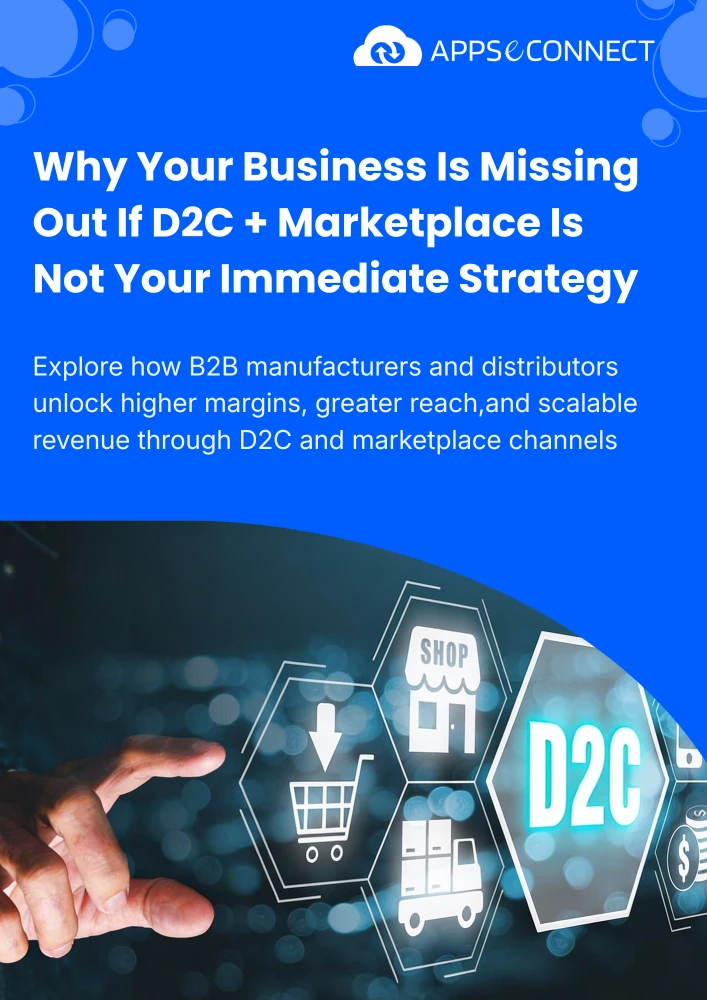
Get Your Free Copy Now – Why Your Business Is Missing Out If D2C & Marketplace Is Not Your Immediate Strategy
Without any obligation
Your dealer network is active, your sales team is hitting targets, and quarterly reports look clean. But while your business has held steady, your end consumers have quietly moved, to Amazon, to Shopify storefronts, to marketplaces that your competitors are already selling through, without a dealer in the middle taking a margin cut. The D2C channel in the US alone has crossed $213 billion in annual spending. Brazil’s eCommerce market grew 18.7% in a single year. These are not projections, they are the markets your customers are already shopping in.
This playbook is for B2B manufacturers and distributors who are ready to ask the harder question: not whether to add D2C and marketplace channels, but how to do it without breaking what’s already working. Written from direct experience working with hundreds of brands across North America, Europe, Latin America, and Asia, the case studies are real, the numbers are documented, and the counsel is blunt.
- How COVID-19 permanently accelerated the consumer shift to online purchasing across every major economy
- Why your dealer network is a distribution mechanism, not a moat
- The margin reality: D2C operations yield 50-75% gross margins vs. 20-35% through traditional dealer channels
- Real data: $213B+ in US D2C spending and what it means for your category right now
- How to eliminate the intermediary margin cut without dismantling dealer relationships
- Why D2C expands your total addressable market into geographies your dealers simply don’t cover
- How seasonal businesses can use geographic arbitrage across hemispheres to smooth revenue cycles
- Why D2C scales volume without scaling headcount, and how one manufacturer proved it by growing D2C to 45% of revenue with just a 10% headcount increase
- Channel understanding: the operational rules of Amazon, Walmart Marketplace, Wayfair, and your own Shopify storefront are entirely different, and non-negotiable
- Digital marketing: why your product listing is the sales pitch your dealer’s team used to deliver in person, now rendered as pixels
- Promotions as a precision instrument: how to prepare for BFCM and Prime Day operationally, not just commercially
- Automation: as the foundation, not a feature, of everything else that works in D2C
- Paid channels: how to build the ERP-to-ad-spend feedback loop that makes paid advertising profitable instead of just expensive
4. The Honest Challenges of D2C Transition, and How to Navigate Them
- How to establish MAP policies and product segmentation strategies that protect dealer relationships before conflict occurs
- The inventory allocation problem: which channel gets stock during a demand surge, and how to build the ERP logic that answers this automatically
- Why D2C returns are categorically different from B2B RMAs, and the operational infrastructure required to handle them at scale
- How to automate subscription management, return-to-ERP credit notes, and financial reconciliation without adding headcount
- Why gross sales is the wrong primary metric, and what net margin after fees actually reveals
- The eight KPIs that matter in D2C: Order Volume, Net Margin After Fees, Returns Rate, CAC, Conversion Rate, Average Order Value, Repeat Purchase Rate, and Shipping Cost Per Order
- How each KPI connects directly to a specific operational automation, and why the businesses that set these frameworks before launch consistently outperform those that discover gaps at month three
- Why optimising for gross sales while net margin quietly deteriorates is the most common and most avoidable D2C failure mode
- Order sync to ERP and financial systems, eliminating the manual queue, the batch delay, and the reconciliation headache
- Order-to-fulfilment routing: how orders reach the right warehouse or 3PL the moment they clear ERP validation
- Inventory sync across all channels: why overselling is a structural problem solved by ERP-connected channels, not by faster manual updates
- Shipment and tracking automation: why customers who know their order status before they ask don’t generate support tickets
- Financial reconciliation by period, channel, and order, compressing a 3-day manual finance close into an automated output
- Why the institutional knowledge that built your B2B business cannot be transferred to an outsourced agency
- What you can legitimately outsource (Amazon advertising, fulfilment, paid social execution) versus what must stay in-house (channel strategy, pricing architecture, customer relationships)
- The capability gap argument for outsourcing, and why the right platform and implementation partner closes those gaps without surrendering strategic control
- The honest conclusion: outsource the tasks, own the strategy
8. How APPSeCONNECT Makes This Infrastructure Possible
- How ERP-first integration connects SAP Business One, NetSuite, Microsoft Business Central, & Sage 300 to Shopify, Amazon, BigCommerce, WooCommerce, Magento, Wayfair, and more
- How appse ai’s 20+ enterprise AI agents handle Inventory Optimisation, Demand Forecasting, Revenue Intelligence, and Customer Lifetime Value decisions autonomously
- The Autonomous Workflow Builder: how your operations team describes an automation in plain English and has AI build the workflow, no developer, no IT ticket, no six-week wait
- Why ERP integration that is live in 4-8 weeks changes the D2C launch calculus entirely
This playbook is written specifically for mid-market B2B manufacturers and distributors who are either preparing to launch D2C and marketplace channels or trying to scale channels that have already started but haven’t yet reached their potential. If any of the following describes your business, this is for you:
- Operations & Supply Chain Leaders managing inventory across multiple channels and struggling with oversells, manual order processing, or fulfilment delays during demand peaks
- Sales & Business Development Leaders watching competitors capture end consumers directly while your dealer network grows more slowly than the market
- IT & Digital Transformation Leaders evaluating iPaaS platforms and needing a clear picture of what ERP-to-channel integration actually delivers in practice
- eCommerce & Marketplace Owners running D2C or marketplace channels that are growing but consuming disproportionate operational resource relative to the revenue they generate
- C-Suite & General Managers at companies with $10M–$200M in revenue who are making the strategic decision about whether and how to commit to D2C as a meaningful revenue channel
It doesn’t sell you the dream, it gives you the operational reality. Most D2C content tells you why you should sell direct. This playbook tells you what actually breaks when you do, and how to build the infrastructure that prevents it. The challenges covered, channel conflict, inventory allocation, returns management, financial reconciliation, are the ones that sink D2C operations that were commercially promising but operationally underprepared.
The numbers are real and the case studies are documented. A water treatment manufacturer grew D2C from 1% to 45% of total revenue with a 10% headcount increase. An East Coast distributor went from managing D2C manually as an afterthought to processing 2,000+ D2C orders daily, with marketplace and D2C now outnumbering B2B orders entirely. These outcomes are not hypothetical. They are the result of a specific automation infrastructure applied to a specific operational problem.
It gives you a framework, not just an argument. The playbook covers the five capabilities to build, the eight KPIs to track from day one, the five automation priorities to implement, and a clear-eyed assessment of what to outsource and what to keep in-house. Readers leave with a decision framework, not just a conviction that D2C matters.
It respects your existing business. This is not a playbook that tells you to abandon your dealer network or rebuild your operations from scratch. It is built on the premise that D2C extends and protects what you’ve already built, and that the right automation infrastructure is what makes that possible without operational chaos.
It directly addresses the resourcing objection. The most common reason mid-market manufacturers delay D2C is the belief that they don’t have the team, the technology, or the capacity. This playbook addresses that objection directly, with a clear picture of what automation replaces, what it costs, and how fast a qualified implementation partner can have your ERP connected to your D2C channels and live.
This playbook gives you the commercial case, the operational framework, and the honest assessment of what it actually takes to build a D2C channel that generates margin, not just revenue. The playbook exists. The case studies are documented. The technology is available. Download it, read it with your operations and commercial leadership, and use it to decide whether steady is still enough, or whether it’s time to build the infrastructure that turns your D2C potential into D2C reality.
Are you looking to automate your business processes and accelerate your growth?
Discover how our robust iPaaS can help you build fast and scalable integrations and enable a future-proof tech landscape, from one single platform to boost your business efficiency!