





An EDI service provider helps a business exchange standard electronic documents with trading partners and connect those documents to internal systems like ERP, WMS, CRM, and accounting. The right provider fits how your data actually moves. The wrong one creates failed transmissions, retailer penalties, and onboarding projects that stall.
Key Takeaways
|
What Is an EDI Service Provider?
An EDI service provider does two jobs at once. It exchanges standard electronic business documents with your trading partners, and it makes sure those documents connect properly with the internal systems you already run, including ERP, WMS, CRM, ecommerce, and accounting software.
Most providers handle far more than file transfer. They also manage mapping, format conversion, validation, partner setup, transaction monitoring, and support around the document flow.
On a daily level, that support keeps purchase orders, invoices, ship notices, order acknowledgements, stock updates, and payment documents moving between businesses. Teams no longer have to manage attachments, copy data by hand, or re-enter the same information in spreadsheets. The real goal is not file delivery alone. The document has to be correct, reach the intended partner, and show up as usable data inside the systems the business already runs.
This is where weak provider choices start to hurt. A document can pass through the exchange layer and still create friction if it does not post properly into ERP, warehouse, finance, or order management systems.
Types of EDI Service Providers
Most buyers do not just choose a vendor. They choose an operating model. That model decides how much work stays with your team, how fast partners can go live, and how predictable the long-term cost feels.
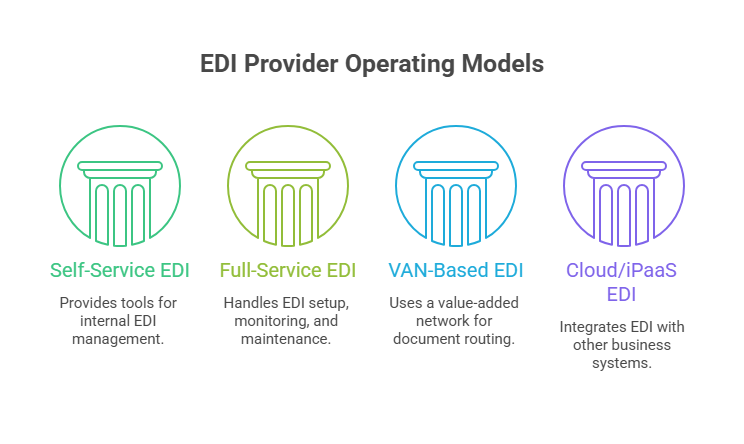
Provider type | How it works | Best fit | Cost and effort | Watch-outs |
Self-service EDI provider | Gives your team tools to create, send, receive, and monitor EDI documents | Small teams with simple partner requirements and enough internal ownership | Lower service cost, higher internal effort | Your team may own setup, mapping, testing, and error handling |
Full-service or managed EDI provider | Handles more of the setup, partner onboarding, monitoring, and ongoing maintenance | Businesses that do not want to manage EDI internally | Higher service involvement, lower internal workload | Scope varies widely, so support and change handling must be clear |
VAN-based EDI provider | Uses a value added network to route documents between trading partners | Partner networks that rely on VAN routing or mailbox-style exchange | Can simplify partner reach, but costs may depend on data volume or terms | Ask how visibility, routing, acknowledgements, and partner changes are handled |
Cloud or iPaaS integration-led provider | Connects EDI exchange with ERP, ecommerce, CRM, WMS, and finance | Mid-market teams that need EDI data to trigger real business workflows | Better fit for connected operations, but discovery and mapping matter | Do not assume every integration platform has the exact EDI scope you need |
Self-service EDI works when the requirement is narrow, volume is low, and the team can manage partner setup without stress. It is often where smaller businesses start when they only need to meet a basic mandate.
Managed EDI works better when the business cannot afford to become its own EDI help desk. VAN-based providers still matter when a trading partner ecosystem expects network-based exchange. Cloud and iPaaS integration-led providers become more relevant when EDI is only one part of the job and the data needs to move into ERP, fulfillment, inventory, and finance workflows.
How to Choose an EDI Service Provider
Choosing an EDI provider starts with one question: where should EDI stop?
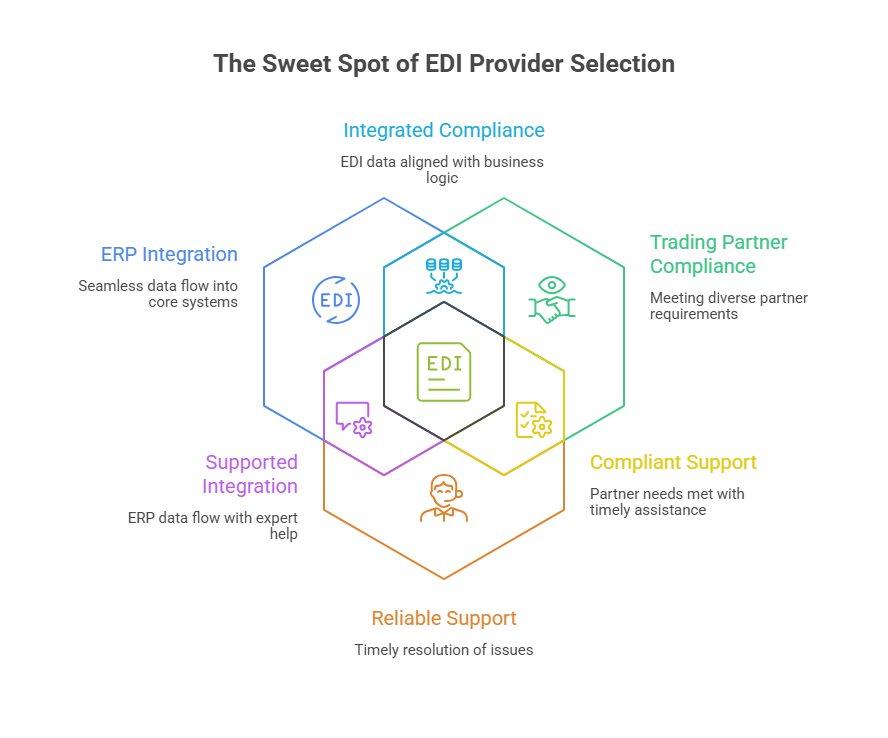
If the job is only to meet one trading partner requirement, a simpler EDI option may be enough. But once EDI data needs to flow into ERP, finance, fulfillment, inventory, and customer operations, the provider has to do more than pass documents from one side to another.
Match the Provider Type to Your ERP
ERP is not just another connected application. It is usually the system the business depends on for order data, product records, stock, pricing, tax, invoices, customers, and financial control. If EDI data does not land there in the right way, teams often end up doing manual review anyway. Ask these questions before the project moves forward:
- Document flow: Which EDI transactions should land in the ERP, and which should be sent from the ERP to partners?
- Field mapping: Which ERP fields are required, which are flexible, and which need partner-specific treatment?
- Validation: What happens when key data does not line up, including pricing, quantity, unit of measure, tax, or customer records?
- Data ownership: If the partner sends data that conflicts with ERP records, which side takes priority?
- Change control: What testing process is used before map changes go live?
A provider may sound convincing during evaluation and still create daily friction if it does not understand the logic and data structure inside your ERP.
Check the Onboarding Model Before You Sign
EDI projects often stall at onboarding. Each partner can come with its own testing cycle, document standards, label instructions, acknowledgements, compliance demands, and timing rules.
Ask who does the work.
- Does your team collect partner specs?
- Does the provider contact the partner?
- Who builds the map, runs the test, fixes rejected documents, and confirms go-live readiness?
For buyers comparing EDI service providers in the USA, Canada, or retail-heavy markets, partner familiarity matters too. Still, do not accept broad experience as proof. Ask about your exact trading partner requirements.
Pressure-Test the Support Model
EDI problems are usually time-sensitive. A failed invoice on Friday afternoon is not a casual support ticket when payment timing is at risk. Look for clear answers on:
- Monitoring: Can the provider detect failed transmissions, rejected documents, and missing acknowledgements?
- Alerts: Who gets notified when something fails?
- Ownership: Does the provider investigate map, protocol, and partner issues, or only platform issues?
- Escalation: How quickly can an urgent production issue reach a qualified EDI specialist?
- Visibility: Can your team see document status without waiting for support?
Strong support is not about friendliness. It is about operational responsibility when money, orders, or partner relationships are on the line.
Read Pricing Like an Operating Model
EDI pricing can look simple on the first quote and messy after go-live. A low base price becomes expensive when every new partner, map, test cycle, document, or change request adds another line item. Ask for pricing in a scenario format using your expected partner count, document volume, transaction types, ERP integration needs, and support expectations. Then ask what changes when volume doubles or a major retailer adds new requirements.
Buyer checklist
- ERP fit: Can the provider connect EDI data to the systems that actually run the business?
- Partner fit: Does it handle your trading partners’ required documents, standards, testing process, and communication methods?
- Ownership fit: Do you know what your team owns and what the provider owns after go-live?
- Support fit: Is there a clear process for failed files, rejected documents, missing acknowledgements, and urgent issues?
- Pricing fit: Are setup, mapping, partner, document, VAN, support, and change costs visible before you sign?
- Scale fit: Can the model handle more partners, documents, regions, and business units without starting over?
- Security fit: Are access control, audit trails, transmission security, and compliance requirements covered for your industry?
- Change fit: Can the provider manage partner requirement changes without turning every update into a mini-project?
EDI Service Provider Pricing Models
The cost of an EDI service provider is shaped by more than one factor. Provider model, partner count, document traffic, integration depth, mapping complexity, communication setup, and support coverage all affect the final price.
The safer question is not what the lowest monthly price is. It is what the full cost will look like when your business adds partners, changes documents, increases order volume, or needs faster support.
Cost component | What it covers | Why it varies |
Setup and implementation | Initial configuration, testing, account setup, and go-live preparation | More partners, systems, and workflows usually mean more setup effort |
EDI mapping | Translating data between business systems and EDI document formats | Each partner can have different field rules, labels, document versions, and validation needs |
Per-partner fees | Costs tied to each retailer, distributor, marketplace, supplier, or logistics partner | Some pricing models increase as the partner network grows |
Per-document or transaction fees | Charges based on document count, data volume, or transaction volume | High order, invoice, ASN, or inventory-feed volume can raise ongoing costs |
VAN or transmission charges | Network routing, mailbox-style exchange, AS2, SFTP, or other transmission costs | Costs depend on network model, kilo-character volume, protocol, or provider terms |
Support or managed service | Monitoring, issue handling, change requests, troubleshooting, partner coordination | Higher-touch support costs more but can reduce internal workload |
Change requests | Updates to maps, fields, partner rules, workflows, or ERP logic | Retailer and partner requirements change over time, so plan for this early |
For small businesses, a basic EDI services provider may be enough if the need is limited to a few documents and one or two partners. The risk is choosing a tool that works for the first mandate but breaks when the business adds more retailers or needs ERP integration.
For mid-market companies, the cost conversation should include people. If finance, operations, or IT spends hours chasing failed files, fixing invoices, or checking documents by hand, the cheap provider is not really cheap.
For larger teams, predictability matters. A full service EDI provider or integration-led EDI solution provider may cost more upfront, but it can reduce internal effort when partner onboarding, monitoring, and workflow integration are handled properly.
The right pricing model should match the business pattern. High document volume, many partners, and complex ERP workflows need a different model than low-volume EDI compliance for a single retailer.
Common Mistakes When Selecting a Provider
Bad EDI decisions rarely fail at the contract stage. They fail when an order does not appear in the ERP, an invoice gets rejected, a partner changes a map, or nobody knows who owns the fix. The consequence usually lands outside IT. Sales sees delayed orders. Finance sees late payment. Operations sees fulfillment gaps. Customer service answers partner complaints.
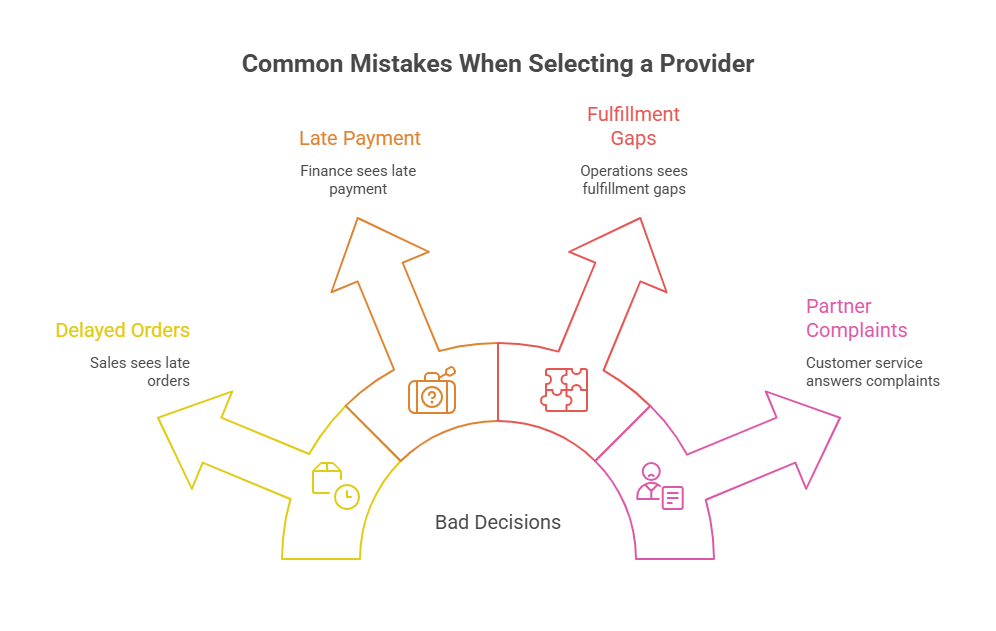
Common mistake | Business consequence | How to prevent it |
Picking on price alone | A low entry cost grows expensive as setup, mapping, support, partner changes, and document fees add up | Compare total cost over at least two years, not just the monthly base price |
Ignoring ERP fit | Orders, invoices, inventory, and shipment data may still need manual cleanup after the exchange | Ask how each EDI document lands in your ERP and which fields are mapped |
Underestimating onboarding | Partner testing drags, especially when each retailer has different document rules | Confirm who owns partner testing, map changes, acknowledgements, and go-live support |
No clear failure handling | Failed files sit unnoticed until a partner complains or a payment is delayed | Confirm alerts, retries, escalation paths, ownership, and response times |
Overlooking per-partner or per-document fees | Costs rise as document volume grows or new partners are added | Ask for every recurring fee, volume-based charge, partner fee, and change-request cost |
Treating EDI as a standalone file problem | Data may move between partners but still fail to update operations properly | Check the full process from partner document to internal workflow completion |
Chargebacks and deductions usually happen because a trading partner received the wrong document, the wrong data, the wrong timing, or no document at all. Missed payments are similar. If an invoice does not transmit cleanly or does not match the partner’s requirements, finance can spend days chasing a problem that should have been caught earlier.
Support is the quiet deal-breaker. Many buyers only learn the support model after something breaks. Before signing, ask what happens when a live transaction fails, who responds, and how quickly the issue moves from alert to resolution.
When an ERP-First, Integration-Led Approach Makes Sense
EDI rarely stops at the document. An 850 purchase order still has to become a sales order. An 856 advance ship notice has to reflect fulfillment. An 810 invoice has to match what finance expects. Inventory, pricing, tax, shipping, and customer data often sit in the ERP. That is why a document-only EDI setup can still leave teams doing manual work.
An ERP-first, integration-led approach makes sense when the real problem is connected operations. The buyer is not only asking whether an EDI document can be sent. The buyer is asking whether partner data can move into the ERP, trigger the right process, update the right system, and stay visible when something fails.
APPSeCONNECT is perfect for teams that want ERP-first integration around orders, inventory, invoices, and fulfillment. It also pairs with appse ai, its AI automation layer, which can extend integration workflows into broader business process automation.
So do not stop at document delivery when reviewing an EDI provider. If the same data needs to support ERP, ecommerce, CRM, warehouse activity, shipping, finance, and customer operations, base the decision on how well the whole workflow holds together. Check the exact EDI document types, supported standards, communication protocols, ERP connectors, onboarding approach for new partners, visibility into errors and transactions, and the team responsible for support. The right provider reduces operational effort. The wrong one adds another system your team has to manage every day.
Frequently Asked Questions
An EDI service provider helps businesses exchange standard electronic data interchange documents with trading partners. It can handle document mapping, translation, transmission, validation, partner onboarding, monitoring, and support. The strongest fit depends on whether you need only document exchange or a deeper connection with ERP and operational systems.
The main types are self-service EDI providers, full-service or managed EDI providers, VAN-based EDI providers, and cloud or iPaaS integration-led providers. Each type changes how much work your team owns, how partners are onboarded, and how EDI data connects to internal systems.
Start with your trading partner requirements, then check ERP fit, onboarding ownership, support model, pricing structure, security needs, and change management. Do not choose by brand name or base price alone. The right provider should match your documents, systems, internal capacity, and long-term partner growth.
Cost depends on setup, mapping, trading partner count, document volume, transaction fees, VAN or transmission charges, support level, and integration depth. Avoid judging only the monthly base price. Ask for a full-cost scenario based on your current and expected partner network.
You may need a VAN if your trading partners prefer network-based routing or mailbox-style exchange. Cloud EDI works well when you need modern access, partner exchange, and integration with business systems. The right choice depends on partner requirements, document volume, visibility needs, and internal ownership.
An EDI provider focuses on exchanging standard business documents with trading partners. An integration platform connects applications and workflows across the business. Many companies need both in one operating model, because EDI documents often need to update ERP, ecommerce, warehouse, finance, and fulfillment systems.
Conclusion
Choosing an EDI service provider is really a risk decision. The right provider fits your ERP, your trading partners, your support expectations, your onboarding workload, and your cost model. The wrong one creates hidden work across finance, operations, IT, and customer-facing teams.
If your EDI requirement starts with a trading partner mandate but ends inside your ERP, map the full process before you commit to a provider model. If you want to know how APPSeCONNECT can automate your EDI requirements, book a demo to talk to an expert.