


Square POS and Amazon Seller Central Integration & Automation
- Automate
- Align
- Accelerate
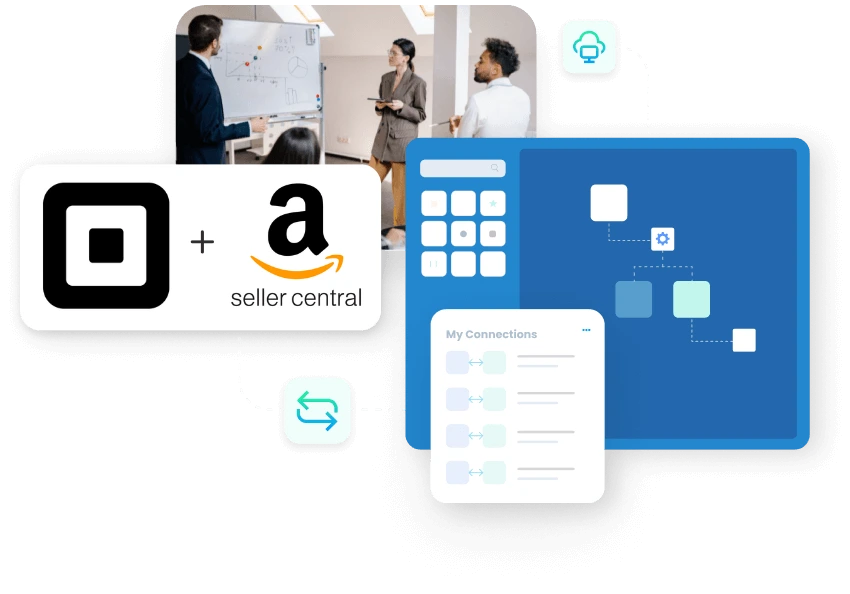
Square POS and Amazon Seller Central integration helps retailers connect counter sales with marketplace operations. Store transactions, Amazon orders, SKU details, inventory changes, shipment updates, refunds, and financial references can move through configured workflows instead of being handled in separate systems or spreadsheets.
The risk is not only duplicate entry. Square teams may sell stock that Amazon still shows as available. Amazon orders may sit until store teams manually review and process them. Listing updates may fail because item data is incomplete. Finance teams may also spend extra time comparing Square payments with Amazon fees, refunds, and settlement activity.
KEY BENEFITS
Why APPSeCONNECT Is the Gold Standard for Square POS and Amazon Seller Central Integration
APPSeCONNECT gives Square POS and Amazon Seller Central a structured way to exchange retail and marketplace records. It helps teams decide which system owns each update, how SKU and location rules should be mapped, and where failed records should be reviewed before teams retry them.
Oversold Amazon Stock
Square register sales can reduce physical stock before Amazon receives the new quantity. That gap can create canceled orders, poor availability control, and seller performance pressure.
Rejected Listing Updates
Square item data may not satisfy Amazon listing requirements. Missing attributes, mismatched variations, or weak category mapping can stop product updates before they reach the marketplace.
Late FBM Shipments
Merchant-fulfilled Amazon orders need to move quickly from Amazon into the fulfillment workflow. When order details do not reach the store or fulfillment team fast enough, shipment confirmation becomes harder to meet on time.
Refund Trace Gaps
Amazon returns and Square refund references do not always sit in the same view. Teams may struggle to connect the buyer request, inventory impact, refund event, and original order.
Settlement Review Delays
Amazon fees, refunds, commissions, and settlement references follow a different path than Square payments and payouts. Finance teams need clearer transaction context before reconciliation work begins.
Location Stock Confusion
Multi-location Square inventory can create Amazon availability issues when the wrong store quantity is used. Location mapping helps marketplace stock follow the fulfillment rule instead of a rough total.

Standard Features Covered in Our Square POS and Amazon Seller Central Integration Template
Square Item Library → Amazon Listing Data
- Square item records can feed Amazon listing workflows when Square is used as the product source. SKU, variation, barcode, title, description, image, and category data can be mapped against Amazon requirements.
Square Stock Counts → Amazon Quantity Updates
- Square inventory can update Amazon sellable quantity by SKU. Location rules, stock buffers, and availability thresholds can be added before the marketplace receives the number.
Square Register Sales → Amazon Availability
- In-store sales can trigger Amazon stock reduction when both channels draw from the same inventory pool. This helps reduce marketplace orders against items already sold at the counter.
Square Price Records → Amazon Offers
- Square pricing can support Amazon offer updates where the seller wants POS-managed prices to guide marketplace pricing. Marketplace-specific checks can be added before changes are pushed.
Square Refund Records → Return Review
- Refund events from Square can be carried into a review flow when they relate to marketplace returns or shared stock movement. Teams can compare refund reference, item, quantity, and restock logic.
Square Tax and Discounts → Validation Flow
- Tax, discount, and line-level details can be mapped for validation where reporting or reconciliation depends on them. The flow can flag mismatches before records move further.
Amazon Orders → Square Order Records
- Amazon orders can create or update Square-side order records. The flow can include SKU, quantity, order ID, tax details, order status, and available shipping information.
Amazon FBM Orders → Store Fulfillment
- Merchant-fulfilled orders can move into a Square-connected store or fulfillment workflow. Store teams can work from mapped order details instead of copying marketplace data manually.
Square Shipment Updates → Amazon Confirmation
- Shipment status, carrier name, and tracking reference can return to Amazon for FBM orders when the fulfillment flow captures those fields.
Amazon FBA Orders → Sales Visibility
- FBA order data can be pulled into reporting or Square-connected records where consolidated channel visibility is required. Fulfillment remains controlled by Amazon.
Amazon Returns → Square Review
- Amazon return and refund context can move into a Square-connected review path. Return reason, SKU, quantity, order reference, and restock treatment can be checked before inventory impact is applied.
Amazon Fees → Finance Review
- Amazon financial events, fees, refunds, and settlement identifiers can support reconciliation review. These references can be compared with Square sales, refunds, payment records, and payout activity when finance workflows are part of the project.
Amazon Feed Responses → Error Handling
- Listing responses, feed processing results, and rejected updates can be captured for review. Teams can correct missing fields, invalid values, or SKU issues before retrying the transaction.
Popular Square POS Integrations
Looking for a Specific Integration?
Visit All Square POS Application
Popular Amazon Seller Central Integrations
Connect Amazon Seller Central with other business applications.
Looking for a Specific Integration?
Visit All Amazon Seller Central Application
INTEGRATION BROCHURE
Download the Square POS and Amazon Seller Central Integration Brochure
Use the brochure to plan how Square POS and Amazon Seller Central should work together across store sales and marketplace operations. It helps teams review SKU ownership, Amazon order import, shared inventory, FBM shipment updates, return handling, refund references, and finance review points.
Inside You’ll Find:
- Integration Architecture: See where Square POS and Amazon Seller Central sit in the retail stack, and how catalog records, stock updates, Amazon orders, store sales, returns, refunds, and financial references can move.
- Flow Planning: Identify which updates should start in Square and which should start in Amazon. Plan order, inventory, listing, fulfillment, return, and settlement-related flows around your operating model.
- Rollout Approach: Begin with SKU mapping, Amazon order capture, and inventory update flows. Add price updates, FBM shipment confirmation, return handling, and finance review once core records are stable.
- Testing Checklist: Test Square item variations, Amazon listing fields, location-level inventory, stock buffers, Amazon order IDs, tax lines, refund scenarios, shipment responses, and retry behavior.
- Operational Readiness: Prepare store, marketplace, fulfillment, and finance users to review logs, inspect failed records, correct mapping gaps, and rerun transactions after launch.
Start Integration at just $99 per month with Shopify, Salesforce, HubSpot, Zoho, WooCommerce and more.
Enterprise-grade integration powered by hands-on support without enterprise pricing
INTEGRATION GUIDE
How Does the Workflow Run End-to-End
Square POS and Amazon Seller Central workflows run through APPSeCONNECT ProcessFlows. A ProcessFlow defines where each transaction starts, where it goes, how fields are mapped, which rules apply, how failures are retried, and how the flow is monitored.
See How This Would Run in Your Business
Square POS and Amazon Seller Central integration workflow
Trigger & Source Connection
Data Extraction & Structure Check
The flow reads the source record and its expected structure. The record may be an item, variation, inventory count, order, shipment update, return, refund, payment, fee, or settlement reference.
Transformation & Field Mapping
Square and Amazon fields are translated into the target structure. SKU, item variation ID, marketplace order ID, location ID, quantity, price, tax, carrier, tracking number, refund ID, and financial reference can be mapped where needed.
Validation & Business Rule Execution
The flow checks the record before it is posted. Validation can include SKU matching, location mapping, stock buffer rules, required Amazon listing attributes, fulfillment status checks, and refund reference checks.
Target Update & Response Handling
The mapped record is sent to the target system. API responses, feed responses, success states, processing messages, and failure reasons are captured for review.
Monitoring, Retry & Audit Logging
Logs, snapshots, node status, and transaction details help teams see where the record failed. Corrected transactions can be retried without rebuilding the whole process manually.
Real-world use cases
Use Cases
APPSeCONNECT’s Square POS and Amazon Seller Central integration is built for sellers who run store counters and Amazon marketplace operations together. It supports retail teams, marketplace operators, fulfillment users, inventory managers, and finance teams that need Square and Amazon records to stay aligned throughout the order lifecycle.
Marketplace Retail
Amazon demand stays visible to store teams
- Amazon orders can create Square-connected order records with mapped SKU and quantity details.
- Square stock changes can refresh Amazon quantity after register sales.
- Marketplace order IDs can stay attached to the operational record.
- Return and refund references can be reviewed against the original order.
What this integration handles
Imported
Reduced
Mapped
Reviewed
Multi-Location Stores
Amazon stock follows the right Square location
- Square location inventory can map to Amazon quantity updates.
- Stock buffers can protect limited store inventory from being fully exposed online.
- Inventory corrections can refresh the Amazon quantity through configured runs.
- Exceptions can show when SKU or location mapping needs review.
What this integration handles
Mapped
Buffered
Updated
Flagged
FBM Fulfillment
Merchant-fulfilled orders move into the right workflow
- Amazon FBM orders can enter a Square-connected fulfillment path.
- Order ID, SKU, quantity, and shipping details can move with the record.
- Carrier and tracking data can be returned to Amazon after shipment.
- Failed shipment updates can be reviewed through logs and retry controls.
What this integration handles
Queued
Routed
Returned
Retried
Finance Review
Square payments and Amazon settlements become easier to compare
- Square payment and refund records can support channel-level review.
- Amazon financial events and settlement references can be captured where scope allows.
- Order and payment identifiers can stay connected to the transaction path
- Logs and snapshots can support audit checks and exception review.
What this integration handles
Matched
Payment references
Captured
Amazon fees
Tracked
Refund activity
Audited
Sync logs
Meet appse ai
How appse ai Helps Streamline Square POS and Amazon Seller Central Integration
After the core connection is live, teams still need to handle repeated SKU errors, rejected listing updates, delayed order movement, stock mismatches, and finance review work. appse ai supports AI-assisted workflow design and operational review so teams can improve the way Square and Amazon automation runs over time.
Workflow Design
Issue Detection
Exception Review
Decision Support
Process Signals
API Orchestration
Workflow Optimization
Ready to Plan Your Square POS and Amazon Seller Central Integration?
Square POS and Amazon Seller Central should not leave store teams, marketplace users, fulfillment staff, and finance teams working from separate records. A connected integration flow helps sales, stock, orders, listings, shipment updates, refunds, and financial references move with better control.
Companies automating their business through APPSeCONNECT
Related Resources
Square POS and Amazon Seller Central integration connects retail store operations with Amazon marketplace workflows. It can support item data, inventory updates, Amazon orders, shipment details, returns, refunds, and financial references through configured flows.
Sellers connect Square POS with Amazon Seller Central to reduce stock mismatch, manual order entry, delayed fulfillment, listing update errors, and reconciliation work. It helps store and marketplace teams work from more aligned records.
APPSeCONNECT uses configured ProcessFlows to move records between Square POS and Amazon Seller Central. Each flow defines the entity, source, target, mapping logic, validation rules, run mode, retry behavior, and monitoring path.


The integration can map product records, SKU details, inventory counts, order data, price updates, shipment details, tracking references, return data, refund references, and financial events. Final scope depends on the approved implementation.
Amazon orders can be imported into Square-connected order workflows. The record can include SKU, quantity, Amazon order ID, order status, tax details, and available shipping information.
Square inventory can update Amazon quantity by SKU when shared stock is part of the integration design. Location mapping and stock buffers can be added to control what Amazon receives.
Square register sales can reduce Amazon availability when the same stock pool is used for both channels. This helps reduce overselling when an item is sold in-store before Amazon quantity is updated.
Square item data can support Amazon listing updates when listing scope is included. Amazon category rules, required attributes, variation structure, and feed responses should be validated before go-live.
Amazon FBM orders can move into Square-connected store or fulfillment workflows. Shipment status, carrier details, and tracking references can return to Amazon where the workflow captures those values.
Amazon FBA order data can be pulled into reporting or connected operational records where consolidated sales visibility is required. Amazon continues to control FBA fulfillment.
Returns and refunds can be mapped into review workflows where the business process requires it. Return reason, refund reference, SKU, quantity, order ID, and restock logic should be tested before launch.
Square pricing can be mapped to Amazon offer updates if Square is the price source. Marketplace-specific pricing rules, feed responses, and validation checks should be reviewed before automated price updates are enabled.
Amazon financial events, fee details, refund data, and settlement references can support reconciliation review. These records can be compared with Square payments, refunds, and payout references when finance workflows are part of the project.
Failed syncs can be reviewed through logs, snapshots, node status, transaction details, and API responses. Teams can correct missing fields, SKU mismatches, rejected listing values, or credential issues before retrying the record.
appse ai helps with workflow design, issue detection, exception review, decision support, process signals, API orchestration, and workflow optimization. It gives teams more context to improve Square and Amazon automation after the core integration is live.
Start with the highest-risk flows first. Common starting points include SKU mapping, Square inventory to Amazon quantity, Amazon order import, Square sales impact on Amazon stock, FBM shipment updates, and refund review.