



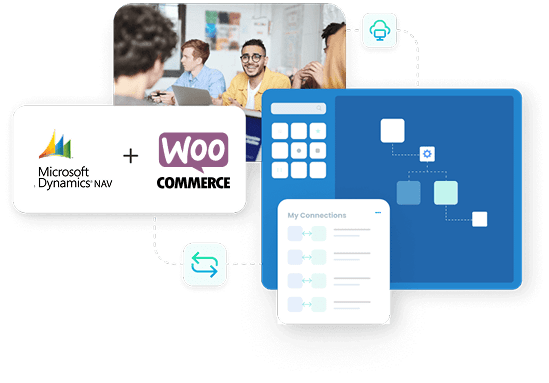
Microsoft Dynamics NAV and WooCommerce Store Integration and Automation
Microsoft Dynamics NAV and WooCommerce integration connects your WordPress storefront with the ERP that runs inventory, pricing, and finance, and APPSeCONNECT gives you a governed platform to move that data both ways without custom scripts. WooCommerce orders and customers post into NAV, NAV stock and price changes push out to the store, and posted shipments and invoices flow back through managed ProcessFlows.
Key Benefits
Why APPSeCONNECT for Microsoft Dynamics NAV and WooCommerce Integration
Microsoft Dynamics NAV and WooCommerce work together through controlled integration workflows. The integration keeps store activity connected to NAV records, so sales, warehouse, and finance teams work from the same order, stock, pricing, and invoice data instead of re-keying it between the store and the ERP.

Post WooCommerce Orders Into NAV Without Re-entry
Store and marketplace orders can move into Microsoft Dynamics NAV with line items, customer, price, tax, and shipping details mapped, so order-to-cash starts without manual copying.

Keep Store Stock Aligned With NAV Inventory
Scheduled or event-driven updates help NAV item availability and WooCommerce stock stay aligned, so the storefront reflects a closer view of what can actually ship.

Sell Off Live NAV Pricing and Discounts
Item prices, price lists, and customer-specific pricing from NAV can reach WooCommerce, so the store quotes figures that match the ERP rather than a stale export.

Create and Reconcile Customers Both Ways
New WooCommerce buyers can create NAV customer records with the right tax and account details, and NAV customer changes can refresh the store, reducing duplicate customer cards.

Return Shipment and Invoice Status to the Store
Posted sales shipments, tracking references, and invoice and payment status from NAV can flow back to the WooCommerce order, so buyers and staff see progress without a finance follow-up.

Handle Guest and Registered Customers
The flow can map both guest checkouts and registered WooCommerce accounts to the correct NAV customer treatment, so neither order type stalls at posting.
Standard Features Covered in Our Microsoft Dynamics NAV and WooCommerce Integration Template
APPSeCONNECT supports Microsoft Dynamics NAV and WooCommerce integration across product, order, customer, and finance workflows. The setup can follow your NAV configuration and WooCommerce store processes, and it can support price lists, discount rules, tax handling, and custom fields based on your project scope.
- NAV Items → WooCommerce Products Item master data from NAV can create or update WooCommerce products. Item number, description, unit of measure, category, and active status can be mapped.
- NAV Prices and Discounts → WooCommerce NAV item prices, price lists, and customer-specific pricing can update the store, so published prices reflect ERP rules.
- NAV Stock → WooCommerce Availability On-hand and available quantities from NAV can update WooCommerce stock levels on a schedule or on change.
- Custom Fields and Attributes Product attributes, variants, and custom fields can be mapped where the store and NAV setup require it.
- WooCommerce Orders → NAV Sales Orders Store orders can create NAV sales orders with line items, quantities, pricing, tax, and shipping method mapped.
- NAV Posted Shipments → WooCommerce Posted sales shipment and tracking details from NAV can update the WooCommerce order and mark it fulfilled.
- Order Status Back-Sync Fulfillment and status changes from NAV can flow back to the store so buyers see accurate progress.
- Returns and Adjustments Return and credit details can route through the configured workflow with less manual handling.
- WooCommerce Customers → NAV Customers New or updated store buyers can create or update NAV customer records with address, tax, and account reference details.
- NAV Customers → WooCommerce Customer changes from NAV can refresh the store record so accounts stay aligned.
- Guest vs Registered Handling Guest checkouts and registered accounts can be mapped to the correct NAV customer, avoiding duplicate cards.
- NAV Invoices → WooCommerce Posted invoice number, amount, due date, and payment status from NAV can be reflected against the store order.
- Payment and AR References Payment status and open balance details can move back to the store or account view where visibility is required.
- Monitoring and Retry Success and error rates are tracked through the Sync Info dashboard, auto-retry handles transient failures, and missed records can be resynced after the cause is corrected.
Popular Microsoft Dynamics NAV and WooCommerce Integrations
Microsoft Dynamics NAV and WooCommerce integration often becomes part of a wider commerce and operations stack. Businesses can connect other stores, marketplaces, CRM systems, payment tools, shipping and 3PL applications, and reporting tools around NAV and WooCommerce workflows, with NAV remaining the ERP system of record. If your business runs on Microsoft Dynamics 365 Business Central, the NAV successor, review the related Business Central and WooCommerce integration options separately.
Popular Microsoft Dynamics NAV Integrations
Connect Microsoft Dynamics NAV with other business applications.




Looking for a Specific Integration?
Popular WooCommerce Integrations
Connect WooCommerce with other business applications.


Looking for a Specific Integration?
INTEGRATION BROCHURE
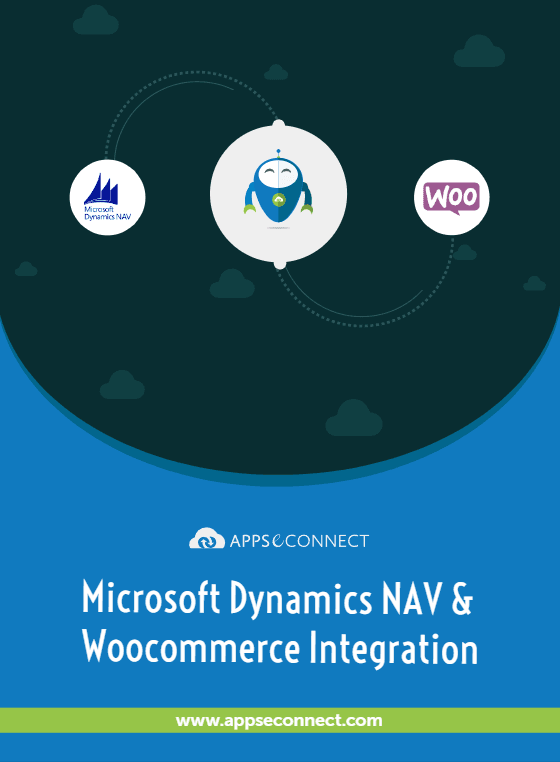
Download the Microsoft Dynamics NAV and WooCommerce Integration Brochure
Use the brochure to plan how Microsoft Dynamics NAV and WooCommerce can exchange product, price, stock, order, customer, shipment, and invoice records. It helps teams decide which system should own each process and how the integration should be rolled out.
Inside you’ll find
- Integration Architecture: See how NAV and WooCommerce connect products, prices, stock, orders, customers, shipments, and invoices, and the direction each flow runs.
- Flow Planning: Review the source and target direction for store-to-NAV and NAV-to-store workflows.
- Rollout Approach: Start with product, price, and stock sync. Then extend into order posting, shipment back-sync, customer records, and invoice visibility.
- Testing Checklist: Validate sample products, prices, stock updates, orders, customers, shipments, and retry scenarios before launch.
- Operational Readiness: Prepare teams to monitor runs, review logs, inspect failed records, correct mapping issues, and retry transactions after go-live.
Real-world use cases
Use Cases
The Microsoft Dynamics NAV and WooCommerce integration supports businesses that need store teams and ERP teams to work from connected records. It is useful for retailers, distributors, manufacturers, and finance and operations teams using NAV as the ERP system and WooCommerce as the WordPress storefront.
Scenario: Store orders reach NAV without staff re-keying them
Retailers running WooCommerce need orders, stock, and prices to stay close to the NAV record so the store and the warehouse do not drift apart. Manual copying between the store and the ERP is where errors and delays start.
- WooCommerce orders can create NAV sales orders with mapped line, price, tax, and customer data.
- NAV stock updates can keep store availability closer to what can actually ship.
- NAV prices and discounts can keep published store pricing aligned with ERP rules.
- Posted shipment and tracking details can flow back to the store order.
What this integration handles
Synced
Orders into NAV
Updated
Stock across store and NAV
Aligned
Prices and discounts
Returned
Shipment and tracking status
Supports online retailers and direct-to-consumer teams running WooCommerce with NAV as the ERP backbone.
Scenario: B2B buyers order against NAV pricing and stock
Distributors and B2B sellers need customer-specific pricing, tax rules, and available stock to reach the store before a buyer commits, so quotes and orders match what NAV can fulfill.
- Customer-specific pricing and price lists from NAV can reach WooCommerce.
- Item and catalog data can move between NAV and the store.
- Orders can post into NAV with the correct customer and tax treatment.
- Guest and registered buyers can map to the right NAV customer record.
What this integration handles
Posted
Orders into NAV
Mapped
Catalog and item data
Priced
Customer-specific NAV pricing
Matched
Guest and registered customers
Supports distributors, wholesalers, and B2B sales teams that use NAV as the ERP backbone.
Scenario: Invoice and payment status stay traceable to the store order
Finance and operations teams need invoices, payment status, and shipment records to stay connected to the original NAV transaction rather than arriving as disconnected exports.
- NAV posted invoices can be reflected against the WooCommerce order.
- Payment status and open balances can support follow-up.
- Logs and snapshots can support reconciliation and exception review.
- The resync function can recover records that failed to post.
What this integration handles
Reflected
Invoice and due date data
Tracked
Payment and balance status
Recoverable
Resynced records
Auditable
Logs and snapshots
Supports finance, accounting, and operations teams that need cleaner transaction traceability.
Deployment process
How Does the Workflow Run End-to-End
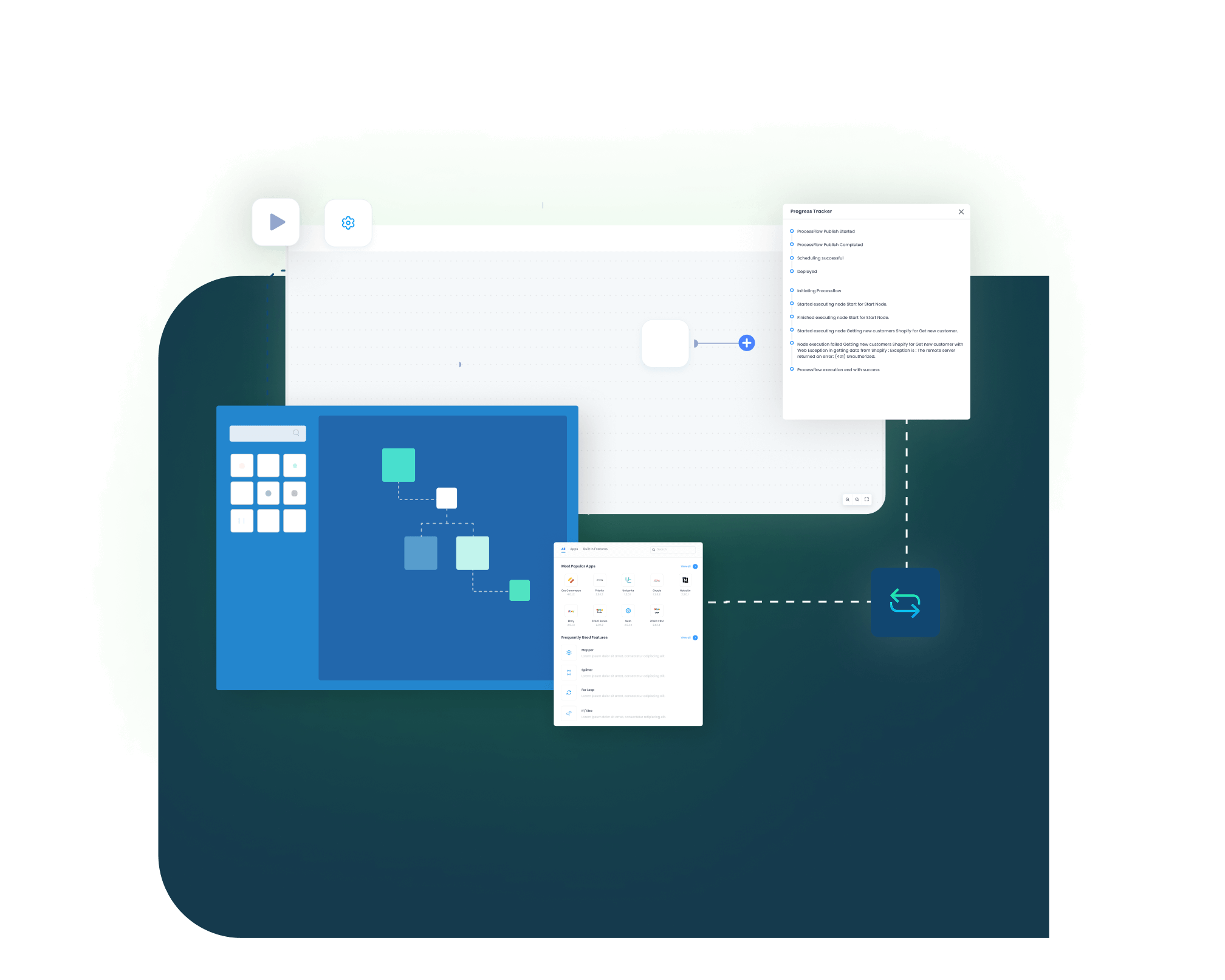
Our Microsoft Dynamics NAV and WooCommerce integration runs through ProcessFlows. Each ProcessFlow defines where the record starts, how the source schema is read, how fields are mapped, which business checks are applied, how the target system responds, and how teams review the transaction afterward.
Trigger and Source Connection
The flow can begin through a schedule, a webhook where supported, or a configured sync. The source can be WooCommerce or Microsoft Dynamics NAV depending on the process.
Data Extraction and Schema Reading
The workflow reads the selected source entity and its schema. This may be a customer, order, material, price, inventory, delivery, or invoice record.
Transformation and Field Mapping
Source data is converted into the target format. Item number, price, tax, customer reference, order line, quantity, shipping method, and status fields can be mapped.
Validation and Business Rule Execution
The record is checked before it is posted. The flow can validate customer matching, item codes, pricing conditions, tax groups, guest-versus-registered handling, and required fields.
Target Push and Response Handling
The prepared record is sent to Microsoft Dynamics NAV or WooCommerce. The response is captured with the success state, failure reason, system message, and sync status.
Monitoring, Retry and Audit Logging
Logs, snapshots, node status, transaction details, and retry controls help teams review issues and rerun records after correction.
Meet appse ai
How appse ai Helps Streamline Microsoft Dynamics NAV and WooCommerce Integration
After Microsoft Dynamics NAV and WooCommerce are connected, teams still need to manage failed records, mapping changes, stock and price timing, and repeated checks. appse ai can add AI-assisted support around workflow design, exception review, process signals, and workflow optimization while keeping NAV and WooCommerce controls in place.
- Workflow Design: Help teams build or adjust automation flows with no-code tools and AI-assisted guidance, especially when new entities or stores are added.
- Issue Detection: Help teams identify failed records, failed workflow runs, and repeated exception patterns across product, order, customer, and invoice flows.
- Exception Review: Review missing fields, mapping gaps, validation errors, and system responses with clearer transaction context.
- Decision Support: Help apply routing and conditional checks when store activity depends on NAV pricing, tax, or stock rules.
- Process Signals: Help teams track where records slow down, fail often, or create extra follow-up work for sales, warehouse, or finance teams.
- API Coordination: Extend NAV and WooCommerce workflows to other stores, marketplaces, payment, and reporting systems from the same automation layer.
- Workflow Optimization: Help teams identify where the integration may need changes as order volume, catalog size, or selling channels grow.

Ready to Launch Your Microsoft Dynamics NAV and WooCommerce Integration Today?
Microsoft Dynamics NAV and WooCommerce should not leave teams working from different versions of order, stock, price, and invoice data. APPSeCONNECT helps connect store activity with NAV records through structured workflows, so teams can reduce manual entry and catch issues early across the order lifecycle.

Frequently Asked Questions
Microsoft Dynamics NAV and WooCommerce integration connects a WooCommerce store with Microsoft Dynamics NAV ERP so orders, products, prices, stock, customers, shipments, and invoices can move between both systems through controlled workflows, with NAV staying the system of record.
APPSeCONNECT connects the two through configured ProcessFlows over NAV web services and the WooCommerce API. Each flow defines the source, target, entity, field mapping, validation rules, retry behavior, and monitoring path, so no custom code is needed to run the integration.
The integration can sync products, item prices and discounts, stock levels, sales orders, customers, posted shipments and tracking, and invoice and payment status. The final scope depends on the NAV configuration and the store workflow.
Yes. NAV item prices, price lists, and customer-specific pricing can be mapped to WooCommerce where the flow is configured for it, so the store can present pricing that follows ERP rules.
Guest checkouts and registered accounts can each be mapped to the correct NAV customer treatment during validation, so both order types post without creating duplicate customer records.
Failed records can be reviewed through logs, snapshots, node status, and API responses in the Sync Info dashboard. Auto-retry handles transient failures, and teams can correct missing fields or mapping issues and resync the affected records.
Yes. Many businesses continue to run Microsoft Dynamics NAV, and the integration supports the NAV estate directly. If you have moved to Microsoft Dynamics 365 Business Central, the NAV successor, a related Business Central and WooCommerce option can be reviewed separately.
Start by selecting the records that create the most manual work, such as order posting, stock sync, price sync, and customer sync. APPSeCONNECT can then help map, configure, test, monitor, and scale the integration.
Companies automating their business through APPSeCONNECT







Customer Success Stories

Crescent Garden
Crescent Garden is a global leader in container gardening solutions, founded in 1999 by Paula Douer and Harry Tchira.
Read Case Study →
Jaipur Living
Jaipur Living is a global home furnishings brand that creates handcrafted rugs and home décor products.
Read Case Study →
Lino BV case study
Lino BV is a Netherlands-based grower and global supplier of dried flowers, grasses, and natural decorative botanicals.
Read Case Study →Related Resources
Articles and Guides to Help You With Your Integration and Automation Journey